


Diagnosis and management of Clostridioides difficile infection in patients with inflammatory bowel disease
- PMID: 33654015
- PMCID: PMC8169557
- DOI: 10.1097/MOG.0000000000000739
Diagnosis and management of Clostridioides difficile infection in patients with inflammatory bowel disease
Abstract
Purpose of review: Clostridioides difficile infection (CDI) may complicate the course of ulcerative colitis and Crohn's disease. The clinical presentation of CDI in this population is often atypical, and patients may experience exacerbations of their underlying inflammatory bowel disease (IBD) secondary to C. difficile. In this review, we aim to review the risk factors, diagnosis, and management of CDI in the context of IBD.
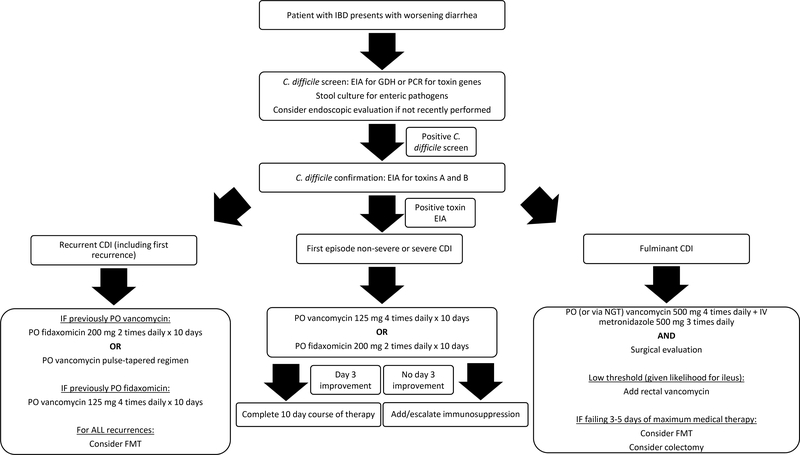
Recent findings: Patients with colonic involvement of their IBD are at higher risk for CDI and colonization may be more common than in the general population. Therefore, CDI is confirmed using a two-step approach to stool testing. Oral vancomycin or fidaxomicin are the preferred agents for nonfulminant disease, and oral metronidazole is no longer recommended as first-line therapy. For all patients with CDI recurrence, fecal microbiota transplant (FMT) should be considered, as this has been shown to be safe and effective. Among those who have worsening of their underlying IBD, retrospective research suggest that outcomes are improved for those who undergo escalation of immunosuppression with appropriate antimicrobial treatment of C. difficile, however prospective data are needed.
Summary: CDI may complicate the course of IBD, however the presentation may not be typical. Therefore, all patients with worsening gastrointestinal symptoms should be evaluated for both CDI and IBD exacerbation. Providers should consider FMT for all patients with recurrent CDI as well as escalation of immunosuppression for patients who fail to improve with appropriate antimicrobial therapy.
Copyright © 2021 Wolters Kluwer Health, Inc. All rights reserved.
Conflict of interest statement
Conflicts of interest: JRA serves as a consultant for Takeda, Janssen, Pfizer, Pandion, Servatus, Finch Therapeutics, Iterative Scopes and Artugen and has grant support from Merck. RSD has no financial or personal conflicts of interest to disclose.
Figures
References
-
- McDonald LC, Gerding DN, Johnson S, et al. Clinical Practice Guidelines for Clostridium difficile Infection in Adults and Children: 2017 Update by the Infectious Diseases Society of America (IDSA) and Society for Healthcare Epidemiology of America (SHEA). Clin Infect Dis. 03 2018;66(7):987–994. doi: 10.1093/cid/ciy149 - DOI - PubMed
Publication types
MeSH terms
Grants and funding
LinkOut - more resources
Full Text Sources
Other Literature Sources
Research Materials
