Review
. 2021 Mar 2;12(1):1390.
doi: 10.1038/s41467-021-21740-0.

Applications, challenges, and needs for employing synthetic biology beyond the lab

Affiliations
Review

Applications, challenges, and needs for employing synthetic biology beyond the lab

Sierra M Brooks et al. Nat Commun. .

Abstract

Synthetic biology holds great promise for addressing global needs. However, most current developments are not immediately translatable to 'outside-the-lab' scenarios that differ from controlled laboratory settings. Challenges include enabling long-term storage stability as well as operating in resource-limited and off-the-grid scenarios using autonomous function. Here we analyze recent advances in developing synthetic biological platforms for outside-the-lab scenarios with a focus on three major application spaces: bioproduction, biosensing, and closed-loop therapeutic and probiotic delivery. Across the Perspective, we highlight recent advances, areas for further development, possibilities for future applications, and the needs for innovation at the interface of other disciplines.


Conflict of interest statement

The authors declare no competing interests.

Figures
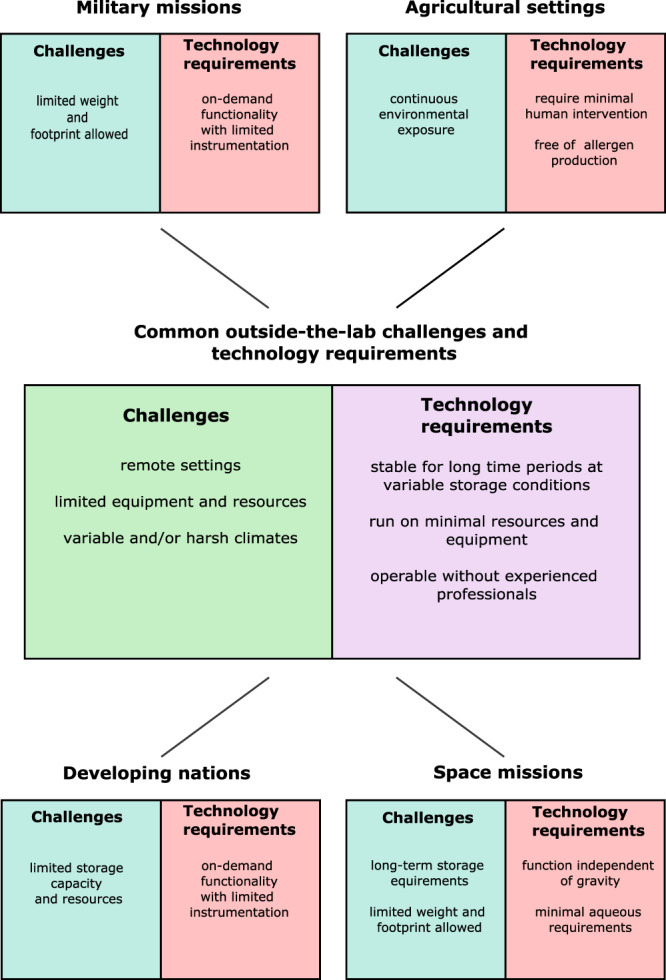
Fig. 1
Fig. 1. Overview of major challenges and requirements for deploying synthetic biology-based platforms in outside-the-lab settings.
Outside-the-lab scenarios have wide-ranging challenges and requirements for synthetic biology that are more demanding than typical laboratory settings. This figure provides a basic overview of major challenges and requirements associated with four major outside-the-lab settings including: space missions, developing nations, military missions, and agricultural settings. Challenges and requirements common to all settings are listed in the center, and those specific to certain outside-the-lab settings are listed in their respective boxes.
Fig. 2
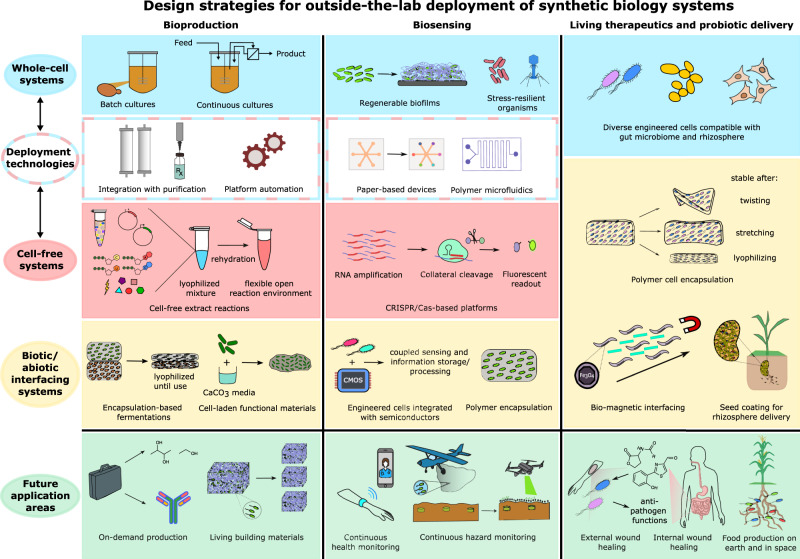
Fig. 2. Design strategies for outside-the-lab deployment of synthetic biology systems.
This Perspective encompasses design strategies for deploying synthetic biology outside-the-lab, which vary based on the particular system type (whole-cell (blue), cell-free (red), biotic/abiotic interfacing (yellow)) and application space (bioproduction, biosensing, living therapeutics, and probiotic delivery; all in green). Outside-the-lab bioproduction design strategies include whole-cell liquid cultures, cell-free extract reactions, and encapsulation platforms interfacing living cells with materials, with widespread future applications including on-demand production of small molecules and biologic therapeutics as well as regenerable living building materials. Outside-the-lab biosensing design strategies include whole-cell engineered stress-resilient organisms and regenerable biofilms, cell-free CRISPR/Cas-based sensing platforms, as well as interfacing living cells with novel polymer and electronic systems, with broad future applications including continuous health and hazard monitoring. For bioproduction and biosensing, both whole-cell and cell-free systems are typically interfaced with deployment technologies, such as platform automation and microfluidic liquid handling, to facilitate outside-the-lab usability. Outside-the-lab closed-loop living therapeutics and probiotic delivery design strategies include whole-cell engineered microbes and mammalian cells compatible with the gut and soil microbiomes, as well as interfacing living cells with materials and magnetic systems, with future applications ranging from wound healing to continuous food production on earth and in space.

References

    1. United Nations. General Assembly. Resolution adopted by the General Assembly on 25 September 2015. (2015).
    1. Xie M, Fussenegger M. Designing cell function: assembly of synthetic gene circuits for cell biology applications. Nat. Rev. Mol. Cell Biol. 2018;19:507–525. doi: 10.1038/s41580-018-0024-z. - DOI - PubMed
    1. Grozinger L, et al. Pathways to cellular supremacy in biocomputing. Nat. Commun. 2019;10:5250. doi: 10.1038/s41467-019-13232-z. - DOI - PMC - PubMed
    1. Gilbert C, Ellis T. Biological engineered living materials: growing functional materials with genetically programmable properties. ACS Synth. Biol. 2019;8:1–15. doi: 10.1021/acssynbio.8b00423. - DOI - PubMed
    1. Kumar A, et al. The ins and outs of microorganism–electrode electron transfer reactions. Nat. Rev. Chem. 2017;1:1–13. doi: 10.1038/s41570-017-0024. - DOI

Publication types