


Evaluation of fireground exposures using urinary PAH metabolites
- PMID: 33654270
- PMCID: PMC8445814
- DOI: 10.1038/s41370-021-00311-x
Evaluation of fireground exposures using urinary PAH metabolites
Abstract
Background: Firefighters have increased cancer incidence and mortality rates compared to the general population, and are exposed to multiple products of combustion including known and suspected carcinogens.
Objective: The study objective was to quantify fire response exposures by role and self-reported exposure risks.
Methods: Urinary hydroxylated metabolites of polycyclic aromatic hydrocarbons (PAH-OHs) were measured at baseline and 2-4 h after structural fires and post-fire surveys were collected.
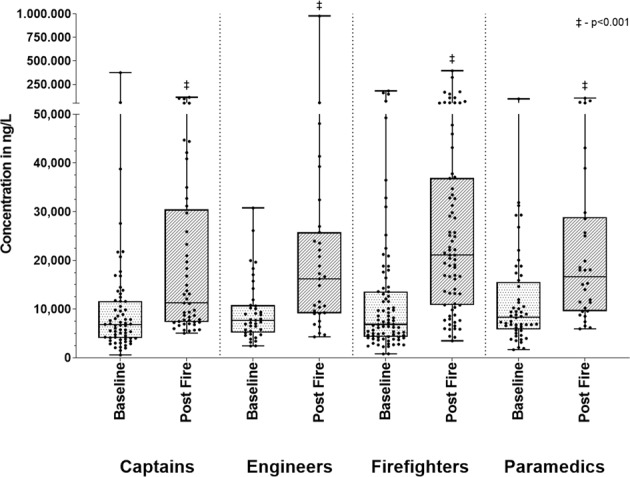
Results: Baseline urine samples were collected from 242 firefighters. Of these, 141 responded to at least one of 15 structural fires and provided a post-fire urine. Compared with baseline measurements, the mean fold change of post-fire urinary PAH-OHs increased similarly across roles, including captains (2.05 (95% CI 1.59-2.65)), engineers (2.10 (95% CI 1.47-3.05)), firefighters (2.83 (95% CI 2.14-3.71)), and paramedics (1.84 (95% CI 1.33-2.60)). Interior responses, smoke odor on skin, and lack of recent laundering or changing of hoods were significantly associated with increased post-fire urinary PAH-OHs.
Significance: Ambient smoke from the fire represents an exposure hazard for all individuals on the fireground; engineers and paramedics in particular may not be aware of the extent of their exposure. Post-fire surveys identified specific risks associated with increased exposure.
Keywords: Cancer; Dermal exposure; Inhalation exposure; Polycyclic aromatic hydrocarbons; Vulnerable occupations; Workplace exposures.
© 2021. The Author(s).
Conflict of interest statement
The authors declare no competing interests.
Figures
References
-
- IARC. Painting, firefighting, and shiftwork: Lyon (FR): IARC; 2010. http://monographs.iarc.fr/ENG/Monographs/vol98/mono98.pdf. - PMC - PubMed
-
- Daniels RD, Bertke S, Dahm MM, Yiin JH, Kubale TL, Hales TR, et al. Exposure-response relationships for select cancer and non-cancer health outcomes in a cohort of U.S. firefighters from San Francisco, Chicago and Philadelphia (1950–2009) Occup Environ Med. 2015;72:699–706. doi: 10.1136/oemed-2014-102671. - DOI - PMC - PubMed
-
- Monash University. Final Report: Australian Firefighters’ Health Study. Melbourne, VIC: Monash University; 2014.
Publication types
MeSH terms
Substances
Grants and funding
LinkOut - more resources
Full Text Sources
Other Literature Sources
Medical
