


Challenges in Sedation Management in Critically Ill Patients with COVID-19: a Brief Review
- PMID: 33654458
- PMCID: PMC7907309
- DOI: 10.1007/s40140-021-00440-x
Challenges in Sedation Management in Critically Ill Patients with COVID-19: a Brief Review
Abstract
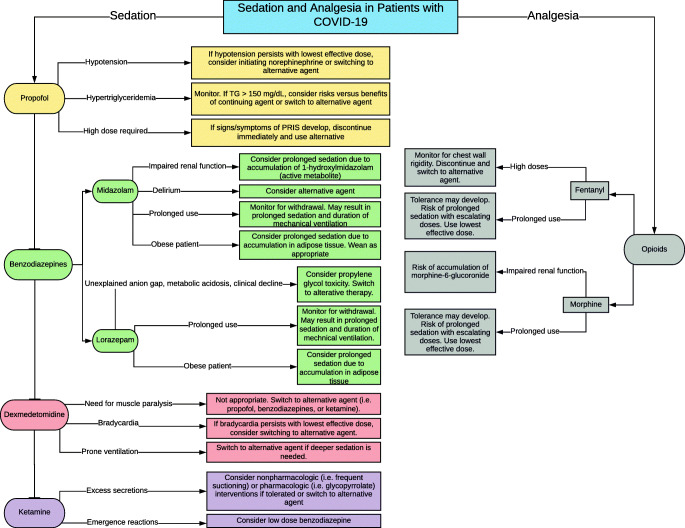
Purpose of review: To highlight the challenges associated with providing sedation and analgesia to critically ill patients with coronavirus disease 2019 (COVID-19) and also understand the pathophysiological alterations induced by the disease process as well as the logistical difficulties encountered by providers caring for these patients. We also discuss the rationale and risks associated with the use of common sedative agents specifically within the context of COVID-19 and provide evidence-based management strategies to help manage sedation and analgesia in such patients.
Recent findings: A significant proportion of patients with COVID-19 require intensive care and mechanical ventilation, thus requiring sedation and analgesia. These patients tend to require higher doses of sedative medications and often for long periods of time. Most of the commonly used sedative and analgesic agents carry unique risks that should be considered within the context of the unique pathophysiology of COVID-19, the logistical issues the disease poses, and the ongoing drug shortages.
Summary: With little attention being paid to sedation practices specific to patients with COVID-19 in critical care literature and minimal mention in national guidelines, there is a significant gap in knowledge. We review the existing literature to discuss the unique challenges that providers face while providing sedation and analgesia to critically ill patients with COVID-19 and propose evidence-based management strategies.
Keywords: Analgesia; COVID-19; Critically ill patients; SARS-CoV-2; Sedation.
© The Author(s), under exclusive licence to Springer Science+Business Media, LLC part of Springer Nature 2021.
Conflict of interest statement
Conflict of InterestNone of the authors has any potential conflicts of interest to disclose.
Figures

References
-
- • Grasselli G, Pesenti A, Cecconi M. Critical care utilization for the COVID-19 outbreak in Lombardy, Italy: early experience and forecast during an emergency response. JAMA. 2020; This is one of the initial studies describing the demographics, clinical characteristics and outcomes in critically ill patients diagnosed with COVID-19. - PubMed
-
- •• Kapp CM, Zaeh S, Niedermeyer S, Punjabi NM, Siddharthan T, Damarla M. The use of analgesia and sedation in mechanically ventilated patients with COVID-19 ARDS. Anesth Analg. 2020; This article is the first to describe sedation and analgesia practices in critically ill patients with COVID-19 requiring mechanical ventilaion. The authors compared the quantity of sedation used in this population to the quantity of sedation described in a prior study of patients with ARDS and found that these patients have higher requirement of sedative and analgesic medications, thus raising the potential for more severe side effects.
Publication types
LinkOut - more resources
Full Text Sources
Other Literature Sources
Research Materials
Miscellaneous