This is a preprint.
Racial and ethnic differences in COVID-19 vaccine hesitancy and uptake
- PMID: 33655271
- PMCID: PMC7924296
- DOI: 10.1101/2021.02.25.21252402
Racial and ethnic differences in COVID-19 vaccine hesitancy and uptake
Update in
-
Self-reported COVID-19 vaccine hesitancy and uptake among participants from different racial and ethnic groups in the United States and United Kingdom.Nat Commun. 2022 Feb 1;13(1):636. doi: 10.1038/s41467-022-28200-3. Nat Commun. 2022. PMID: 35105869 Free PMC article.
Abstract
Background: Racial and ethnic minorities have been disproportionately impacted by COVID-19. In the initial phase of population-based vaccination in the United States (U.S.) and United Kingdom (U.K.), vaccine hesitancy and limited access may result in disparities in uptake.
Methods: We performed a cohort study among U.S. and U.K. participants in the smartphone-based COVID Symptom Study (March 24, 2020-February 16, 2021). We used logistic regression to estimate odds ratios (ORs) of COVID-19 vaccine hesitancy (unsure/not willing) and receipt.
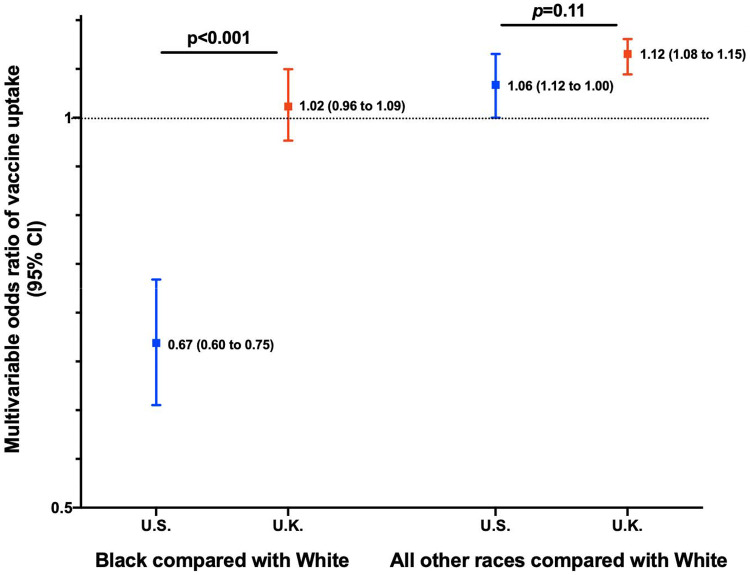
Results: In the U.S. ( n =87,388), compared to White non-Hispanic participants, the multivariable ORs of vaccine hesitancy were 3.15 (95% CI: 2.86 to 3.47) for Black participants, 1.42 (1.28 to 1.58) for Hispanic participants, 1.34 (1.18 to 1.52) for Asian participants, and 2.02 (1.70 to 2.39) for participants reporting more than one race/other. In the U.K. ( n =1,254,294), racial and ethnic minorities had similarly elevated hesitancy: compared to White participants, their corresponding ORs were 2.84 (95% CI: 2.69 to 2.99) for Black participants, 1.66 (1.57 to 1.76) for South Asian participants, 1.84 (1.70 to 1.98) for Middle East/East Asian participants, and 1.48 (1.39 to 1.57) for participants reporting more than one race/other. Among U.S. participants, the OR of vaccine receipt was 0.71 (0.64 to 0.79) for Black participants, a disparity that persisted among individuals who specifically endorsed a willingness to obtain a vaccine. In contrast, disparities in uptake were not observed in the U.K.
Conclusions: COVID-19 vaccine hesitancy was greater among racial and ethnic minorities, and Black participants living in the U.S. were less likely to receive a vaccine than White participants. Lower uptake among Black participants in the U.S. during the initial vaccine rollout is attributable to both hesitancy and disparities in access.
Conflict of interest statement
Declaration of Interests
LP, CH, SS, RD, and JW are employees of Zoe Global Ltd. TDS is a consultant to Zoe Global Ltd. DAD and ATC previously served as investigators on a clinical trial of diet and lifestyle using a separate smartphone application that was supported by Zoe Global Ltd.
Figures
References
-
- COVID-19 Map - Johns Hopkins Coronavirus Resource Center. https://coronavirus.jhu.edu/map.html.
-
- Medicines and Healthcare products Regulatory Agency. UK medicines regulator gives approval for first UK COVID-19 vaccine. GOV.UK https://www.gov.uk/government/news/uk-medicines-regulator-gives-approval... (2020).
-
- Department of Health and Social Care. Oxford University/AstraZeneca vaccine authorised by UK medicines regulator. GOV.UK https://www.gov.uk/government/news/oxford-universityastrazeneca-vaccine-... (2020).
Publication types
Grants and funding
LinkOut - more resources
Full Text Sources
Other Literature Sources