Comparison of Transcatheter Aortic Valve Replacement between Self-Expanding versus Balloon-Expandable Valves in Patients with Small Aortic Annulus
- PMID: 33655721
- PMCID: PMC7925971
- DOI: 10.4070/kcj.2020.0409
Comparison of Transcatheter Aortic Valve Replacement between Self-Expanding versus Balloon-Expandable Valves in Patients with Small Aortic Annulus
Abstract
Background and objectives: Transcatheter aortic valve replacement (TAVR) has been reported as a good alternative for surgical aortic valve replacement in patients with small aortic annulus. Head-to-head comparisons of different transcatheter aortic valves in these patients are insufficient. We compared the outcomes after TAVR between two different types of recent transcatheter aortic valves (self-expanding vs. balloon-expandable) in patients with small aortic annulus.
Methods: A total of 70 patients with severe aortic stenosis and small annulus (mean diameter ≤23 mm or minimal diameter ≤21 mm on computed tomography) underwent TAVR with either a self-expanding valve with supra-annular location (n=45) or a balloon-expandable valve with intra-annular location (n=25). The echocardiographic hemodynamic parameters after TAVR and 1-year follow-up were compared.
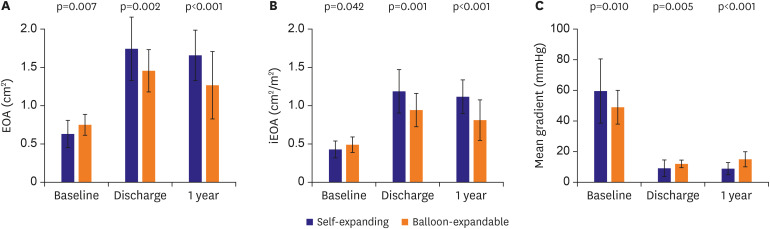
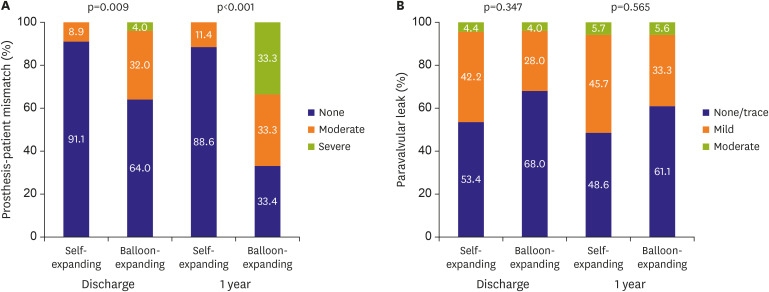
Results: Between the self-expanding and balloon-expandable valve-treated patients, the clinical outcomes including permanent pacemaker implantation (11.1% vs. 8.0%), acute kidney injury stage 2 or 3 (4.4% vs. 4.0%), and major vascular complication (4.4% vs. 0.0%) were similar without all-cause mortality, stroke, and life-threatening bleeding during 30-day follow-up. Compared with the balloon-expandable valve-treated patients, the self-expanding valve-treated patients presented larger effective orifice area (EOA) (1.46±0.28 vs. 1.75±0.42 cm², p=0.002) and indexed EOA (0.95±0.21 vs. 1.18±0.28 cm²/m², p=0.001), whereas mean aortic valve gradient (11.7±2.9 vs. 8.9±5.2 mmHg, P=0.005) and incidence of ≥moderate prosthesis-patient mismatch (36.0% vs. 8.9%, p=0.009) were lower. These hemodynamic differences were maintained at 1-year follow-up.
Conclusions: TAVR with self-expanding valves was associated with superior hemodynamic outcomes compared with balloon-expandable valves in patients with small aortic annulus.
Keywords: Aortic valve stenosis; Transcatheter aortic valve replacement.
Copyright © 2021. The Korean Society of Cardiology.
Conflict of interest statement
MK Hong and YG Ko are proctors of Medtronic. The other authors have no financial conflicts of interest.
Figures
References
-
- Kalavrouziotis D, Rodés-Cabau J, Bagur R, et al. Transcatheter aortic valve implantation in patients with severe aortic stenosis and small aortic annulus. J Am Coll Cardiol. 2011;58:1016–1024. - PubMed
-
- Nishimura RA, Otto CM, Bonow RO, et al. 2017 AHA/ACC Focused Update of the 2014 AHA/ACC guideline for the management of patients with valvular heart disease: a report of the American College of Cardiology/American Heart Association Task Force on Clinical Practice Guidelines. Circulation. 2017;135:e1159–95. - PubMed
-
- Baumgartner H, Falk V, Bax JJ, et al. 2017 ESC/EACTS Guidelines for the management of valvular heart disease. Eur Heart J. 2017;38:2739–2791. - PubMed
-
- Mauri V, Kim WK, Abumayyaleh M, et al. Short-term outcome and hemodynamic performance of next-generation self-expanding versus balloon-expandable transcatheter aortic valves in patients with small aortic annulus: a multicenter propensity-matched comparison. Circ Cardiovasc Interv. 2017;10:e005013. - PubMed
Grants and funding
- HI17C0882/Korea Health Industry Development Institute/Republic of Korea
- HI16C2211/Korea Health Industry Development Institute/Republic of Korea
- HI15C2782/Korea Health Industry Development Institute/Republic of Korea
- 2015M3A9C6031514/NRF/National Research Foundation of Korea/Korea
- Cardiovascular Research Center/Korea
LinkOut - more resources
Full Text Sources
Other Literature Sources