


Rare severe hypofibrinogenemia induced by tissue plasminogen activator in stroke patients: Case report
- PMID: 33655967
- PMCID: PMC7939149
- DOI: 10.1097/MD.0000000000024978
Rare severe hypofibrinogenemia induced by tissue plasminogen activator in stroke patients: Case report
Abstract
Rationale: Severe hypofibrinogenemia after intravenous thrombolysis (IVT) with recombinant tissue plasminogen activator (rt-PA) is rare and easily overlooked, but hypofibrinogenemia increases the risk of major bleeding. However, it is unclear when hypofibrinogenemia reaches the peak and when hypofibrinogenemia is resolved.
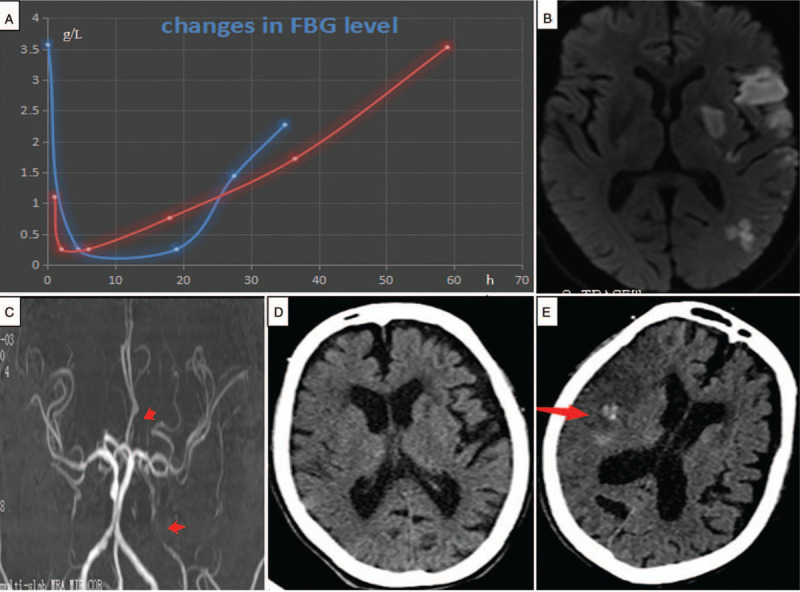
Patient concerns: Case 1 was of a 66-year-old man who was hospitalized due to sudden onset of vague speech and right hemiplegia for 4 hours. Case 2 was of an 84-year-old woman who was hospitalized for sudden onset of left hemiplegia and vague speech for 4 hours. In case 1, fibrinogen levels decreased from normal values to <0.25 g/L within 4.5 hours after commencing IVT and returned to normal at 35 hours later. In case 2, fibrinogen levels decreased from 1.1 to <0.25 g/L within 2 hours after commencing IVT and normalized 36.5 hours later.
Diagnoses: Both patients were diagnosed with rt-PA-related hypofibrinogenemia.
Interventions: No antiplatelet or symptomatic treatment was administered during the period of hypofibrinogenemia.
Outcomes: Fibrinogen levels gradually recovered. In case 1, the patient did not experience cerebral hemorrhage during hypofibrinogenemia. His symptoms improved significantly within 1 week. In case 2, repeat computed tomography revealed minor cerebral hemorrhage, but no deterioration in her condition was noted until she was discharged.
Lessons: Rapid, severe, and prolonged hypofibrinogenemia may occur after IVT with rt-PA, which may increase the risk of massive hemorrhage and affect the related therapy. Prompt diagnosis of hypofibrinogenemia is important for preventing complications. We recommend checking the fibrinogen levels routinely after IVT. Fibrinogen replacement therapy and platelet transfusion are the main management routes for rt-PA-related symptomatic intracranial hemorrhage.
Copyright © 2021 the Author(s). Published by Wolters Kluwer Health, Inc.
Conflict of interest statement
The authors have no conflicts of interest to disclose.
Figures
References
-
- Skeik N, Gits CC, Ehrenwald E, et al. Fibrinogen level as a surrogate for the outcome of thrombolytic therapy using tissue plasminogen activator for acute lower extremity intravascular thrombosis. Vasc Endovascular Surg 2013;47:519–23. - PubMed
-
- Seet RC, Rabinstein AA. Symptomatic intracranial hemorrhage following intravenous thrombolysis for acute ischemic stroke: a critical review of case definitions. Cerebrovasc Dis 2012;34:106–14. - PubMed
-
- Smith K, Fraser G, Seder D, et al. Hypofibrinogenemia and abnormal INR after treatment with systemic recombinant tissue plasminogen activator for acute ischemic stroke. Crit Care Med 2012;40:1–328.
-
- Matrat A, De Mazancourt P, Derex L, et al. Characterization of severe hypofibrinogenemia induced by alteplase in two patients thrombolysed for stroke. Thromb Res 2013;131:e45–8. - PubMed
-
- Vandelli L, Marietta M, Gambini M, et al. Fibrinogen decrease after intravenous thrombolysis in ischemic stroke patients is a risk factor for intracerebral hemorrhage. J Stroke Cerebrovasc Dis 2015;24:394–400. - PubMed
Publication types
MeSH terms
Substances
LinkOut - more resources
Full Text Sources
Other Literature Sources
Medical
