


Research Letter: Sleep Mediates the Association Between Prior Concussion and Depressive Symptoms
- PMID: 33656485
- PMCID: PMC8249320
- DOI: 10.1097/HTR.0000000000000663
Research Letter: Sleep Mediates the Association Between Prior Concussion and Depressive Symptoms
Abstract
Objective: To test sleep quality as one mechanistic pathway through which repeated concussion increases risk of depression later in life among former contact sport athletes.
Setting: Multicenter study enrolled former American collegiate football players from 16 different National Collegiate Athletic Association member institutions.
Participants: Fifty-eight former American collegiate football players approximately 15 years following sport discontinuation.
Design: Participants completed in-person evaluations including comprehensive semistructured interviews with detailed concussion history and sport history, as well as self-reported measures of depression symptom severity (Beck Depression Inventory-II) and sleep quality (Pittsburgh Sleep Quality Index). Years of football participation were included as a covariate. Mediation modeling examined the degree to which sleep quality accounted for the association between repeated concussion and depression symptoms.
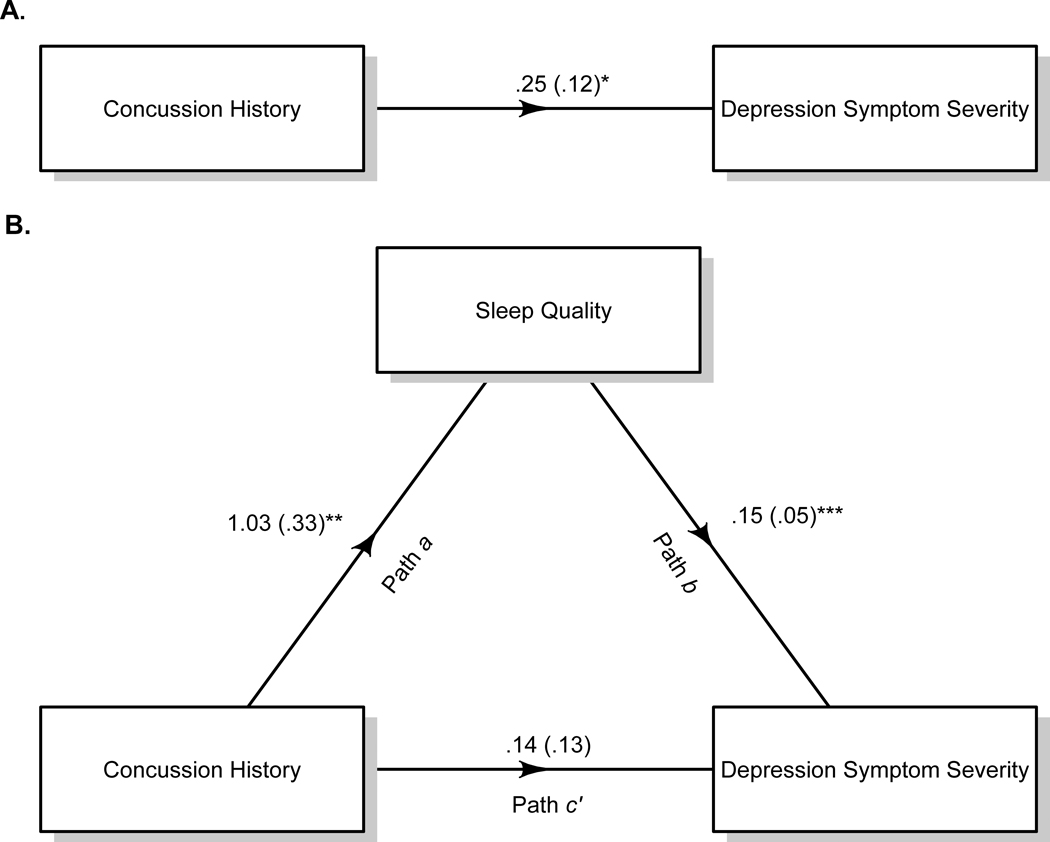
Results: Within the mediation model, concussion history significantly predicted sleep quality (B = 1.03; 95% CI, 0.37 to 1.65; P = .002) and sleep quality significantly predicted depressive symptom severity (controlling for the effects of concussion history; B = 0.15; 95% CI, 0.06 to 0.24; P = .001). The association between prior concussion and depressive symptom severity was fully mediated by sleep quality. With inclusion of the indirect effects, concussion history did not predict depressive symptom severity (direct effect: B = 0.14; 95% CI, -0.09 to 0.41; P = .249; indirect effect: 0.15; 95% CI, 0.03 to 0.29; P = .016).
Conclusions: Current findings raise the possibility that the greater risk of depression reported in those with a history of mTBI/concussion is mediated by sleep quality, a common sequela of mTBI. These findings highlight potential opportunities for prophylactic sleep-related intervention among individuals with multiple prior concussions to mitigate the risk of depression.
Copyright © 2021 Wolters Kluwer Health, Inc. All rights reserved.
Conflict of interest statement
The authors declare no conflicts of interest.
Figures
References
-
- Kerr ZY, Marshall SW, Harding HP, Guskiewicz KM. Nine-year risk of depression diagnosis increases with increasing self-reported concussions in retired professional football players. Am J Sports Med. 2012;40(10):2206–2212. - PubMed
-
- Lovato N, Gradisar M. A meta-analysis and model of the relationship between sleep and depression in adolescents: recommendations for future research and clinical practice. Sleep Med Rev. 2014;18(6):521–529. - PubMed
-
- Chaput G, Giguere JF, Chauny JM, Denis R, Lavigne G. Relationship among subjective sleep complaints, headaches, and mood alterations following a mild traumatic brain injury. Sleep Med. 2009;10(7):713–716. - PubMed
-
- Muthén LK, Muthén BO. Mplus User’s Guide 7th ed. ed. Los Angeles, CA: Muthén & Muthén; 1998–2015.
Publication types
MeSH terms
Grants and funding
LinkOut - more resources
Full Text Sources
Other Literature Sources
Medical
