Effect of Incentives for Alcohol Abstinence in Partnership With 3 American Indian and Alaska Native Communities: A Randomized Clinical Trial
- PMID: 33656561
- PMCID: PMC7931140
- DOI: 10.1001/jamapsychiatry.2020.4768
Effect of Incentives for Alcohol Abstinence in Partnership With 3 American Indian and Alaska Native Communities: A Randomized Clinical Trial
Abstract
Importance: Many American Indian and Alaska Native communities are disproportionately affected by problems with alcohol use and seek culturally appropriate and effective interventions for individuals with alcohol use disorders.
Objective: To determine whether a culturally tailored contingency management intervention, in which incentives were offered for biologically verified alcohol abstinence, resulted in increased abstinence among American Indian and Alaska Native adults. This study hypothesized that adults assigned to receive a contingency management intervention would have higher levels of alcohol abstinence than those assigned to the control condition.
Design, setting, and participants: This multisite randomized clinical trial, the Helping Our Native Ongoing Recovery (HONOR) study, included a 1-month observation period before randomization and a 3-month intervention period. The study was conducted at 3 American Indian and Alaska Native health care organizations located in Alaska, the Pacific Northwest, and the Northern Plains from October 10, 2014, to September 2, 2019. Recruitment occurred between October 10, 2014, and February 20, 2019. Eligible participants were American Indian or Alaska Native adults who had 1 or more days of high alcohol-use episodes within the last 30 days and a current diagnosis of alcohol dependence. Data were analyzed from February 1 to April 29, 2020.
Interventions: Participants received treatment as usual and were randomized to either the contingency management group, in which individuals received 12 weeks of incentives for submitting a urine sample indicating alcohol abstinence, or the control group, in which individuals received 12 weeks of incentives for submitting a urine sample without the requirement of alcohol abstinence. Regression models fit with generalized estimating equations were used to assess differences in abstinence during the intervention period.
Main outcomes and measures: Alcohol-negative ethyl glucuronide (EtG) urine test result (defined as EtG<150 ng/mL).
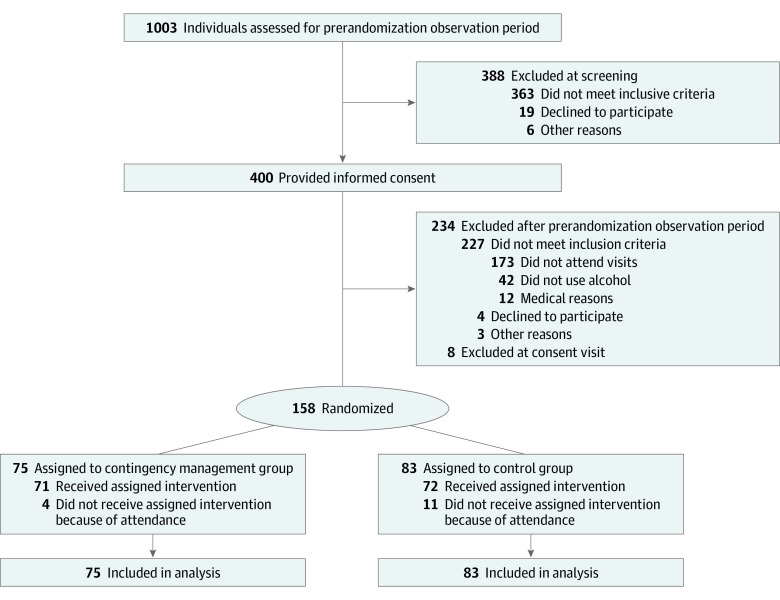
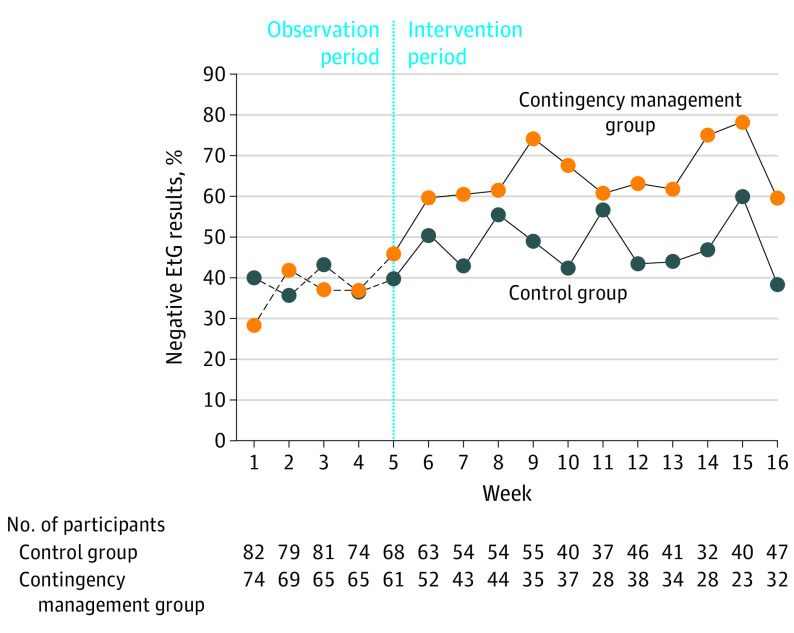
Results: Among 1003 adults screened for eligibility, 400 individuals met the initial criteria. Of those, 158 individuals (39.5%; mean [SD] age, 42.1 [11.4] years; 83 men [52.5%]) met the criteria for randomization, which required submission of 4 or more urine samples and 1 alcohol-positive urine test result during the observation period before randomization. A total of 75 participants (47.5%) were randomized to the contingency management group, and 83 participants (52.5%) were randomized to the control group. At 16 weeks, the number who submitted an alcohol-negative urine sample was 19 (59.4%) in the intervention group vs 18 (38.3%) in the control group. Participants randomized to the contingency management group had a higher likelihood of submitting an alcohol-negative urine sample (averaged over time) compared with those randomized to the control group (odds ratio, 1.70; 95% CI, 1.05-2.76; P = .03).
Conclusions and relevance: The study's findings indicate that contingency management may be an effective strategy for increasing alcohol abstinence and a tool that can be used by American Indian and Alaska Native communities for the treatment of individuals with alcohol use disorders.
Trial registration: ClinicalTrials.gov Identifier: NCT02174315.
Conflict of interest statement
Figures
Comment in
-
Bringing Together Behavioral Science, Community Engagement, and Cultural Adaptations to Increase Alcohol Abstinence Among American Indian and Alaska Native People Using Contingency Management Therapy.JAMA Psychiatry. 2021 Jun 1;78(6):595-596. doi: 10.1001/jamapsychiatry.2020.4757. JAMA Psychiatry. 2021. PMID: 33656541 No abstract available.
References
-
- Getches DH, Wilkinson CF, Williams RA, Jr. Cases and Materials on Federal Indian Law. 4th ed. West Group; 1998.
-
- National Conference of State Legislatures. Federal and state recognized tribes. Updated March 2020. Accessed May 26, 2020. https://www.ncsl.org/research/state-tribal-institute/list-of-federal-and...
-
- National Institute on Alcohol Abuse and Alcoholism . Alcohol Use and Alcohol Use Disorders in the United States: Main Findings From the 2001-2002 National Epidemiologic Survey on Alcohol and Related Conditions (NESARC). National Institutes of Health; 2006. US Alcohol Epidemiologic Data Reference Manual. Vol 8. NIH publication 05-5737. Accessed May 8, 2020. https://pubs.niaaa.nih.gov/publications/NESARC_DRM/NESARCDRM.pdf
-
- Center for Behavioral Health Statistics and Quality . Results from the 2017 National Survey on Drug Use and Health: detailed tables. Substance Abuse and Mental Health Services Administration; 2018. Accessed April 27, 2020. https://www.samhsa.gov/data/report/2017-nsduh-detailed-tables
Publication types
MeSH terms
Substances
Associated data
Grants and funding
LinkOut - more resources
Full Text Sources
Other Literature Sources
Medical
Miscellaneous