


Who is mentally healthy? Mental health profiles of Japanese social networking service users with a focus on LINE, Facebook, Twitter, and Instagram
- PMID: 33657132
- PMCID: PMC7928453
- DOI: 10.1371/journal.pone.0246090
Who is mentally healthy? Mental health profiles of Japanese social networking service users with a focus on LINE, Facebook, Twitter, and Instagram
Abstract
Background: Both negative and positive associations between social networking service (SNS) usage and mental health have been suggested by previous studies; however, their differences by type of SNS and age remain unclear. We addressed this issue based on the frequency of traditional communication such as face-to-face and non-face-to-face communication (e.g., phone, email, and letters).
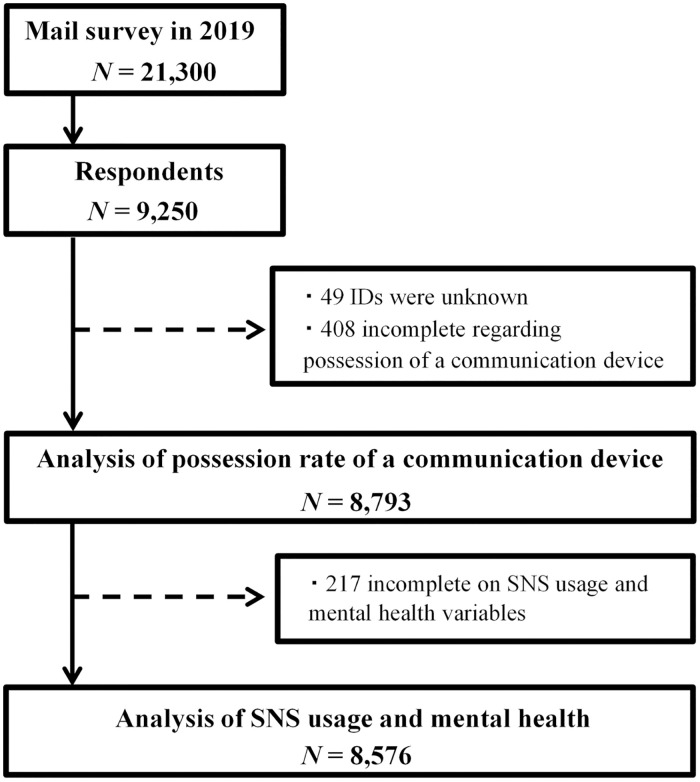
Methods: In total, 8,576 individuals participated, including 2,543 aged 18-39, 3,048 aged 40-64, and 2,985 aged over 65 years. They were asked to indicate their frequency of SNS usage, both for posting and checking, of LINE (a popular message application in Japan), Facebook, Twitter, and Instagram, with frequent usage defined as posting or checking more than a few times a week. To determine mental health status, WHO-5 (i.e., well-being), K6 (i.e., distress symptoms), and feelings of loneliness were assessed. Multiple and logistic regression analyses were adjusted for the frequency of traditional communication. To avoid type 1 error, a Bonferroni correction of p ≤ 0.002 was applied in the regression models (p = 0.05/18, a number of regression models).
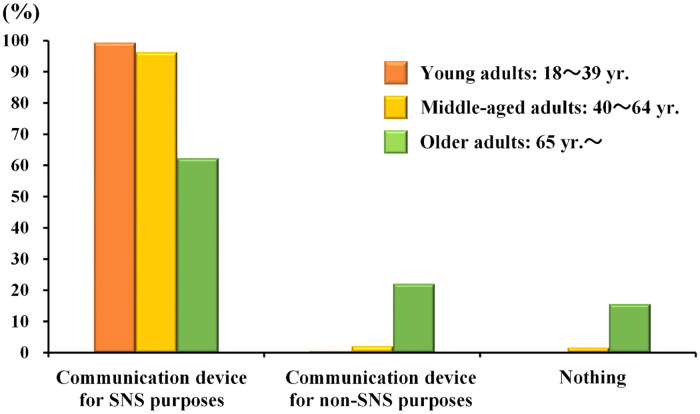
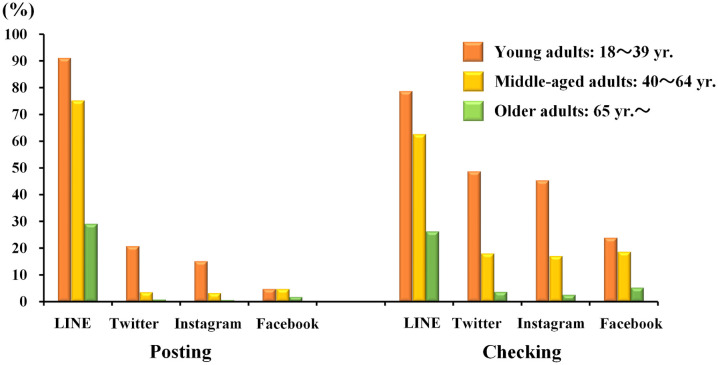
Results: The most frequently used SNS across the three age groups was LINE; frequent usage (both posting and checking) among older adults was independently associated with better well-being. Frequent posting on Facebook was associated with better well-being in middle-aged adults. Young adults who frequently checked on Instagram showed a tendency toward better well-being and lower distress symptoms. On the contrary, frequent usage of Twitter was associated with distress symptoms or feelings of loneliness across all three age groups.
Conclusions: We found generational and SNS-type-dependent negative and positive associations between SNS use and mental health, indicating the possible influences of SNS use and the importance of non-SNS communication.
Conflict of interest statement
The authors have declared that no competing interests exist.
Figures
References
-
- Hanson BS, Isacsson SO, Janzon L, Lindell SE. Social network and social support influence mortality in elderly men. The prospective population study of "Men born in 1914," Malmo, Sweden. American journal of epidemiology. 1989;130(1):100–11. Epub 1989/07/01. 10.1093/oxfordjournals.aje.a115301 . - DOI - PubMed
-
- Ellison NB, Steinfield C, Lampe C. The Benefits of Facebook “Friends:” Social Capital and College Students’ Use of Online Social Network Sites. Journal of Computer-Mediated Communication. 2007;12(4):1143–68. 10.1111/j.1083-6101.2007.00367.x - DOI
Publication types
MeSH terms
LinkOut - more resources
Full Text Sources
Other Literature Sources
Medical
