


Social inequalities and COVID-19 mortality in the city of São Paulo, Brazil
- PMID: 33657223
- PMCID: PMC7989375
- DOI: 10.1093/ije/dyab022
Social inequalities and COVID-19 mortality in the city of São Paulo, Brazil
Abstract
Background: Heterogeneity in COVID-19 morbidity and mortality is often associated with a country's health-services structure and social inequality. This study aimed to characterize social inequalities in COVID-19 mortality in São Paulo, the most populous city in Brazil and Latin America.
Methods: We conducted a population-based study, including COVID-19 deaths among São Paulo residents from March to September 2020. Age-standardized mortality rates and unadjusted rate ratios (RRs) [with corresponding 95% confidence intervals (CIs)] were estimated by race, sex, age group, district of residence, household crowding, educational attainment, income level and percentage of households in subnormal areas in each district. Time trends in mortality were assessed using the Joinpoint model.
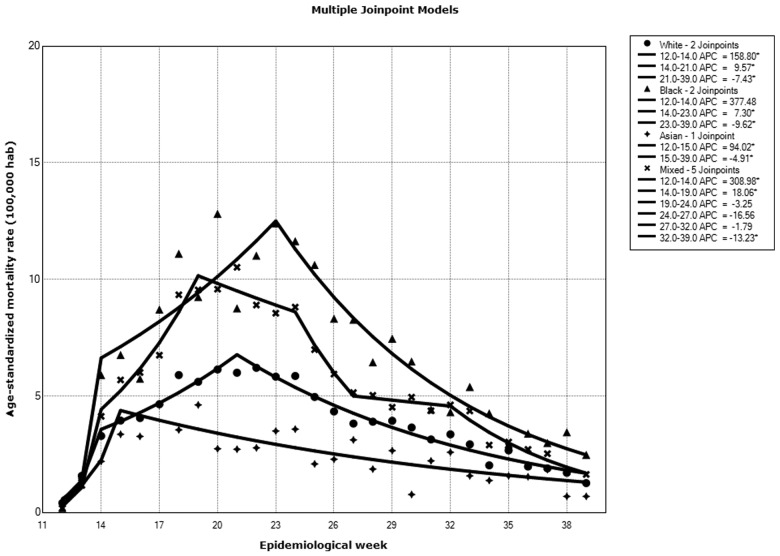
Results: Males presented an 84% increase in COVID-19 mortality compared with females (RR = 1.84, 95% CI 1.79-1.90). Higher mortality rates were observed for Blacks (RR = 1.77, 95% CI 1.67-1.88) and mixed (RR = 1.42, 95% CI 1.37-1.47) compared with Whites, whereas lower mortality was noted for Asians (RR = 0.63, 95% CI 0.58-0.68). A positive gradient was found for all socio-economic indicators, i.e. increases in disparities denoted by less education, more household crowding, lower income and a higher concentration of subnormal areas were associated with higher mortality rates. A decrease in mortality over time was observed in all racial groups, but it started earlier among Whites and Asians.
Conclusion: Our results reveal striking social inequalities in COVID-19 mortality in São Paulo, exposing structural inequities in Brazilian society that were not addressed by the governmental response to COVID-19. Without an equitable response, COVID-19 will further exacerbate current social inequalities in São Paulo.
Keywords: COVID-19; mortality; race factors; social determinants of health.
© The Author(s) 2021; all rights reserved. Published by Oxford University Press on behalf of the International Epidemiological Association.
Figures
References
-
- World Health Organization. Coronavirus Disease 2019 (COVID-19)—Situation Report 51. Geneva: World Health Organization.
-
- World Health Organization. WHO Coronavirus Disease (COVID-19) Dashboard. https://covid19.who.int/ (12 October 2020, date last accessed).
-
- Ministério da Saúde. COVID-19 NO BRASIL. https://covid.saude.gov.br/ (14 October 2020, date last accessed).
Publication types
MeSH terms
LinkOut - more resources
Full Text Sources
Other Literature Sources
Medical
