. 2021 Apr;14(2):e003202.
doi: 10.1161/CIRCGEN.120.003202. Epub 2021 Mar 3.

Transcriptome Sequencing of Patients With Hypertrophic Cardiomyopathy Reveals Novel Splice-Altering Variants in MYBPC3

Affiliations

Transcriptome Sequencing of Patients With Hypertrophic Cardiomyopathy Reveals Novel Splice-Altering Variants in MYBPC3

Mira Holliday et al. Circ Genom Precis Med. 2021 Apr.

Abstract

Background: Transcriptome sequencing can improve genetic diagnosis of Mendelian diseases but requires access to tissue expressing disease-relevant transcripts. We explored genetic testing of hypertrophic cardiomyopathy using transcriptome sequencing of patient-specific human induced pluripotent stem cell derived cardiomyocytes (hiPSC-CMs). We also explored whether antisense oligonucleotides (AOs) could inhibit aberrant mRNA splicing in hiPSC-CMs.

Methods: We derived hiPSC-CMs from patients with hypertrophic cardiomyopathy due to MYBPC3 splice-gain variants, or an unresolved genetic cause. We used transcriptome sequencing of hiPSC-CM RNA to identify pathogenic splicing and used AOs to inhibit this splicing.

Results: Transcriptome sequencing of hiPSC-CMs confirmed aberrant splicing in 2 people with previously identified MYBPC3 splice-gain variants (c.1090+453C>T and c.1224-52G>A). In a patient with an unresolved genetic cause of hypertrophic cardiomyopathy following genome sequencing, transcriptome sequencing of hiPSC-CMs revealed diverse cryptic exon splicing due to an MYBPC3 c.1928-569G>T variant, and this was confirmed in cardiac tissue from an affected sibling. Antisense oligonucleotide treatment demonstrated almost complete inhibition of cryptic exon splicing in one patient-specific hiPSC-CM line.

Conclusions: Transcriptome sequencing of patient specific hiPSC-CMs solved a previously undiagnosed genetic cause of hypertrophic cardiomyopathy and may be a useful adjunct approach to genetic testing. Antisense oligonucleotide inhibition of cryptic exon splicing is a potential future personalized therapeutic option.

Keywords: cardiomyopathy, hypertrophic; genetic testing; oligonucleotide, antisense; stem cell; transcriptome.


Figures
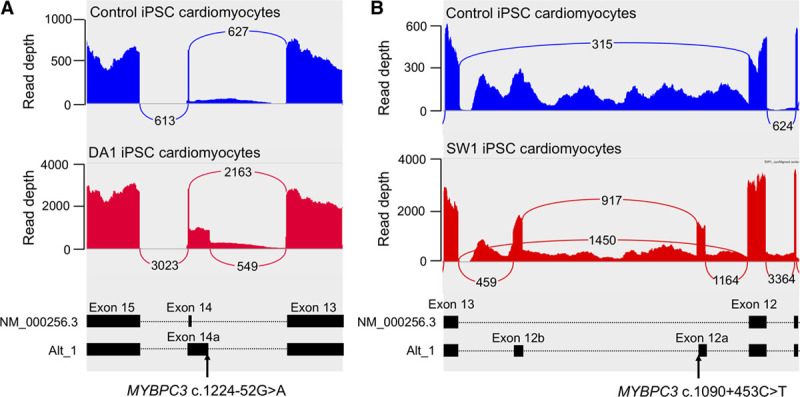
Figure 1.
Figure 1.
Novel MYBPC3 splice junctions detected in human induced pluripotent stem cell derived cardiomyocyte (hiPSC-CM) of DA1 and SW1. Sashimi plots show sites of aberrant MYBPC3 splice junctions in control hiPSCM-CMs (upper blue) and (A) DA1 (left red) and (B) SW1 (right red). Loops with numbers show number of sequencing reads supporting each major splice junction, as reported by Integrated Genome Viewer. Lower panels show transcript structures with exons (black boxes) and position of intronic splice gain variant.
Figure 2.
Figure 2.
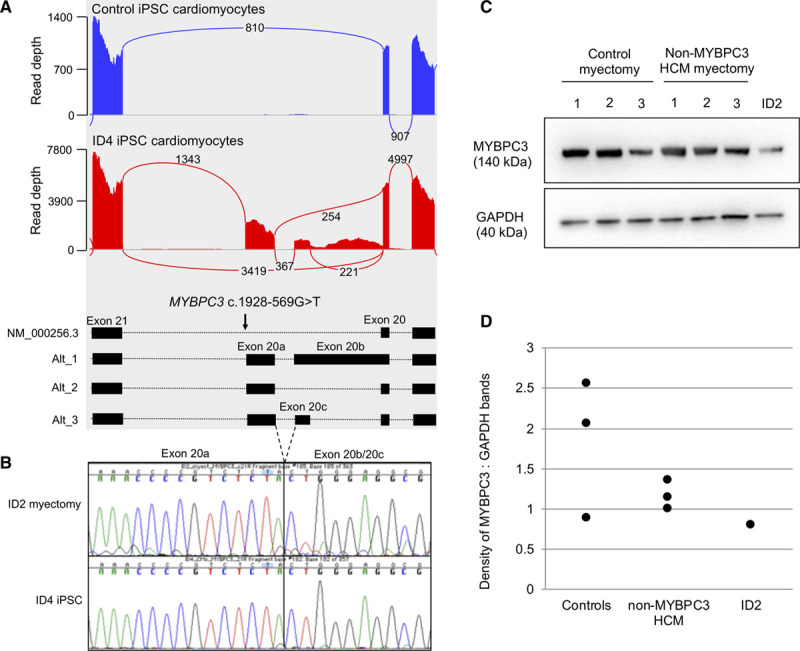
Novel MYBPC3 splice junctions detected in human induced pluripotent stem cell derived cardiomyocyte (hiPSC-CM) of ID4. A, Sashimi plots show sites of aberrant MYBPC3 splice junctions in control hiPSCM-CMs (blue) and ID4 (red) and SW1 (right red). Loops with numbers show number of sequencing reads supporting each major splice junction, as reported by IGV. Middle shows transcript structures with exons (black boxes) and position of intronic splice gain variant. B, Sanger sequencing across the novel splice junction of exon 20a and exon 20b/20c in myectomy tissue and hiPSC-CMs. C, Western blot of human heart tissue from 3 age- and sex-matched control donors, 3 age-matched HCM who do not have an MYBPC3 pathogenic variant and ID2. D, Relative band intensity of MYBPC3 compared with GAPDH.
Figure 3.
Figure 3.
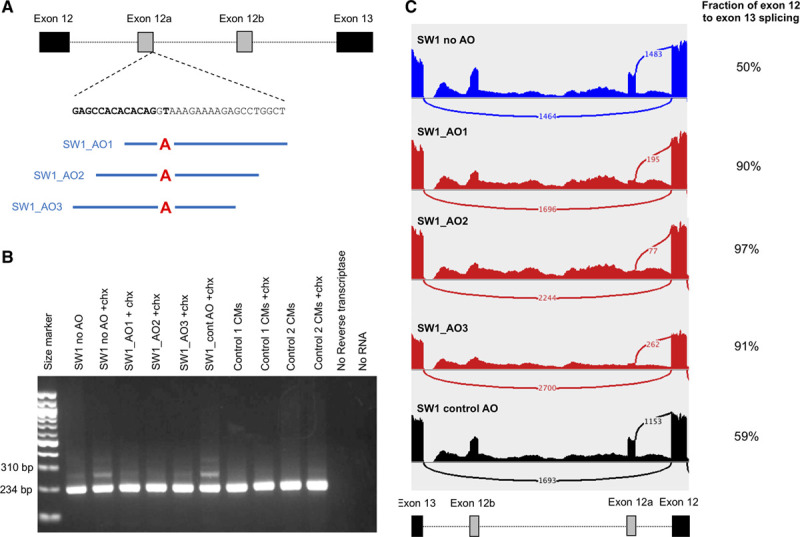
Antisense oligonucleotide treatment of SW1 human induced pluripotent stem cell–derived cardiomyocytes (hiPSC-CMs). A, Location of antisense oligonucleotides (AOs) designed to inhibit splicing of exon 12a. B, RT-PCR amplification of RNA extracted from induced pluripotent stem cell-derived cardiomyocytes of SW1 and controls. C, Sashimi plots show number of reads supporting canonical exon 12 and 13 splicing and exon 12 to cryptic exon 12a splicing in hiPSC-CMs with no AO treatment (blue), AO treatment (red), or control AO (black). Number of reads supporting canonical exon 12 to exon 13 splicing over total reads supporting exon 12 splicing are shown on the right. chx indicates cycloheximide.

References

    1. Cummings BB, Marshall JL, Tukiainen T, Lek M, Donkervoort S, Foley AR, Bolduc V, Waddell LB, Sandaradura SA, O’Grady GL, et al. Improving genetic diagnosis in Mendelian disease with transcriptome sequencing. Sci Transl Med. 2017; 9:eaal5209. - PMC - PubMed
    1. Kremer LS, Bader DM, Mertes C, Kopajtich R, Pichler G, Iuso A, Haack TB, Graf E, Schwarzmayr T, Terrile C, et al. Genetic diagnosis of Mendelian disorders via RNA sequencing. Nat Commun. 2017; 8:15824. doi: 10.1038/ncomms15824 - PMC - PubMed
    1. Lee H, Huang AY, Wang LK, Yoon AJ, Renteria G, Eskin A, Signer RH, Dorrani N, Nieves-Rodriguez S, Wan J, et al. ; Undiagnosed Diseases Network. Diagnostic utility of transcriptome sequencing for rare Mendelian diseases. Genet Med. 2020; 22:490–499. doi: 10.1038/s41436-019-0672-1 - PMC - PubMed
    1. Staerk J, Dawlaty MM, Gao Q, Maetzel D, Hanna J, Sommer CA, Mostoslavsky G, Jaenisch R. Reprogramming of human peripheral blood cells to induced pluripotent stem cells. Cell Stem Cell. 2010; 7:20–24. doi: 10.1016/j.stem.2010.06.002 - PMC - PubMed
    1. Ross SB, Fraser ST, Semsarian C. Induced pluripotent stem cells in the inherited cardiomyopathies: From disease mechanisms to novel therapies. Trends Cardiovasc Med. 2016; 26:663–672. doi: 10.1016/j.tcm.2016.05.001 - PubMed

Publication types

MeSH terms

LinkOut - more resources