. 2021 Mar 3;19(1):40.
doi: 10.1186/s12915-021-00966-w.

GRK2 regulates GLP-1R-mediated early phase insulin secretion in vivo

Affiliations

GRK2 regulates GLP-1R-mediated early phase insulin secretion in vivo

Alba C Arcones et al. BMC Biol. .

Abstract

Background: Insulin secretion from the pancreatic β-cell is finely modulated by different signals to allow an adequate control of glucose homeostasis. Incretin hormones such as glucagon-like peptide-1 (GLP-1) act as key physiological potentiators of insulin release through binding to the G protein-coupled receptor GLP-1R. Another key regulator of insulin signaling is the Ser/Thr kinase G protein-coupled receptor kinase 2 (GRK2). However, whether GRK2 affects insulin secretion or if GRK2 can control incretin actions in vivo remains to be analyzed.

Results: Using GRK2 hemizygous mice, isolated pancreatic islets, and model β-cell lines, we have uncovered a relevant physiological role for GRK2 as a regulator of incretin-mediated insulin secretion in vivo. Feeding, oral glucose gavage, or administration of GLP-1R agonists in animals with reduced GRK2 levels (GRK2+/- mice) resulted in enhanced early phase insulin release without affecting late phase secretion. In contrast, intraperitoneal glucose-induced insulin release was not affected. This effect was recapitulated in isolated islets and correlated with the increased size or priming efficacy of the readily releasable pool (RRP) of insulin granules that was observed in GRK2+/- mice. Using nanoBRET in β-cell lines, we found that stimulation of GLP-1R promoted GRK2 association to this receptor and that GRK2 protein and kinase activity were required for subsequent β-arrestin recruitment.

Conclusions: Overall, our data suggest that GRK2 is an important negative modulator of GLP-1R-mediated insulin secretion and that GRK2-interfering strategies may favor β-cell insulin secretion specifically during the early phase, an effect that may carry interesting therapeutic applications.

Keywords: G protein-coupled receptor kinase 2 (GRK2); Glucagon-like peptide 1 (GLP-1); Granule dynamics; Incretin; Insulin signaling; β-arrestin.


Conflict of interest statement

The authors declare that they have no competing interests.

Figures
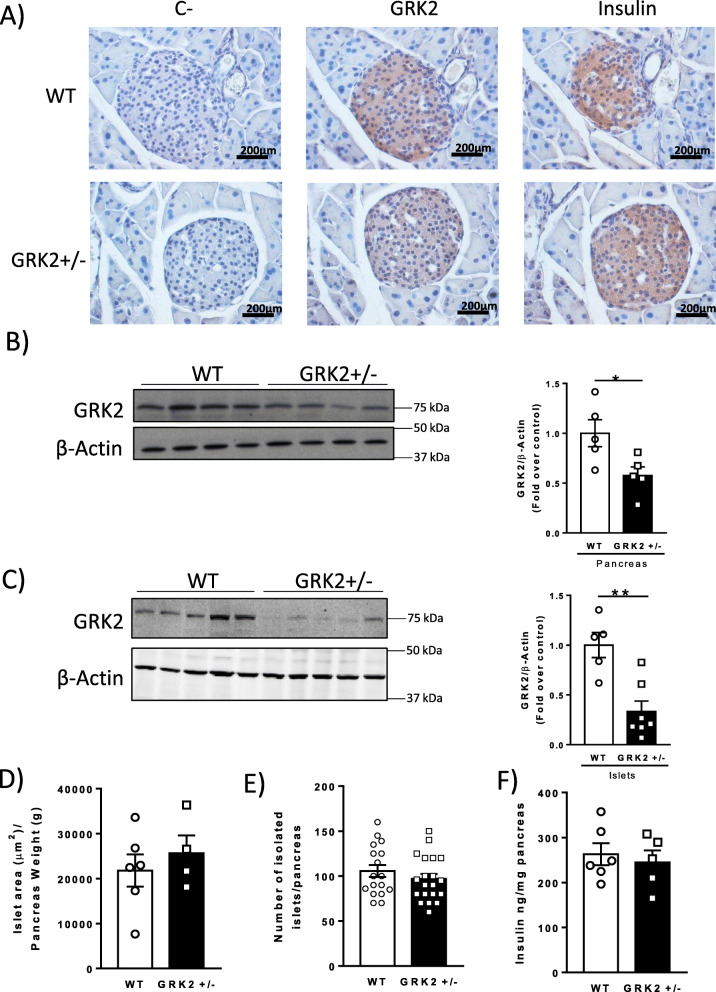
Fig. 1
Fig. 1
Specific localization of GRK2 in the pancreatic islet and expression levels of GRK2 protein in the pancreas of WT and GRK2+/− mice. Representative photomicrographs showing the immunohistochemical staining of serial pancreatic sections using antibodies against GRK2 or insulin as an islet marker, counterstained with hematoxylin (magnification × 40; scale bar 0.2 mm). Incubations without primary antibody are performed as a negative control (a). Whole pancreatic tissue lysates, WT n = 5, GRK2+/− n = 5 (b) or isolated islets lysates, WT n = 5, GRK2+/− n = 7 (c) were subjected to Western blot analysis and probed with antibodies against GRK2 and β-actin. Stereological analysis of the pancreas analyzing three pancreatic sections separated 0.4 mm (each whole section was imaged, with an average 30 islets detected per section: total 565 islets were counted in WT mice (average of 94 islets/mice in three sections) and 407 islets in GRK2+/− mice (average of 101 islets/mice in three sections), non statistically different by t test), islet mass was quantified measuring insulin-positive area in WT n = 6 and GRK2+/− n = 4 (d). Number of isolated islets per digested pancreas, WT n = 17, GRK2+/− n = 20 (e). Total pancreatic insulin content measured in acidic-extracts of pancreata by ELISA, WT n = 6 GRK2+/− n = 5 (f). Means ± SEM data are represented, statistical analysis was performed using unpaired t test. *p < 0.05, **p<0.01
Fig. 2
Fig. 2
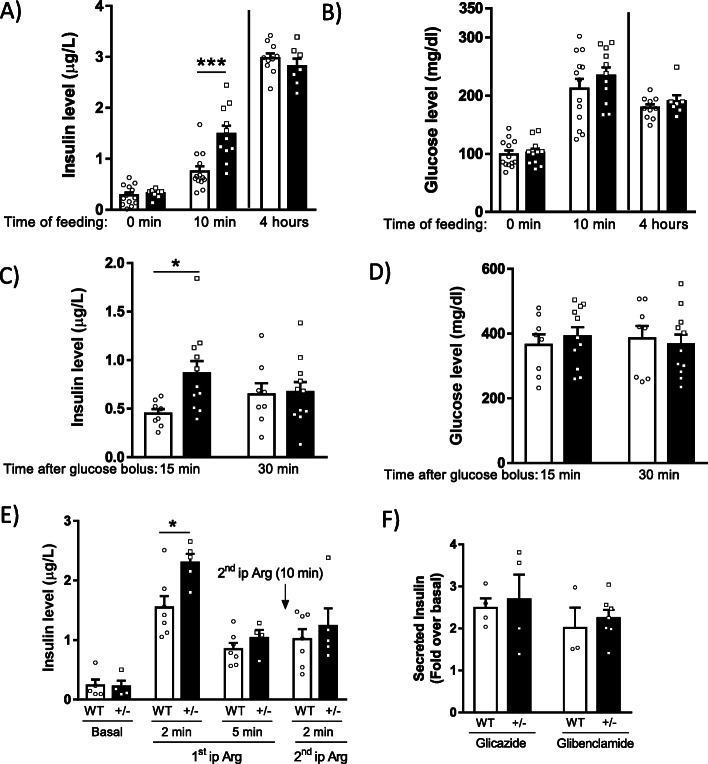
Increased early phase insulin secretion and RRP size in GRK2+/− mice. Insulin (a) and glucose (b) were measured after feeding animals for 10 min (early phase insulin secretion) or 4 h (late phase) (same animals were used to assess insulin and glucose levels, WT n = 13, 13, 10 and GRK2+/− n = 11, 11, 7; for 0, 10 min, and 4 h, respectively). oGTT (2 g/kg) was performed in WT and GRK2+/− mice, and insulin (c) and glucose levels (d) were assessed in serum samples 15 min (early phase) and 30 min (late phase) after a glucose gavage (same animals were used to assess insulin and glucose levels, WT n = 7, GRK2+/− n = 10). To explore the status of different pools of insulin granules, mice were injected ip with 1 g/kg arginine (1st ipArg; measured at 2 and 5 min) to elicit insulin secretion from the RRP. A second arginine injection 10 min later (2nd ipArg; measured 2 min later) reveals effects in replenishing the RRP from the RP. In both cases, insulin concentrations in serum are shown in the graph (WT n = 5, 7, 7, 7; GRK2 +/− n = 4, 5, 4, 5 for 0, 2, 5 min and 2 min after 2nd ip Arg, respectively) (e). Mice were injected ip with the sulfonylureas glicazide (10 mg/kg) or glibenclamide (5 mg/kg). Insulin levels were measured at 0 and 15 min and fold increase in serum insulin levels is shown (glicazide: WT n = 4, GRK2+/− n = 4; glibenclamide: WT n = 3, GRK2+/− n = 7) (f). Means ± SEM data are represented, WT: White bars, GRK2+/−: Black bars, statistical analysis was performed by 1-way ANOVA followed by Bonferroni’s post hoc test *p < 0.05; ***p < 0.01
Fig. 3
Fig. 3
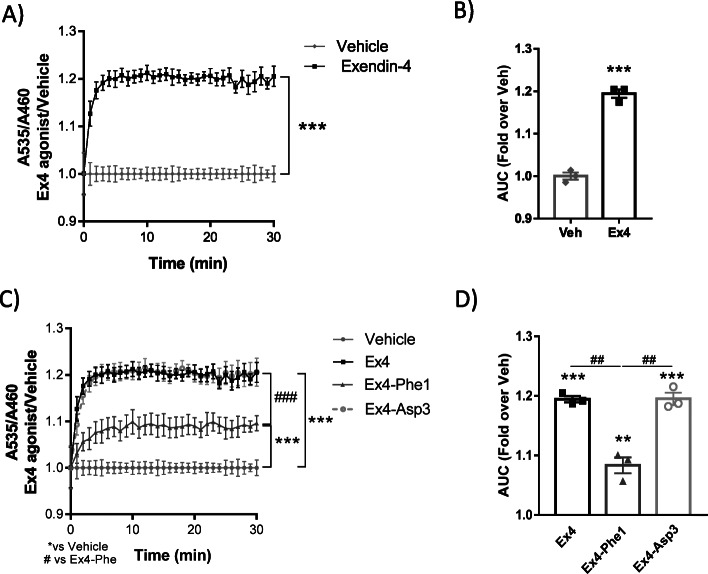
GRK2 is recruited to the activated GLP-1R and this occurs to a different extent by biased agonists. GRK2 recruitment to GLP-1R was measured by nanoBRET in INS1 832/3 GLP-1R KO cells using 100 nM of Exendin-4 (a). AUC of GRK2 recruitment assay by nanoBRET (b), n = 3 independent experiments, each point is an average from 3 to 4 technical replicas (a, b). The same experiment was performed in the presence of 100 nM of different Exendin-4 biased agonists: Ex4-Phe1 (Gαs-biased) and Ex4-Asp3 (β-arrestin biased) (c). AUC of GRK2 recruitment assay by nanoBRET (d). N = 3 independent experiments, each point is an average from 3 to 4 technical replicas. Means ± SEM data are represented, statistical analysis was performed using repeated measures two-way ANOVA (a, c) or paired one-way ANOVA (d) followed by Bonferroni’s post hoc test and paired t test (b), **/##p < 0.01, ***/###p < 0.001
Fig. 4
Fig. 4
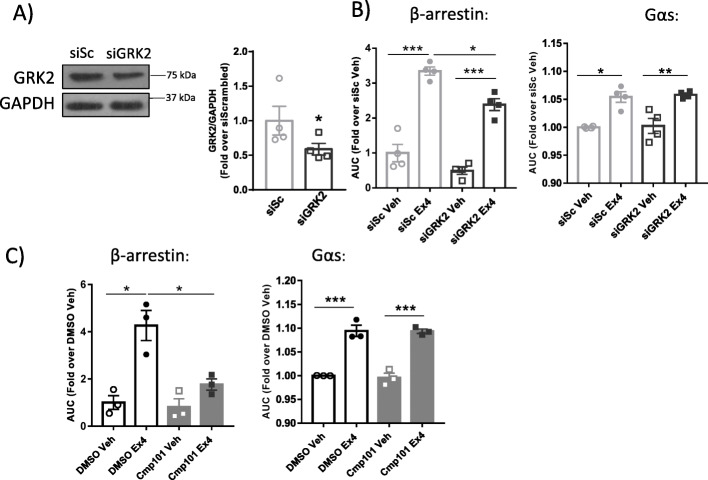
GRK2 levels and activity can modulate β-arrestin 2 association. Western blot analysis of the level of GRK2 silencing in Min6B1 cells (siSc: siRNA Scrambled; siGRK2: siRNA αAdrbk1), n = 4 independent experiments (a). AUC of β-arrestin 2 or Gαs recruitment quantified by NanoBIT and nanoBRET, respectively, for 30 min after GLP-1R activation in Min6B1 cells silenced (b) or inhibited (c) for GRK2, n = 4 (b) or 3 (c) independent experiments, each point is an average from 3 to 4 technical replicas. Means ± SEM data are represented. Statistical analysis was performed by paired t test (a) or paired one-way ANOVA followed by Bonferroni’s post hoc test (b, c). *p < 0.05, **p < 0.01, ***p < 0.001
Fig. 5
Fig. 5
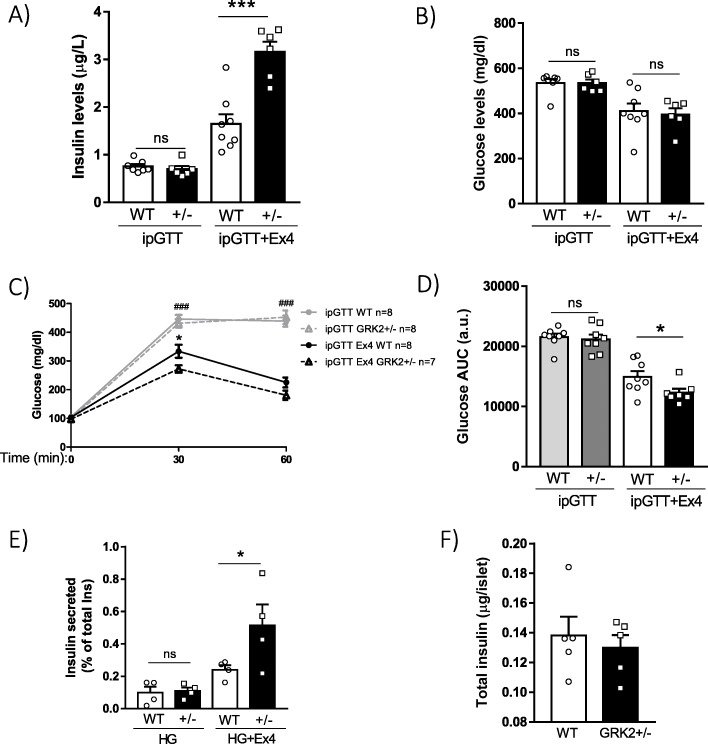
GRK2 +/− mice display increased GLP-1R-dependent insulin release in vivo and in isolated islets. Insulin (a) and glucose (b) levels were assessed in serum samples of fasted mice (basal) and 15 min after the administration of an intraperitoneal glucose bolus (ipGTT, 2 g/kg) with or without the GLP-1 analog Exendin-4 (Ex4, 5 μg/kg (for ipGTT or ipGTT+Ex4, respectively, WT n = 7 or 8; for GRK2+/− n = 6 or 6; same mice were used to assess insulin and glucose levels). Analysis of glucose levels (c) and bar graph representing the area under the curve (AUC) (d) after insulinogenic stimuli are shown; WT: n = 8 for ipGTT and ipGTT + Ex4 and GRK2+/− n = 8 for ipGTT and 7 for ipGTT + Ex4. Insulin secretion in isolated pancreatic islets stimulated with high glucose (HG, 17 mM) or high glucose with Exendin-4 (HG + Ex4 100 nM) from WT and GRK2+/− mice, expressed as % of insulin content, n = 4 mice (2–3 different 5-islets pool were assessed per mice as technical replicas) (e). Amount of total islet insulin content as obtained by acidic extraction, n = 5 mice (8–11 5-islets pools were assessed per mice as technical replicas) (f). Means ± SEM data are represented. Statistical analysis was performed using repeated measures 2-way ANOVA (c) or 1-way ANOVA (a, b, d, and e) followed by Bonferroni’s post hoc test and unpaired t test (f); (*) was used for comparisons between WT and GRK2+/− mice, (#) was used for comparisons between basal vs ipGTT or ipGTT vs ipGTT + Ex4 (C). *p < 0.05; *** ###p < 0.001
Fig. 6
Fig. 6
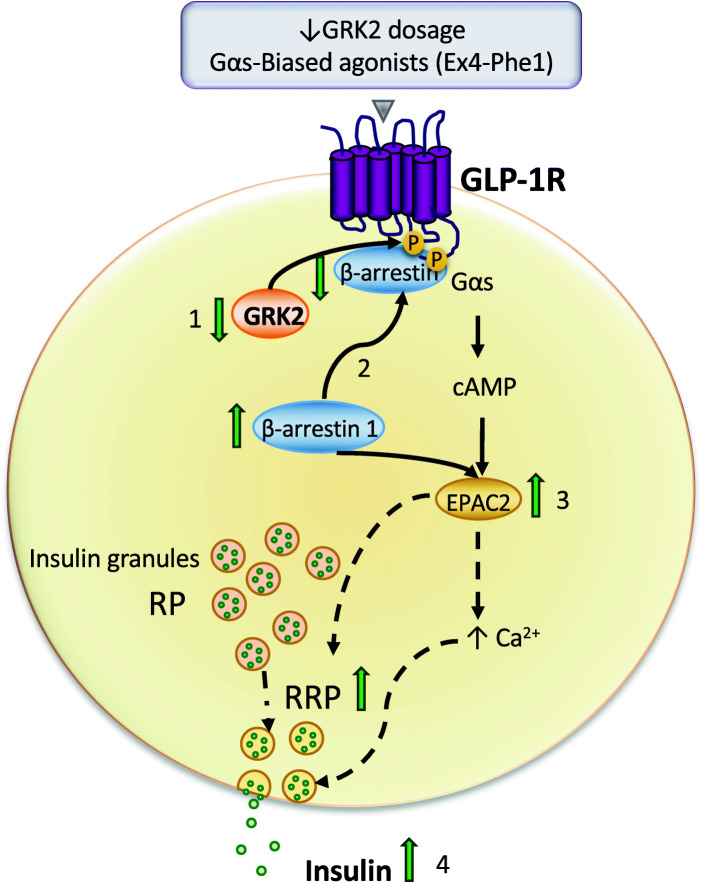
Schematic representation of the proposed impact of GRK2 on GLP-1R actions in the β-cell. Upon GLP-1R activation in the β-cell GRK2 is recruited to the activated receptor (1). In a situation of reduced GRK2 dosage or upon stimulation with Gαs-biased agonists (Ex-Phe1), less GRK2 would associate with GLP-1R leading to diminished β-arrestin recruitment (2) and reducing receptor desensitization. Also, these higher levels of free β-arrestin 1 could then activate EPAC2 (3), which would potentiate insulin secretion (4) in a dual manner: contributing to GLP-1R-mediated acute actions on insulin release (Ca2+), as well as increasing the size or efficiency of the RRP. Dotted lines represent indirect mechanisms of action

References

    1. Röder PV, Wu B, Liu Y, Han W. Pancreatic regulation of glucose homeostasis. Experimental & molecular medicine. 2016. 10.1038/emm.2016.6. - PMC - PubMed
    1. Winzell MS, Ahrén B. G-protein-coupled receptors and islet function-Implications for treatment of type 2 diabetes. Pharmacol Ther. 2007;116:437–448. doi: 10.1016/j.pharmthera.2007.08.002. - DOI - PubMed
    1. Ruiz de Azua I, Gautam D, Jain S, Guettier J-M, Wess J. Critical metabolic roles of β-cell M3 muscarinic acetylcholine receptors. Life Sci. 2012;91:986–91. doi:10.1016/j.lfs.2012.04.010. - PMC - PubMed
    1. Begg DP, Woods SC. Interactions between the central nervous system and pancreatic islet secretions: a historical perspective. Adv Physiol Educ. 2013;37:53–60. doi: 10.1152/advan.00167.2012. - DOI - PMC - PubMed
    1. Reimann F, Gribble FM. G protein-coupled receptors as new therapeutic targets for type 2 diabetes. Diabetologia. 2016;59:229–233. doi: 10.1007/s00125-015-3825-z. - DOI - PMC - PubMed

Publication types

MeSH terms

Substances