


[The content of yellow pigments in durum wheat (Titicum durum Desf.) grains: biosynthesis, genetic control, marker selection]
- PMID: 33659834
- PMCID: PMC7716578
- DOI: 10.18699/VJ20.642
[The content of yellow pigments in durum wheat (Titicum durum Desf.) grains: biosynthesis, genetic control, marker selection]
Abstract
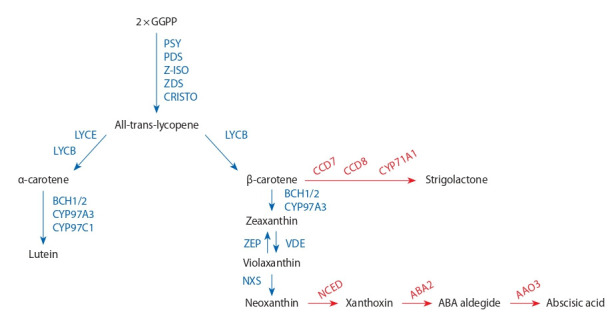
Grain with high contents of yellow pigments will add the natural bright-yellow colour to the paste, which unlike a paste with a high level of whiteness, are preferred by consumers. The provitamin activity (vitamin A) and antioxidant activity of the carotenoid pigment increase the biological and nutritional value of the grain with high contents of these pigments. The purpose of this review is to summarize modern knowledge about the biosynthesis and genetic control of pigment accumulation in durum wheat and to assess the main results of research and selection over the past 20 years abroad and in Russia. The trait "concentration carotenoid pigment in grain" (Ypc) is quantitative. However, the prevalence of strong additive gene effects and high heritability have contributed to significant progress in breeding for this trait. Molecular labeling of quantitative trait loci (QTL) that control the synthesis of the carotenoid pigment and the yellowness index (YI) found that they are distributed across all chromosomes of the durum wheat genome. The main QTLs, which determine 60 % of the variation of the trait, were mapped to 7AL and 7BL chromosome. The contribution of these QTLs is associated with allelic variations that control the activity of phytoene synthase (PSY). QTLs with minor effects found on the remaining chromosomes are also reliably mapped using molecular markers. As confirmed in a number of experiments, most of them are QTLs located on 3AS (linked to the LCYE (lycopene ε-cyclase) allele and on 4BS (the LpxB1.1c gene). It has been shown that the LpxB1.1c allele contributes to a decrease in the activity of lipoxygenase, which oxidases carotenoids during the production of end products. This review considered and discusses the problems of molecular markers in breeding programs to increase the concentration of pigments in the grain and improve the color characteristics of the paste.
Зерно с высоким содержанием каротиноидных пигментов ценится за ярко-желтый цвет пасты, производимой из него, и провитаминную (витамин А) и антиоксидантную активность пигментов. Цель настоя- щего обзора – обобщение современных знаний о биосинтезе и генетическом контроле накопления пигментов в зерне твердой пшеницы и оценка основных результатов исследований и селекции за последние двадцать лет за рубежом и в России. Признак «концентрация каротиноидных пигментов в зерне» (Ypc) относится к раз- ряду количественных. Тем не менее превалирование сильных аддитивных эффектов генов и высокая насле- дуемость способствовали значительному прогрессу в селекции по этому признаку. Методами молекулярного маркирования локусов количественных признаков (QTL), контролирующих синтез каротиноидных пигментов и значения индекса желтизны (IY), установлено их распределение по всем хромосомам генома твердой пшеницы. Основные генетические локусы, определяющие более 60 % варьирования признака, были картированы в хромосомах 7AL и 7BL. Вклад этих локусов связан с аллельными вариациями, влияющими на активность фермента фитоенсинтетазы (PSY). В других хромосомах были локализованы минорные генетические факторы, из которых наиболее значимы QTL, расположенные в хромосомах 3AS (ассоциирован с геном LCYE-ликопин- ε-циклаза) и 4ВS (аллель Lpx-B1.1c). При этом показано, что аллель Lpx-B1.1c вносит вклад в снижение актив- ности липоксигеназы, окисляющей каротиноиды в процессе изготовления конечных продуктов. Рассмотрены и обсуждены проблемы использования молекулярных маркеров в селекционных программах, нацеленных на увеличение концентрации пигментов в зерне и улучшение цветовых характеристик пасты.
Keywords: carotenoids; concentration pigment; durum wheat; marker-assisted selection; yellow index.
Copyright © AUTHORS, 2018.
Figures


Publication types
LinkOut - more resources
Full Text Sources
Research Materials
Miscellaneous