


Conjoint expression and purification strategy for acquiring proteins with ultra-low DNA N6-methyladenine backgrounds in Escherichia coli
- PMID: 33660764
- PMCID: PMC7960888
- DOI: 10.1042/BSR20203769
Conjoint expression and purification strategy for acquiring proteins with ultra-low DNA N6-methyladenine backgrounds in Escherichia coli
Abstract
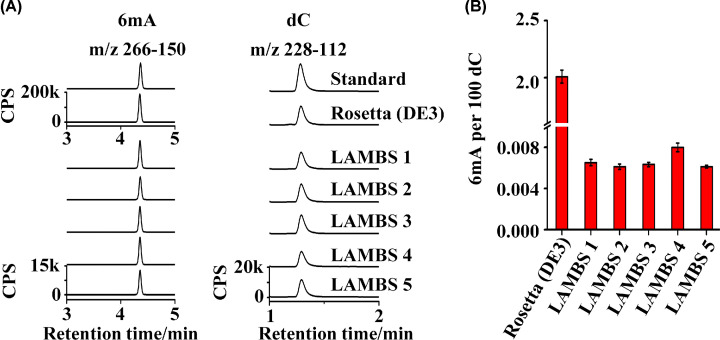
DNA N6-methyladenine (6mA), a kind of DNA epigenetic modification, is widespread in eukaryotes and prokaryotes. An enzyme activity study coupled with 6mA detection using ultra-high-performance liquid chromatography-quadruple mass spectrometry (UHPLC-MS/MS) is commonly applied to investigate 6mA potentially related enzymes in vitro. However, the protein expressed in a common Escherichia coli (E. coli) strain shows an extremely high 6mA background due to minute co-purified bacterial DNA, though it has been purified to remove DNA using multiple strategies. Furthermore, as occupied by DNA with abundant 6mA, the activity of 6mA-related proteins will be influenced seriously. Here, to address this issue, we for the first time construct a derivative of E. coli Rosetta (DE3) via the λRed knockout system specifically for the expression of 6mA-related enzymes. The gene dam encoding the 6mA methyltransferase (MTase) is knocked out in the newly constructed strain named LAMBS (low adenine methylation background strain). Contrasting with E. coli Rosetta (DE3), LAMBS shows an ultra-low 6mA background on the genomic DNA when analyzed by UHPLC-MS/MS. We also demonstrate an integral strategy of protein purification, coupled with the application of LAMBS. As a result, the purified protein expressed in LAMBS exhibits an ultra-low 6mA background comparing with the one expressed in E. coli Rosetta (DE3). Our integral strategy of protein expression and purification will benefit the in vitro investigation and application of 6mA-related proteins from eukaryotes, although these proteins are elusive until now.
Keywords: DNA N6-methyladenine; E. coli Rosetta (DE3); UHPLC-MS/MS; low background; λRed system.
© 2021 The Author(s).
Conflict of interest statement
The authors declare that there are no competing interests associated with the manuscript.
Figures


References
Publication types
MeSH terms
Substances
LinkOut - more resources
Full Text Sources
Other Literature Sources
Research Materials
