


Treatment outcomes of psychotherapy for binge-eating disorder in a randomized controlled trial: Examining the roles of childhood abuse and post-traumatic stress disorder
- PMID: 33660906
- PMCID: PMC8187312
- DOI: 10.1002/erv.2823
Treatment outcomes of psychotherapy for binge-eating disorder in a randomized controlled trial: Examining the roles of childhood abuse and post-traumatic stress disorder
Abstract
Objective: To examine childhood abuse and post-traumatic stress disorder (PTSD) as predictors and moderators of binge-eating disorder (BED) treatment outcomes in a randomized controlled trial comparing Integrative Cognitive-Affective Therapy with cognitive-behavioural therapy administered using guided self-help.
Method: In 112 adults with BED, childhood abuse was defined as any moderate/severe abuse as assessed by the Childhood Trauma Questionnaire, lifetime PTSD was assessed via the Structured Clinical Interview for DSM-IV, and outcomes were assessed via the Eating Disorder Examination (EDE). Covariate-adjusted regression models predicting binge-eating frequency and EDE global scores at end of treatment and 6-month follow-up were conducted.
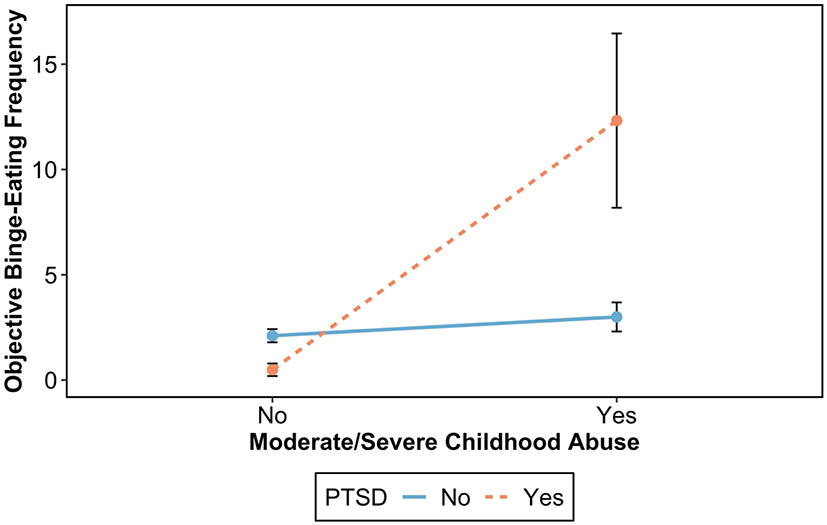
Results: Lifetime PTSD predicted greater binge-eating frequency at end of treatment (B = 1.32, p = 0.009) and childhood abuse predicted greater binge-eating frequency at follow-up (B = 1.00, p = 0.001). Lifetime PTSD moderated the association between childhood abuse and binge-eating frequency at follow-up (B = 2.98, p = 0.009), such that childhood abuse predicted greater binge-eating frequency among participants with a history of PTSD (B = 3.30, p = 0.001) but not among those without a PTSD history (B = 0.31, p = 0.42). No associations with EDE global scores or interactions with treatment group were observed.
Conclusions: Results suggest that a traumatic event history may hinder treatment success and that PTSD may be more influential than the trauma exposure itself.
Keywords: binge-eating disorder; childhood abuse; eating disorders; post-traumatic stress disorder; psychotherapy.
© 2021 Eating Disorders Association and John Wiley & Sons Ltd.
Conflict of interest statement
Figures
References
-
- Afifi TO, Sareen J, Fortier J, Taillieu T, Turner S, Cheung K, & Henriksen CA (2017). Child maltreatment and eating disorders among men and women in adulthood: Results from a nationally representative United States sample. International Journal of Eating Disorders, 50(11), 1281–1296. 10.1002/eat.22783 - DOI - PMC - PubMed
-
- American Psychiatric Association. (2013a). Feeding and Eating Disorders. In Diagnostic and Statistical Manual of Mental Disorders (DSM-5®). Washington, DC: American Psychiatric Association Publishing. 10.1176/appi.books.9780890425596.dsm10 - DOI
-
- American Psychiatric Association. (2013b). Trauma- and Stressor-Related Disorders. In Diagnostic and Statistical Manual of Mental Disorders (DSM-5®). Washington, DC: American Psychiatric Association Publishing.
-
- Benjamin LS (1974). Structural analysis of social behavior. Psychological Review, 81, 392–425.
Publication types
MeSH terms
Grants and funding
LinkOut - more resources
Full Text Sources
Other Literature Sources
Medical
