


Effect of SMS reminders on PrEP adherence in young Kenyan women (MPYA study): a randomised controlled trial
- PMID: 33662265
- PMCID: PMC8289198
- DOI: 10.1016/S2352-3018(20)30307-6
Effect of SMS reminders on PrEP adherence in young Kenyan women (MPYA study): a randomised controlled trial
Abstract
Background: Pre-exposure prophylaxis (PrEP) is highly effective for preventing HIV acquisition. However, adherence among young women (aged 18-24 years) has been challenging. SMS reminders have been shown to improve adherence to antiretroviral therapy in some contexts, including in combination with real-time adherence monitoring. We aimed to determine the effect of SMS reminders on PrEP adherence among young women in Kenya over a 2-year period.
Methods: The monitoring PrEP among young adult women (MPYA) study was an open label randomised controlled trial involving young adult women at high risk of HIV in Thika and Kisumu, Kenya. Participants were recruited from colleges, vocational institutions, informal settlements, and community-based organisations supporting young women. Women had to be aged 18-24 years and at high risk of HIV acquisition (defined as a VOICE risk score of 5 or higher, or being in a serodiscordant relationship). Study staff randomly assigned participants (1:1) to receive either SMS reminders (SMS reminder group) or no reminders (no SMS reminder group). Study group assignment was known to trial staff but masked to investigators. Reminders were initially sent daily and participants could switch to as-needed reminders (ie, sent only if they missed opening the monitor as expected) after 1 month. Study visits occurred at 1 month, 3 months, and then quarterly (ie, every 3 months). The primary outcome was PrEP adherence over 24 months measured with a real-time electronic monitor and assessed by negative binomial models adjusted for the study site and quarter among participants who collected PrEP. This trial is registered with ClinicalTrials.gov, NCT02915367.
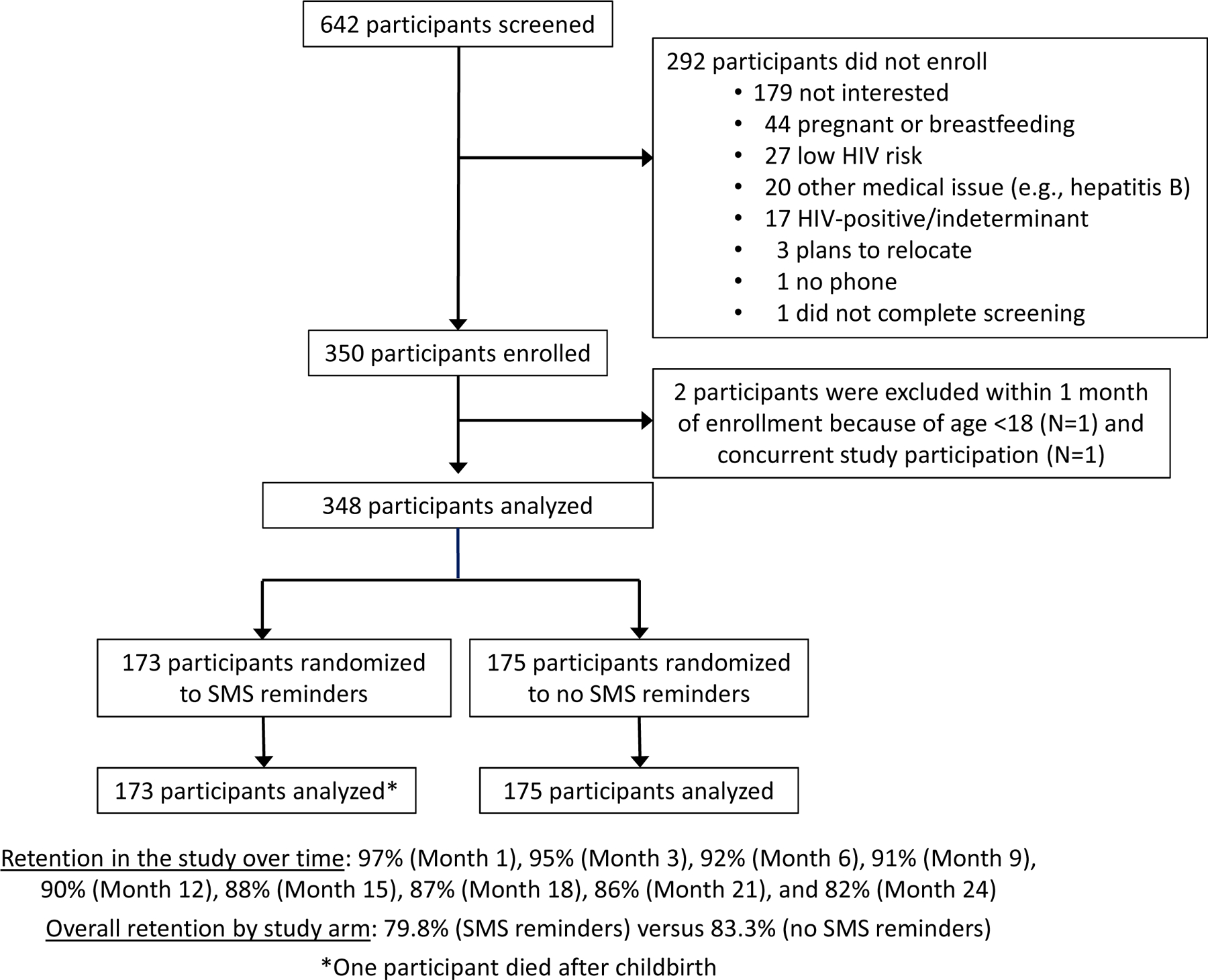
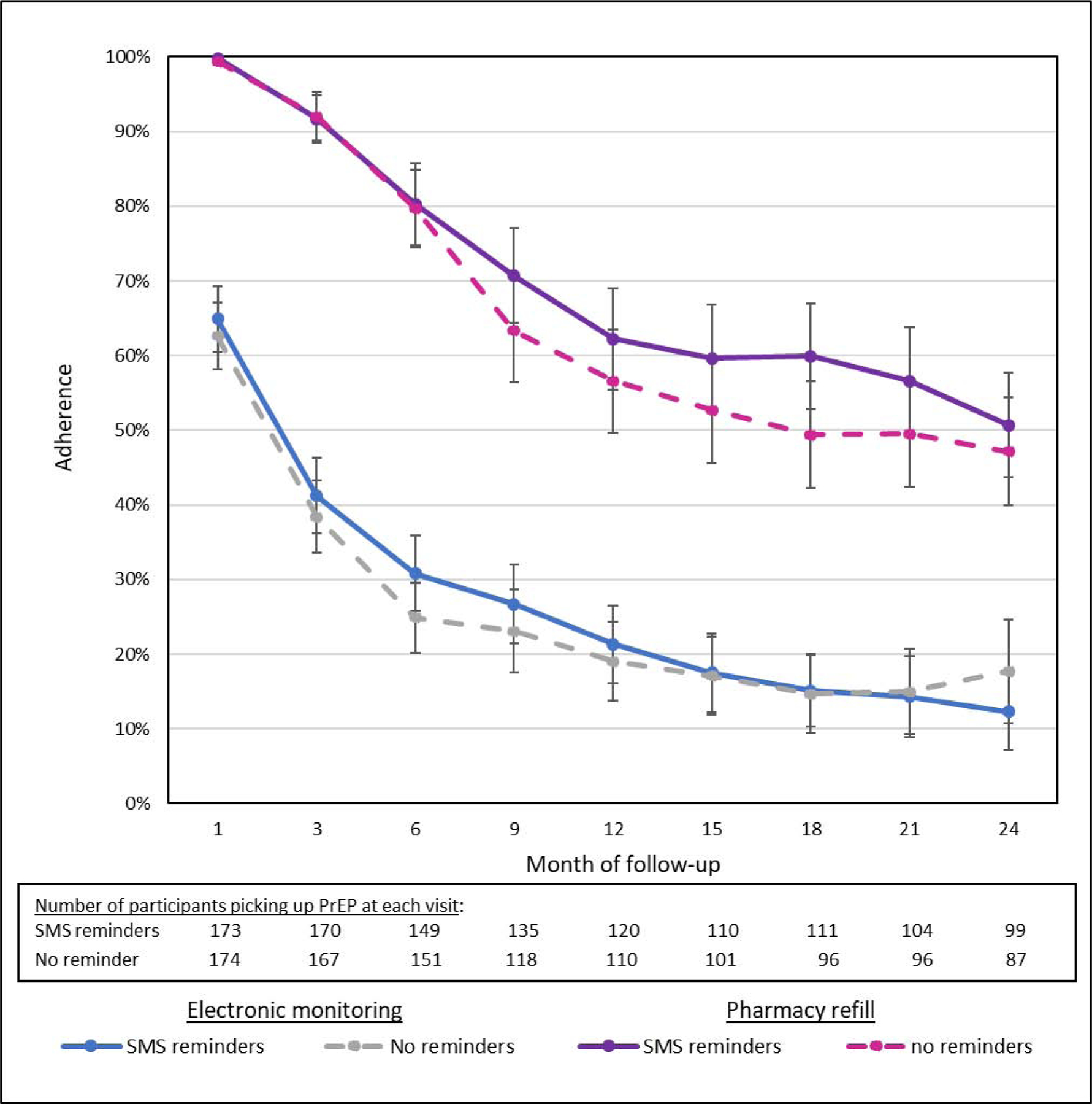
Findings: Of 642 women initially approached, 348 eligible women were enrolled between Dec 21, 2016, and Feb 5, 2018. Participants were randomly assigned to either the SMS reminder group (n=173) or the no SMS reminder group (n=175). The median age was 21 years (IQR 19-22) and 228 (66%) of the 348 participants reported condomless sex in the month before baseline. 24 (14%) of the 173 participants assigned to receive daily SMS reminders later opted for as-needed reminders. 69 291 (97%) of 71 791 SMS reminders were sent as planned. Among participants collecting PrEP (thus potentially suggesting a desire for HIV protection), electronically monitored adherence averaged 26·8% over 24 months and was similar by study group (27·0% with SMS, 26·6% without SMS, adjusted incidence rate ratio 1·16 [95% CI 0·93-1·45], p=0·19). There were no serious adverse events related to trial participation; five social harms occurred in each study group, primarily related to PrEP use.
Interpretation: SMS reminders were ineffective in promoting PrEP adherence among young Kenyan women. Given the overall low adherence in the trial, additional interventions are needed to support PrEP use in this population.
Funding: US National Institute of Mental Health.
Copyright © 2021 Elsevier Ltd. All rights reserved.
Conflict of interest statement
Competing interests
JEH reports personal fees from Merck, outside the submitted work; KN reports personal fees from Gilead Sciences and Merck; PA reports personal fees and grants from Gilead Sciences; and JMB reports personal fees from Gilead Sciences, Janssen, and Merck, outside the submitted work. The other authors declare no competing interests.
Figures
Comment in
-
Engaging young women in Africa for PrEP use and adherence.Lancet HIV. 2021 Mar;8(3):e122-e123. doi: 10.1016/S2352-3018(20)30335-0. Lancet HIV. 2021. PMID: 33662262 No abstract available.
References
Publication types
MeSH terms
Substances
Associated data
Grants and funding
LinkOut - more resources
Full Text Sources
Other Literature Sources
Medical
Research Materials
Miscellaneous
