Review
. 2021:62:100057.
doi: 10.1194/jlr.TR120000979. Epub 2021 Mar 2.

Cholesterol homeostasis in the vertebrate retina: biology and pathobiology

Affiliations
Review

Cholesterol homeostasis in the vertebrate retina: biology and pathobiology

Sriganesh Ramachandra Rao et al. J Lipid Res. 2021.

Abstract

Cholesterol is a quantitatively and biologically significant constituent of all mammalian cell membrane, including those that comprise the retina. Retinal cholesterol homeostasis entails the interplay between de novo synthesis, uptake, intraretinal sterol transport, metabolism, and efflux. Defects in these complex processes are associated with several congenital and age-related disorders of the visual system. Herein, we provide an overview of the following topics: (a) cholesterol synthesis in the neural retina; (b) lipoprotein uptake and intraretinal sterol transport in the neural retina and the retinal pigment epithelium (RPE); (c) cholesterol efflux from the neural retina and the RPE; and (d) biology and pathobiology of defects in sterol synthesis and sterol oxidation in the neural retina and the RPE. We focus, in particular, on studies involving animal models of monogenic disorders pertinent to the above topics, as well as in vitro models using biochemical, metabolic, and omic approaches. We also identify current knowledge gaps and opportunities in the field that beg further research in this topic area.

Keywords: cholesterol; de novo synthesis; homeostasis; lipoprotein; oxysterol; photoreceptor; retina; retinal pigment epithelium.


Conflict of interest statement

Conflicts of interest The authors declare that they have no conflicts of interest with the contents of this article.

Figures
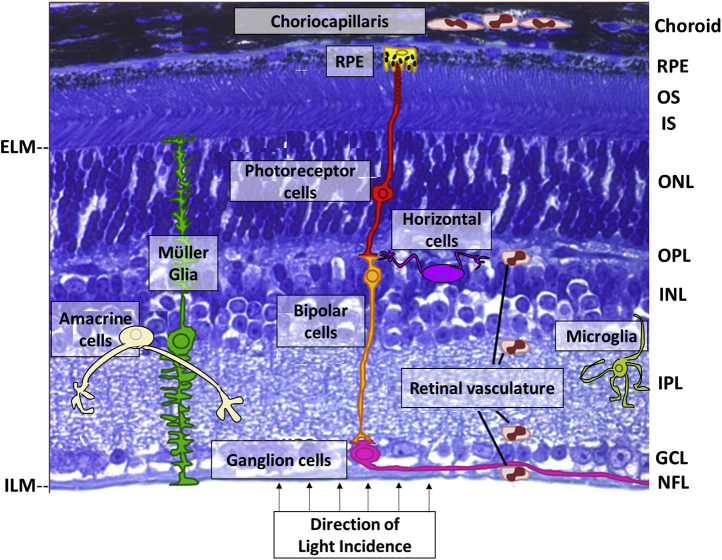
Fig. 1
Fig. 1
Histological organization of a model vertebrate retina. Schematic representation of individual retinal cell types is superimposed on a light microscopy image of a normal C57Bl/6J mouse retina (Toluidine blue-stained). The retinal pigment epithelium (RPE) forms a cellular monolayer interface between the neural retina and the choriocapillaris (the elements of the choroidal blood supply most proximal to the RPE). The RPE junctional complex network comprises the outer blood-retinal barrier, restricting the flow of blood-borne substances from the choroid to the outer retina. The photoreceptor layer (containing rods and cones) spans nearly half the total neural retina thickness and is comprised of the photoreceptor outer segment (OS) and inner segment (IS) layers, the outer nuclear layer (ONL, containing the rod and cone nuclei), and the outer plexiform layer (OPL), the latter containing the axonal processes and presynaptic endings of the photoreceptor cells, along with the postsynaptic processes of the bipolar cells and dendritic extensions of the horizontal cells. The inner nuclear layer (INL) consists of the nuclei and cell bodies of bipolar cells, amacrine cells, and horizontal cells, as well the Müller glia. The inner plexiform layer (IPL) consists of the axonal processes and synaptic termini of bipolar and amacrine cells, along with the dendritic arbors of the ganglion cells; the latter form the ganglion cell layer (GCL) of the neural retina. The collective axons of the ganglion cells form the nerve fiber layer (NFL) and exit the eye as the optic nerve en route to the visual cortex of the brain. The inner retinal cells are nourished by the retinal vasculature; the tight junctions of its constituent endothelial cells comprise the inner blood-retinal barrier. Microglia normally reside in the IPL and GCL, but migrate into the INL and outer retinal layers when activated. Note: The schematic does not depict some features specific to human or primate retinas, such as the macula or cone-rich fovea. ELM, external limiting membrane; ILM, internal limiting membrane. (Modified and adapted, with permission, from (10)).
Fig. 2
Fig. 2
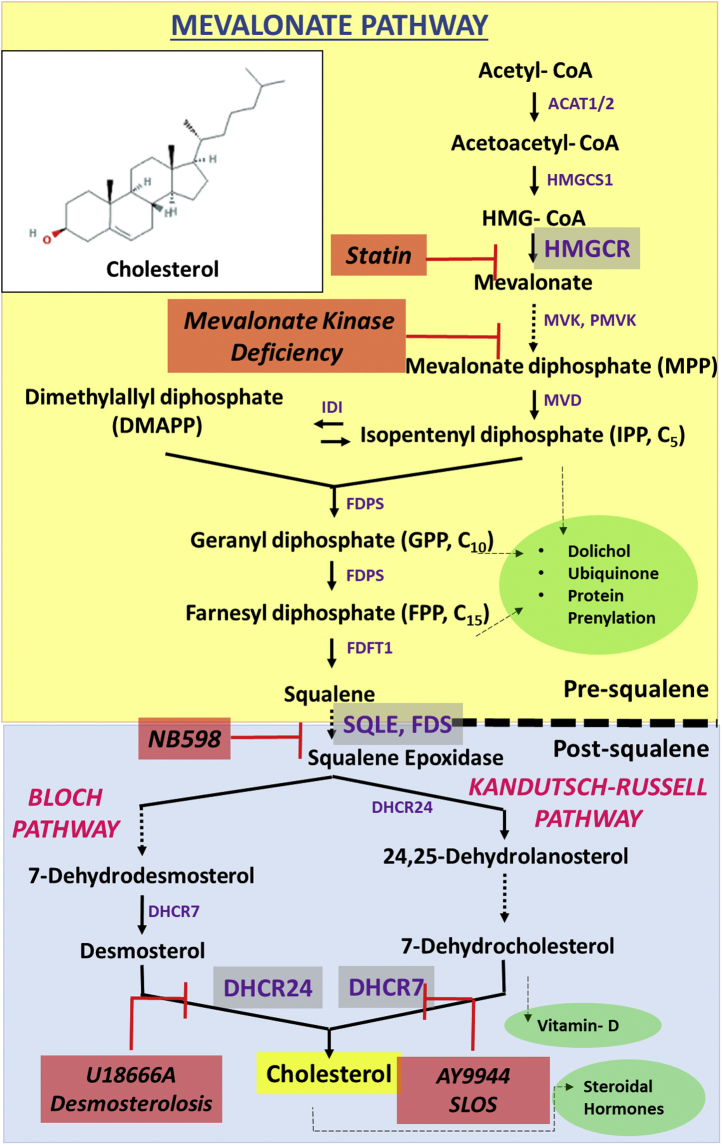
Schematic representation of the mevalonate pathway. Acetyl-CoA is converted in two steps, sequentially catalyzed by ACAT1 and ACAT2 and HMGCS1 (HMG-CoA synthase 1), to mevalonate, whose formation is the main rate-limiting step in the pathway, catalyzed by HMGCR (HMG-CoA reductase; inhibited by statins). The presqualene portion of the pathway generates a series of acyclic isoprenoid compounds, with a critical branch point at the level of farnesyl diphosphate (FPP) generation. The committed step toward sterol synthesis involves epoxidation of squalene to squalene-2,3-epoxide, catalyzed squalene epoxidase (SQLE; inhibited by NB-598), which then undergoes cyclization to form the first sterol intermediate (lanosterol; 4α,4β,14α-trimethyl-cholesta-8(9),24-dien-3β-ol) in the postsqualene portion of the pathway. This is followed by a series of demethylation and double-bond isomerization and reduction reactions, with ultimate engagement of either the Bloch Pathway or the Kandutsch-Russell Pathway to form cholesterol. Reduction of the side-chain double bonds in desmosterol (cholesta-5,24-dien-3β-ol) and 7-dehydrodesmosterol (cholesta-5,7,24-trien-3β-ol) is catalyzed by DHCR24 (inhibited by U18666A), whereas reduction of the ring B nuclear double bond in 7-dehydrocholesterol (7DHC; cholesta-5,7-dien-3β-ol) and 7-dehydrodesmosterol are catalyzed by DHCR7 (inhibited by AY9944). The mevalonate pathway is involved in the synthesis of several other important isoprenoid metabolites, including ubiquinone (coenzyme Q), dolichols, vitamin-D, and steroid hormones. Mutations in the DHCR24 gene lead to desmosterolosis, whereas such defects in the DHCR7 gene cause Smith-Lemli-Opitz syndrome (SLOS). Inset: Chemical structure of cholesterol (cholest-5-en-3β–ol). DHCR24, 24-dehydrocholesterol reductase; DHCR7, 7DHC reductase.
Fig. 3
Fig. 3
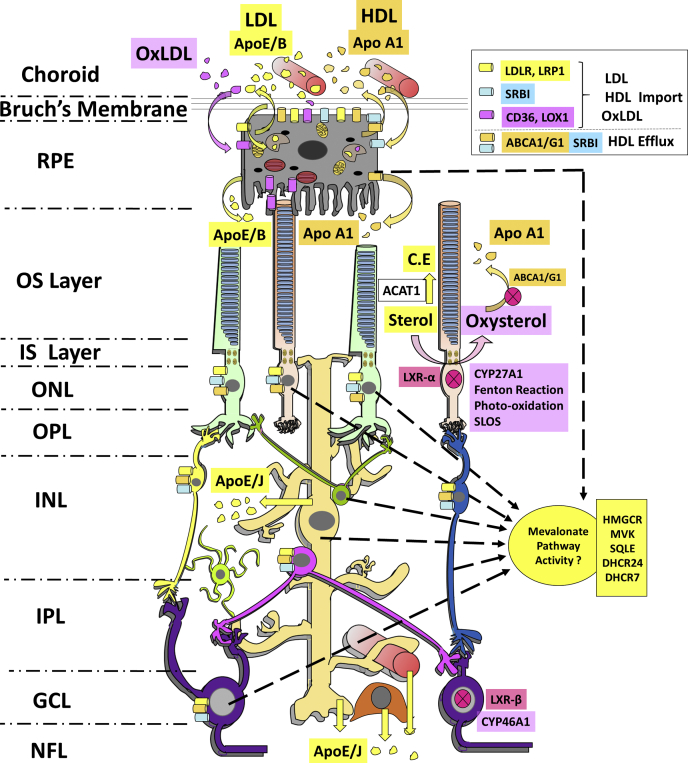
Hypothetical model of cholesterol homeostatic processes governing the vertebrate retina. The mevalonate pathway is active in both the RPE and the neural retina; however, the exact contributions of each of the retinal cell types to the overall synthesis and steady-state content of cholesterol in the retina remains to be determined. The RPE is capable of ABCA1-mediated bidirectional sterol efflux. The RPE also may exhibit apical secretion of APO-E–containing LDL, as well as LDLR-dependent uptake of LDL, and CD36-dependent uptake of OxLDL from the choroid. CD36 is also involved in diurnal uptake of rod outer segment (OS) tips; however, lipid hydroperoxides and oxysterols may competitively inhibit this process. Müller glia actively synthesize, package (with APO-E and APO-J), and secrete cholesterol, which then can be taken up by neighboring neurons. Sterol efflux from the neural retina is dependent on the activities of CYP27A1, CYP46A1, LXRs, and ABCA1. Excess retinal cholesterol may be esterified and stored as lipid droplets by the activity of ACAT1 and LCAT. Oxidative stress, involving both enzymatic and nonenzymatic processes, can lead to oxysterol formation; those by-products either are removed from the cell by sterol efflux or remain and accumulate in lipid droplets and cellular membranes, which can result in retinal pathology. (See Fig. 2 and text for definition of abbreviations.)

References

    1. Bloch K. Sterol structure and function. Steroids. 1989;53:261–270. - PubMed
    1. Luo J., Yang H., Song B.L. Mechanisms and regulation of cholesterol homeostasis. Nat. Rev. Mol. Cell Biol. 2020;21:225–245. - PubMed
    1. Bjorkhem I., Meaney S. Brain cholesterol: long secret life behind a barrier. Arterioscler. Thromb. Vasc. Biol. 2004;24:806–815. - PubMed
    1. Olkkonen V.M., Beaslas O., Nissila E. Oxysterols and their cellular effectors. Biomolecules. 2012;2:76–103. - PMC - PubMed
    1. Griffiths W.J., Wang Y. Oxysterol research: a brief review. Biochem. Soc. Trans. 2019;47:517–526. - PMC - PubMed

Publication types

LinkOut - more resources