Review
. 2021 Jun:138:111430.
doi: 10.1016/j.biopha.2021.111430. Epub 2021 Feb 25.

Flavonoids against the SARS-CoV-2 induced inflammatory storm

Affiliations
Review

Flavonoids against the SARS-CoV-2 induced inflammatory storm

Alena Liskova et al. Biomed Pharmacother. 2021 Jun.

Abstract

The disease severity of COVID-19, especially in the elderly and patients with co-morbidities, is characterized by hypercytokinemia, an exaggerated immune response associated with an uncontrolled and excessive release of proinflammatory cytokine mediators (cytokine storm). Flavonoids, important secondary metabolites of plants, have long been studied as therapeutic interventions in inflammatory diseases due to their cytokine-modulatory effects. In this review, we discuss the potential role of flavonoids in the modulation of signaling pathways that are crucial for COVID-19 disease, particularly those related to inflammation and immunity. The immunomodulatory ability of flavonoids, carried out by the regulation of inflammatory mediators, the inhibition of endothelial activation, NLRP3 inflammasome, toll-like receptors (TLRs) or bromodomain containing protein 4 (BRD4), and the activation of the nuclear factor erythroid-derived 2-related factor 2 (Nrf2), might be beneficial in regulating the cytokine storm during SARS-CoV-2 infection. Moreover, the ability of flavonoids to inhibit dipeptidyl peptidase 4 (DPP4), neutralize 3-chymotrypsin-like protease (3CLpro) or to affect gut microbiota to maintain immune response, and the dual action of angiotensin-converting enzyme 2 (ACE-2) may potentially also be applied to the exaggerated inflammatory responses induced by SARS-CoV-2. Based on the previously proven effects of flavonoids in other diseases or on the basis of newly published studies associated with COVID-19 (bioinformatics, molecular docking), it is reasonable to assume positive effects of flavonoids on inflammatory changes associated with COVID-19. This review highlights the current state of knowledge of the utility of flavonoids in the management of COVID-19 and also points to the multiple biological effects of flavonoids on signaling pathways associated with the inflammation processes that are deregulated in the pathology induced by SARS-CoV-2. The identification of agents, including naturally occurring substances such as flavonoids, represents great approach potentially utilizable in the management of COVID-19. Although not clinically investigated yet, the applicability of flavonoids against COVID-19 could be a promising strategy due to a broad spectrum of their biological activities.

Keywords: Anti-inflammatory effects; COVID-19; Cytokine storm; Flavonoids; Immunomodulation; Inflammation; Phytochemicals; SARS-CoV-2.


Conflict of interest statement

All authors declare that they have no conflict of interest.

Figures
ga1
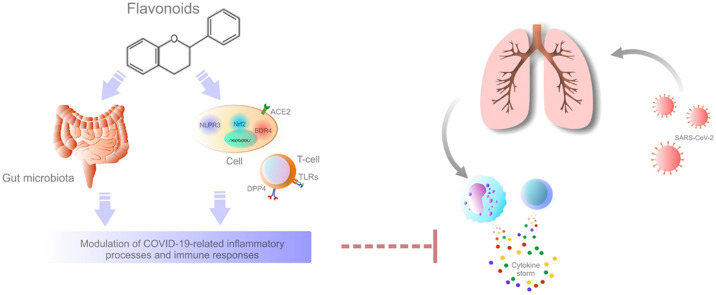
Graphical abstract
Fig. 1
Fig. 1
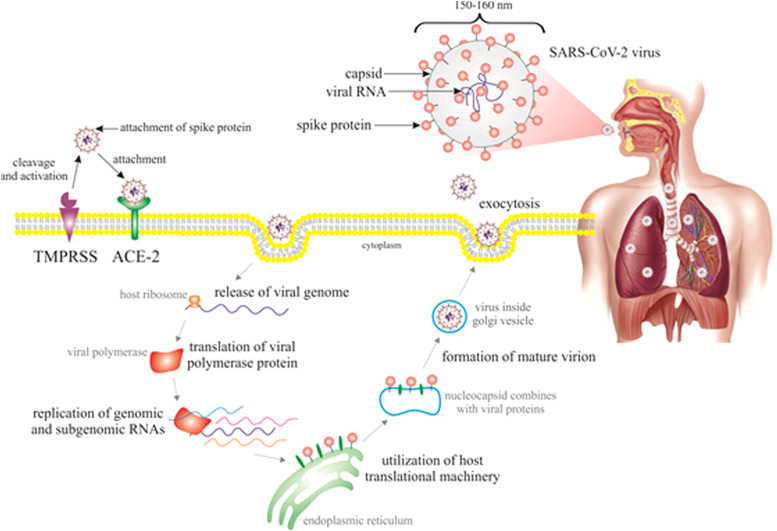
SARS-CoV-2 infection of host cells. Abbreviations: ACE-2, angiotensin-converting enzyme-2; TMPRSS, transmembrane serine protease. Explanatory notes: The spike glycoprotein of SARS-CoV-2 is composed of two subunits: S1 mediates the binding of the virus to the ACE-2 receptor and S2 drives host cell membrane fusion allowing viral entry. After the binding of S1 region of the virus to the receptor (ACE-2), the S protein is cleaved by host proteases such as TMPRSS (more specifically TMPRSS2) to be functional and to activate fusogenicity. Then, the fusion of the viral envelope and host plasma membrane and acidified endosomes results in the release of viral genome into the cytoplasm. The next process is facilitated by low pH of endosomes and S2 functional subunit of spike protein. SARS-CoV-2 takes advantage of host endoplasmatic reticulum to form numerous double-membrane vesicles that shield the viral genome and enable replication through the replication-transcription complex. The viral genome is translated into viral polyproteins by the protein translation machinery of the host cell that split by viral proteases into structural and non-structural viral proteins. The assembly of viral particles takes place in the endoplasmatic reticulum/Golgi compartment, and then the assembled virions are carried to the cell surface and are discharged from the cell via exocytosis , , .
Fig. 2
Fig. 2
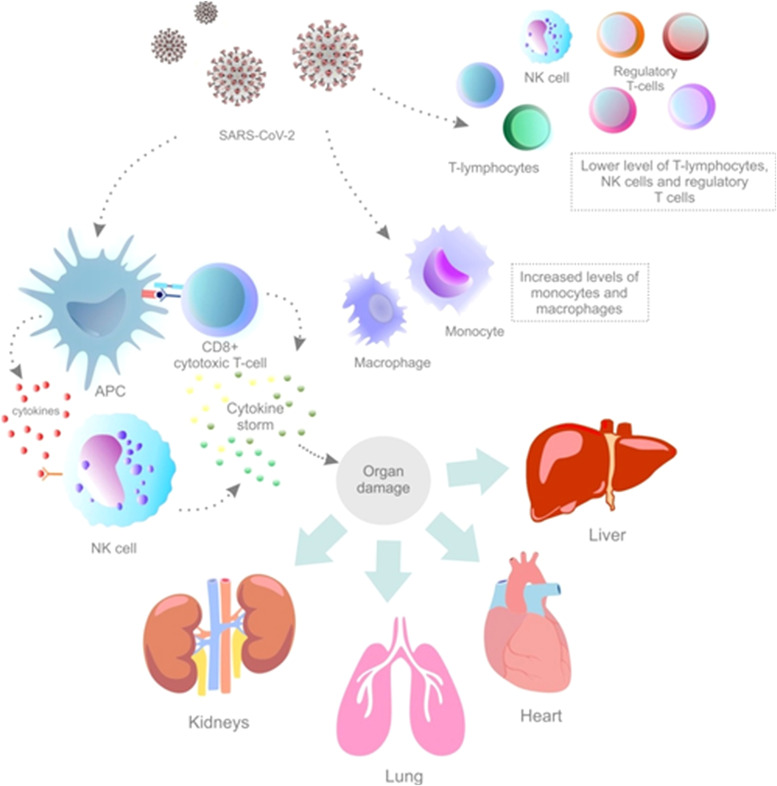
Immunologic features of SARS-CoV-2-associated pathology. Abbreviations: NK cells, natural killer cells; APC, antigen-presenting cells. Explanatory notes: APC presents viral antigens to NK cells and CD8-positive cytotoxic cells to activate innate and adaptive immunity and to produce proinflammatory mediators (cytokines) . The immune activation might become so intense that it can lead to exaggerated immune response (cytokine storm) , . The cytokine storm can result in the damage of lungs, kidneys, heart, and/or liver . The immunologic features of COVID-19 include also lower levels of T-lymphocytes, NK cells, and regulatory T-cells in patients with severe disease progression. An increased level of monocytes and macrophages in COVID-19 patients can also explain the elevation of proinflammatory cytokines .
Fig. 3
Fig. 3
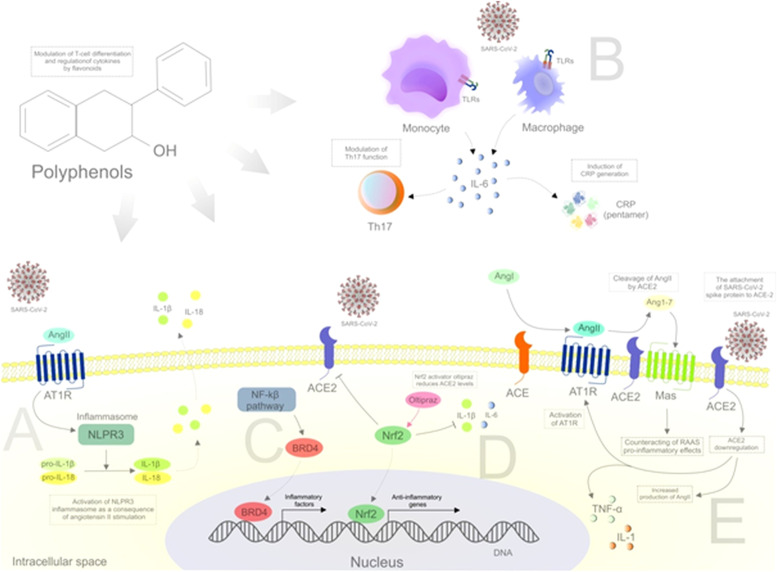
Inflammatory pathways associated with SARS-CoV-2 that can be potentially targeted by flavonoids. Abbreviations: AngII, angiotensin II; ACE, angiotensin-converting enzyme; ACE-2, angiotensin-converting enzyme 2; Ang1-7, angiotensin 1-7; AngII, angiotensin II; AT1R, angiotensin II receptor type 1; BRD4, bromodomain-containing protein 4; CRP, c-reactive protein; IL, interleukin; Mas, mitochondrial assembly receptor; NF-κB, nuclear factor kappa B; Nrf2, nuclear factor erythroid 2-related factor 2; RAAS, renin-angiotensin-aldosterone system; TLRs, toll-like receptors. Explanatory notes: (A) An essential determinant of the inflammatory response is the cleavage and secretion of pro-IL-1β and pro-IL-18 into bioactive cytokines activated by the NLRP3 inflammasome . The NLRP3 inflammasome is activated in response to AngII stimulation . (B) TLR activation followed by viral infection can induce the production of IL-6 by macrophages and monocytes. TLRs, TNFα, and IL-1β are considered as the most important stimulators of IL-6. IL-6 is the main regulator of T-cells and can modulate the function of Th17 cells to serve as proinflammatory self-reactive T-cells. IL-6 can also induce the production of acute phase proteins such as CRP . (C) The recruitment of BRD4 by NF-κB leads to the activation of NF-κB-mediated proinflammatory signaling while BRD4 inhibitors decrease the recruitment of macrophages and infiltration of T-cells. The transmembrane E protein of SARS-CoV-2 has been recently demonstrated to bind to BRD4 . (D) The activity of Nrf2 is associated with the modulation of execution and resolution of inflammation through the repression of proinflammatory signals such as IL-6 or IL-1β . (E) Despite the crucial role for viral entry, ACE-2 paradoxically exerts protective effects via conversing AngII to Ang1-7 . SARS-CoV-2 spike protein attachment to ACE-2 leads to ACE-2 downregulation (increase in the level of AngII and augmentation of AngII/AT1R axis activation that are associated with proinflammatory responses). RAAS activation can promote proinflammatory responses through AT1R in kidney and vascular system . The ACE-2-cleaved protein Ang1-7 bind to Mas that is followed by a decrease in proinflammatory cytokine production (TNF-α, IL-6) . Therefore, the binding of SARS-CoV-2 to ACE-2 prevents the production of anti-inflammatory Ang1-7 and leads to the accumulation of proinflammatory AngII .

References

    1. Huang Q., Wu X., Zheng X., Luo S., Xu S., Weng J. Targeting inflammation and cytokine storm in COVID-19. Pharmacol. Res. 2020;159 - PMC - PubMed
    1. Costela-Ruiz V.J., Illescas-Montes R., Puerta-Puerta J.M., Ruiz C., Melguizo-Rodríguez L. SARS-CoV-2 infection: the role of cytokines in COVID-19 disease. Cytokine Growth Factor Rev. 2020;54:62–75. - PMC - PubMed
    1. Soy M., Keser G., Atagündüz P., Tabak F., Atagündüz I., Kayhan S. Cytokine storm in COVID-19: pathogenesis and overview of anti-inflammatory agents used in treatment. Clin. Rheumatol. 2020;39:2085–2094. - PMC - PubMed
    1. Petrovska B.B. Historical review of medicinal plants’ usage. Pharmacogn. Rev. 2012;6:1–5. - PMC - PubMed
    1. Che C.T., Zhang H. Plant natural products for human health. IJMS. 2019;20:830. - PMC - PubMed

MeSH terms