Review
. 2021 Jun:61:16-24.
doi: 10.1016/j.mib.2021.02.001. Epub 2021 Mar 1.

Natural products that target the cell envelope

Affiliations
Review

Natural products that target the cell envelope

Julia E Page et al. Curr Opin Microbiol. 2021 Jun.

Abstract

The inexorable spread of resistance to clinically used drugs demands that we maintain a full pipeline of antibiotic candidates. As organisms have struggled to survive and compete over evolutionary history, they have developed the capacity to make a remarkably diverse array of natural products that target the cell envelope. A few have been developed for use in the clinic but most have not, and there are still an enormous number of opportunities to investigate. Substrate-binding antibiotics for Gram-positive organisms, phage-derived lysins, and outer membrane protein-targeting agents for Gram-negative organisms represent promising avenues where nature's gifts may be repurposed for use in the clinic.


Conflict of interest statement

Competing interests

The authors declare that they have no conflicts of interest with the contents of this article.

Figures
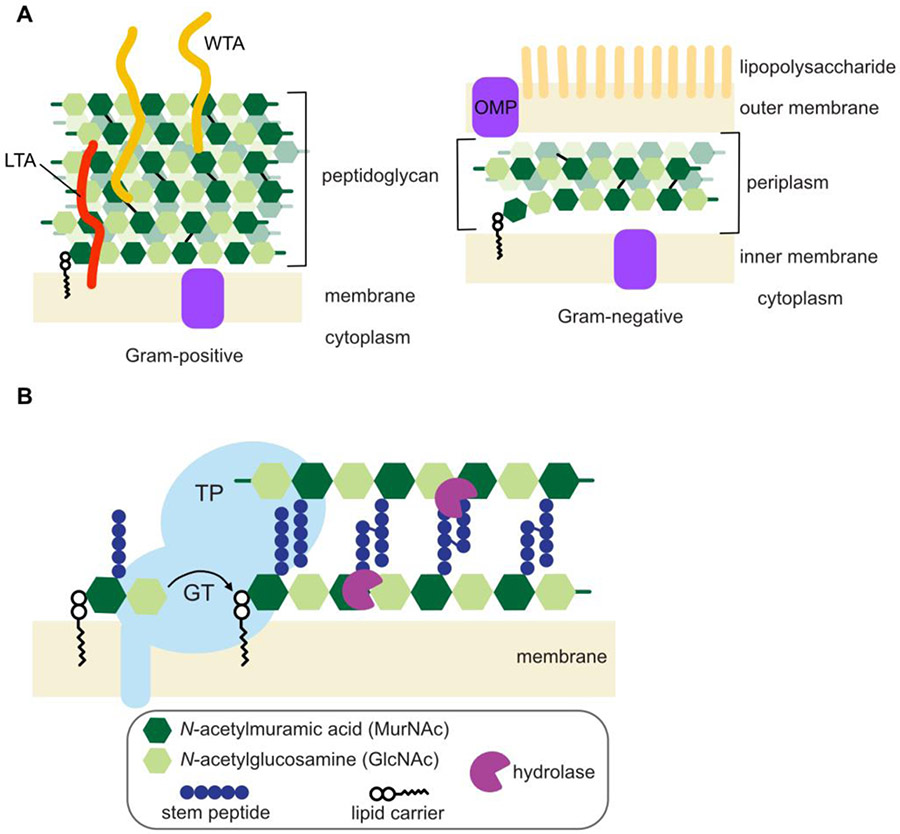
Figure 1:
Figure 1:. The cell envelope, including the peptidoglycan cell wall, is a complex structure that protects bacteria from the surrounding environment.
A) Gram-positive bacteria have a single membrane surrounded by a thick layer of peptidoglycan (PG). Wall teichoic acids (WTAs) are attached covalently to PG, while lipoteichoic acids (LTAs) are anchored in the membrane. Gram-negative organisms have two membranes that sandwich a thin layer of peptidoglycan in the periplasm. The outer membrane (OM) contains outer membrane proteins (OMPs), as well as lipopolysaccharide on its outer leaflet. B) PG is synthesized by glycosyltransferases (GTs) that polymerize Lipid II and transpeptidases (TPs) that enact crosslinking. Hydrolases, including lysins, cleave PG at diverse positions.
Figure 2:
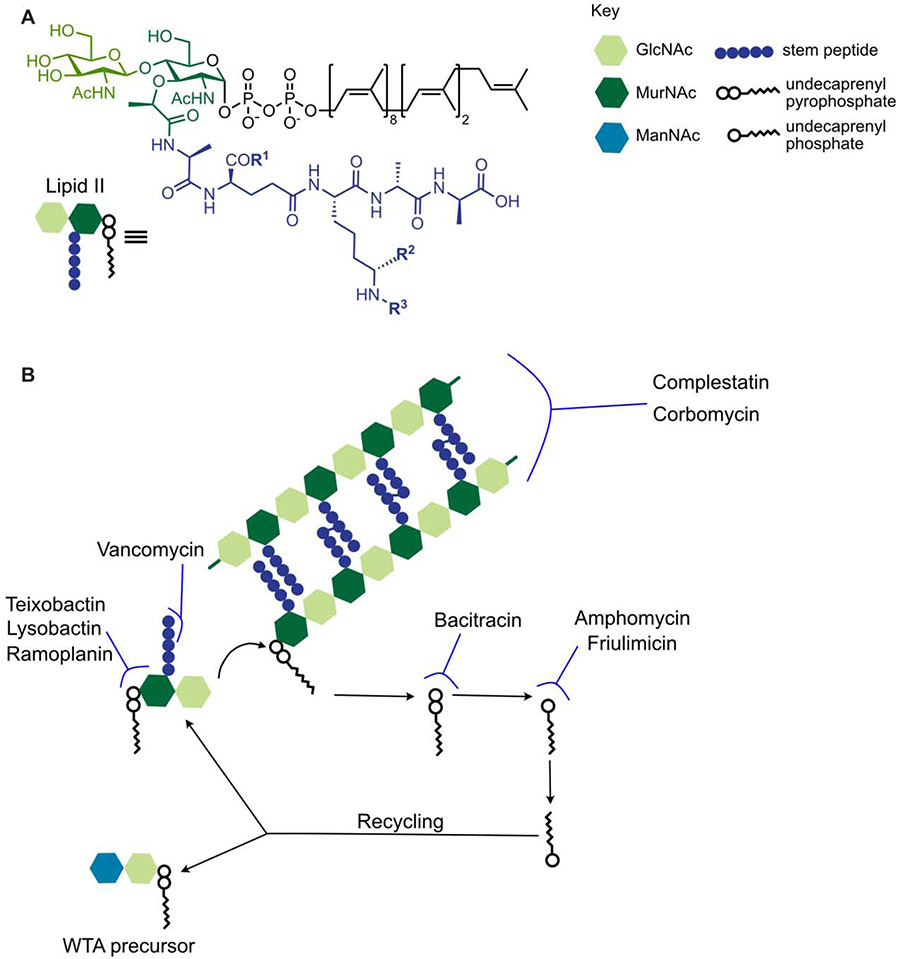
Figure 2:. Substrate-binding antibiotics recognize various features of Lipid II, inhibiting different stages of peptidoglycan synthesis and lipid recycling.
A) The chemical structure of Lipid II. R1, R2, and R3 vary by species. In S. aureus, for example, R1 = NH2, R2 = H, and R3 = Gly5. B) When a Lipid II monomer is added to the existing PG matrix, undecaprenyl pyrophosphate is released. It is metabolized to undecaprenyl phosphate, which then gets flipped across the membrane for recycling. This lipid carrier is used in both the PG monomer, Lipid II, and in WTA precursors. Teixobactin, ramoplanin, and lysobactin bind the hydrophilic head group of Lipid II, vancomycin binds the stem peptide, and corbomycin and complestatin are proposed to bind formed PG. Bacitracin inhibits the metabolism of undecaprenyl pyrophosphate to undecaprenyl phosphate, preventing recycling of this lipid carrier, while amphomycin and friulimicin bind undecaprenyl phosphate.
Figure 3:
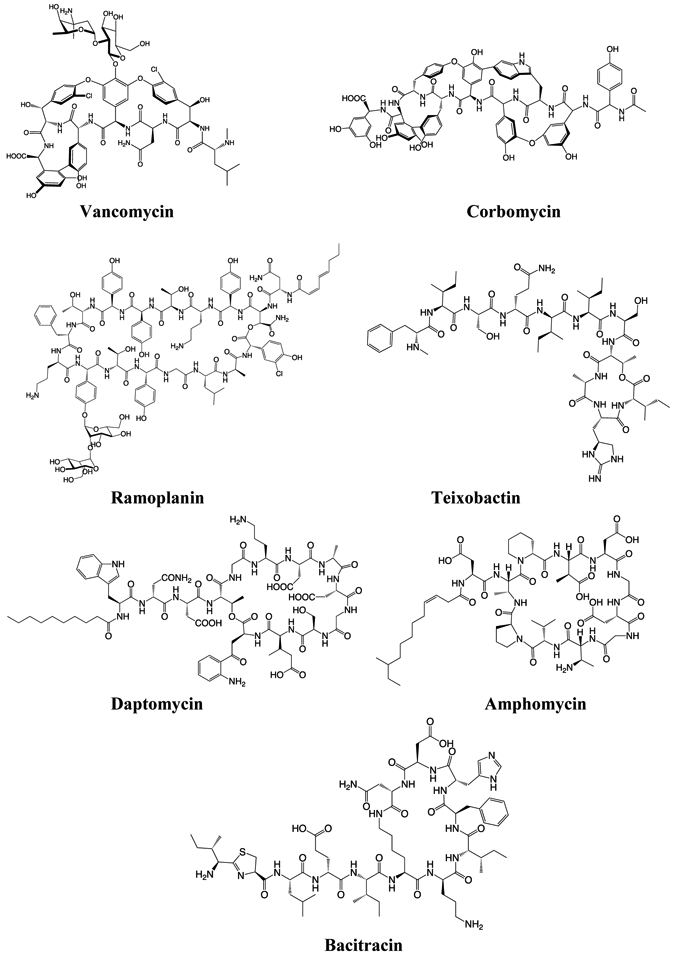
Figure 3:. Structures of natural products that bind to Lipid II or peptidoglycan.
Vancomycin, corbomycin, ramoplanin, daptomycin, and amphomycin are produced by Gram-positive Actinobacteria, which include Streptomyces. Teixobactin is produced by Gram-negative Proteobacteria. Bacitracin is produced by certain strains of the Firmicute Bacillus.
Figure 4:
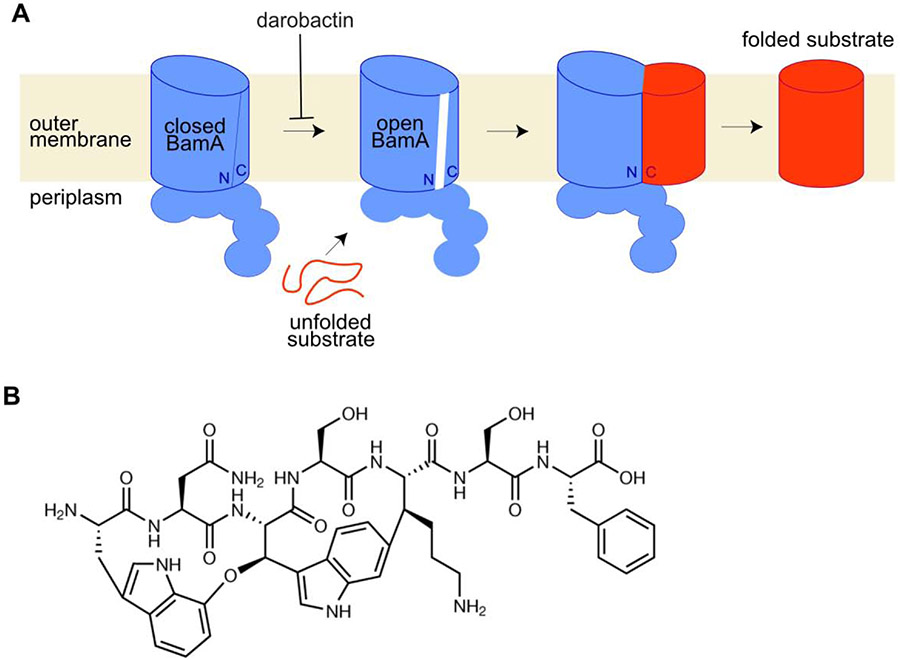
Figure 4:. BamA catalyzes folding and insertion of beta-barrel proteins into the OM and is a highly promising antibiotic target.
A) As part of the Bam complex, BamA folds ß-barrels for insertion into the outer membrane. A gate within BamA opens to engage the substrate, with the N-terminal side of the BamA ß-barrel forming hydrogen bonds with the C-terminus of the substrate. Darobactin is proposed to stabilize the closed conformation of BamA such that the substrate cannot be inserted into this gate. B) The structure of darobactin.

References

    1. Silhavy TJ, Kahne D, Walker S: The Bacterial Cell Envelope. Cold Spring Harb Perspect Biol 2010, 2. - PMC - PubMed
    1. Rajagopal M, Walker S: Envelope Structures of Gram-Positive Bacteria. Curr Top Microbiol Immunol 2017, 404:1–44. - PMC - PubMed
    1. Theuretzbacher U, Outterson K, Engel A, Karlén A: The global preclinical antibacterial pipeline. Nature Reviews Microbiology 2020, 18:275–285. - PMC - PubMed
    1. Levine DP: Vancomycin: A History. Clin Infect Dis 2006, 42:S5–S12. - PubMed
    1. Bugg TDH, Wright GD, Dutka-Malen S, Arthur M, Courvalin P, Walsh CT: Molecular basis for vancomycin resistance in Enterococcus faecium BM4147: biosynthesis of a depsipeptide peptidoglycan precursor by vancomycin resistance proteins VanH and VanA. Biochemistry 1991, 30:10408–10415. - PubMed

Publication types

MeSH terms