Review
. 2021 Mar 4;17(1):103.
doi: 10.1186/s12917-021-02805-0.

First-line management of canine status epilepticus at home and in hospital-opportunities and limitations of the various administration routes of benzodiazepines

Affiliations
Review

First-line management of canine status epilepticus at home and in hospital-opportunities and limitations of the various administration routes of benzodiazepines

Marios Charalambous et al. BMC Vet Res. .

Abstract

Status epilepticus (SE) or prolonged epileptic seizure activity is a common neurological emergency with a high mortality rate and, if left untreated, can lead to irreversible cerebral damage and systemic complications. Fast and effective first-line management is of paramount importance, particularly in the at-home management of seizures where drug administration routes are limited. Benzodiazepines (BZDs) have been exclusively used in veterinary medicine for decades as first-line drugs based on their high potency and rapid onset of action. Various administration routes exist in dogs, such as oral, intravenous, intramuscular, rectal, and intranasal, all with different advantages and limitations. Recently, intranasal drug delivery has become more popular due to its unique and favourable characteristics, providing potential advantages over other routes of drug administration in the management of canine SE. This narrative review provides an outline of the management of SE at home and in a hospital setting, discusses considerations and challenges of the various routes of BZD administration, and evaluates the impact of intranasal drug administration (nose-brain pathway) for controlling canine SE at home and within hospital settings.

Keywords: Administration routes; Diazepam; Dog; Emergency seizures; Epilepsy; Midazolam; Nasal.


Conflict of interest statement

HV is a member of the editorial board of the journal.

Figures
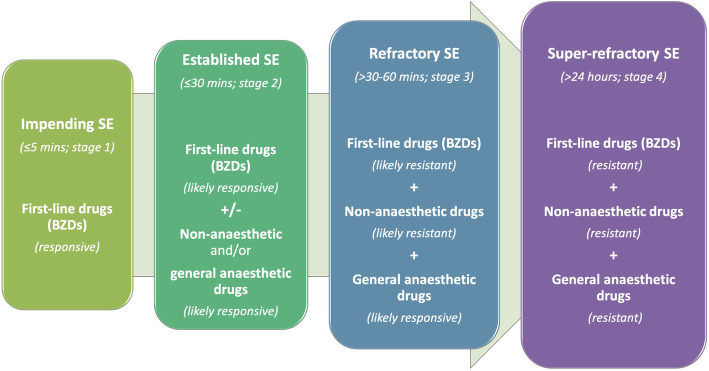
Fig. 1
Fig. 1
Stages of SE according to time and responsiveness to antiseizure medication. The more advanced the stage of SE is, the less responsive to antiseizure medication, and in particular first-line drugs (benzodiazepines), will be. Thus, in more advanced stages of SE, further antiseizure medication might be gradually added-on in order to control the epileptic seizures
Fig. 2
Fig. 2
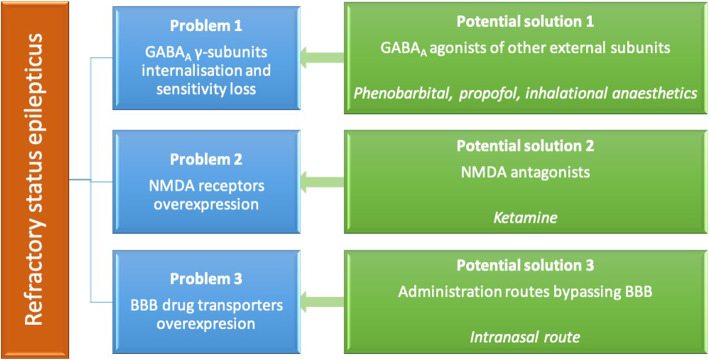
Summary of the main causes of pharmaco-resistance in refractory stages of SE and potential solutions to them
Fig. 3
Fig. 3
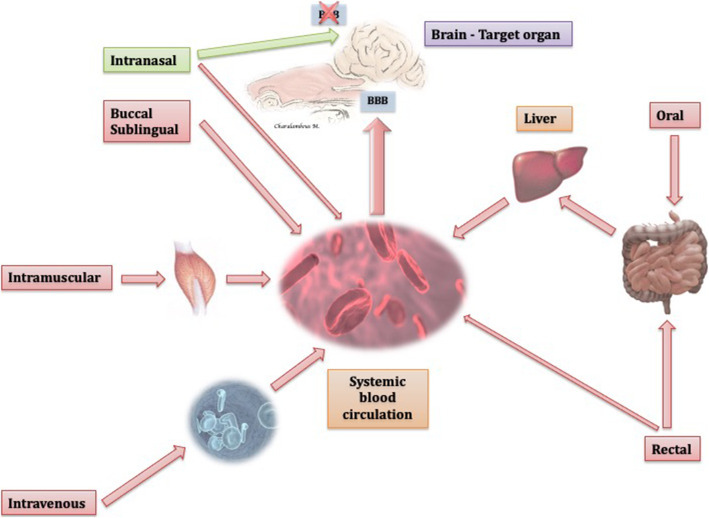
Schematic illustration of the different routes of drug administration’ pathways to the brain. The intranasal route is the only route that provides a direct pathway to the brain avoing the BBB (green arrow), along with an indirect pathway (red arrow). The remaining routes reach the brain indirectly (red arrows) via the systemic blood circulation passing via the BBB. Oral, in particular, and rectal route undergo first-pass hepatic metabolism, although rectally administered drugs could potentially avoid the first-pass metabolism, if they do not reach more cranial parts of the colon. Figures from authors’ personal record modified with microsoft power point
Fig. 4
Fig. 4
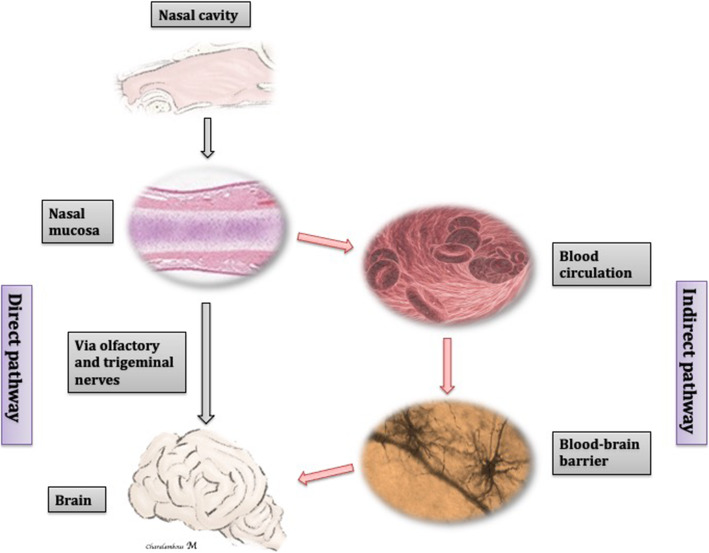
Schematic illustration of the indirect and direct (nose-brain) nasal drug delivery pathways. Drugs administered IN can penetrate directly into the brain through the olfactory and/or trigeminal nerve pathways or indirectly following absorption into the systemic blood circulation. Figures from authors’ personal record modified with microsoft power point
Fig. 5
Fig. 5
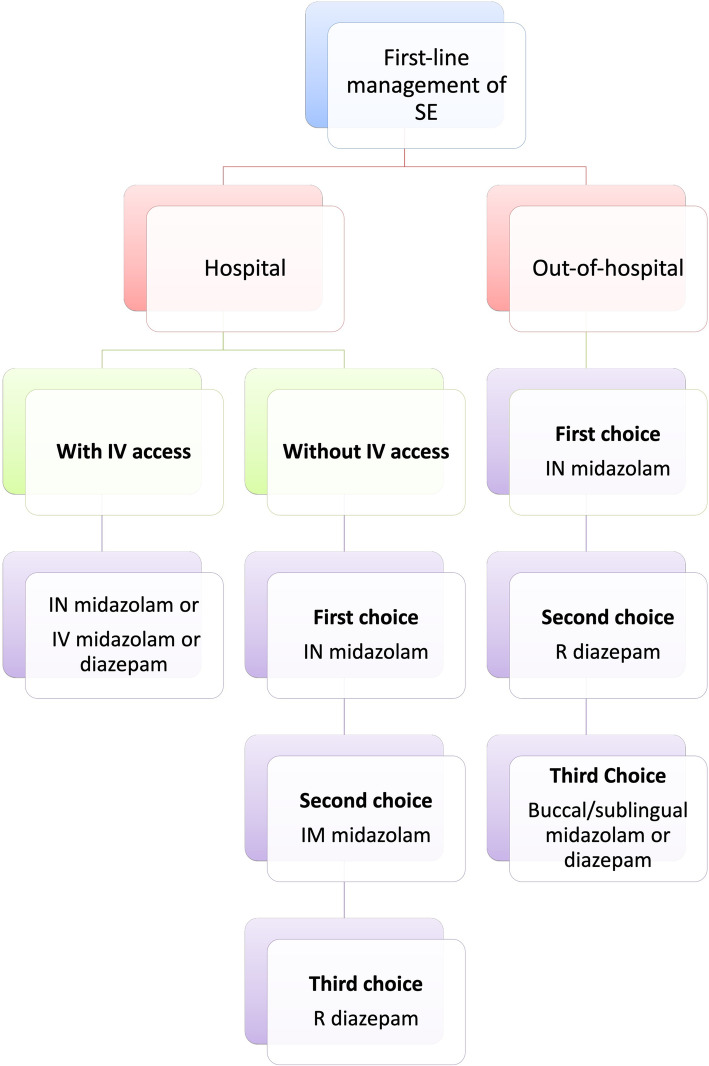
Cascade of choices for the first-line management of SE at home and in-hospital, with or without IV access

References

    1. Berendt M, Farquhar RG, Mandigers PJ, Pakozdy A, Bhatti SF, De Risio L, et al. International veterinary epilepsy task force consensus report on epilepsy definition, classification and terminology in companion animals. BMC Vet Res. 2015;11:182. doi: 10.1186/s12917-015-0461-2. - DOI - PMC - PubMed
    1. Trinka E, Brigo F, Shorvon S. Recent advances in status epilepticus. Curr Opin Neurol. 2016;29(2):189–198. doi: 10.1097/WCO.0000000000000307. - DOI - PubMed
    1. Walker M. Status epilepticus: an evidence based guide. BMJ. 2005;331(7518):673–677. doi: 10.1136/bmj.331.7518.673. - DOI - PMC - PubMed
    1. Lado FA, Moshe SL. How do seizures stop? Epilepsia. 2008;49(10):1651–1664. doi: 10.1111/j.1528-1167.2008.01669.x. - DOI - PMC - PubMed
    1. Blades Golubovic S, Rossmeisl JH., Jr Status epilepticus in dogs and cats, part 1: etiopathogenesis, epidemiology, and diagnosis. J Vet Emerg Crit Care (San Antonio) 2017;27(3):278–287. doi: 10.1111/vec.12605. - DOI - PubMed

MeSH terms

LinkOut - more resources