Review
. 2021 Mar 4;16(1):117.
doi: 10.1186/s13023-021-01758-9.

Standard of care versus new-wave corticosteroids in the treatment of Duchenne muscular dystrophy: Can we do better?

Affiliations
Review

Standard of care versus new-wave corticosteroids in the treatment of Duchenne muscular dystrophy: Can we do better?

Stephanie Kourakis et al. Orphanet J Rare Dis. .

Abstract

Background: Pharmacological corticosteroid therapy is the standard of care in Duchenne Muscular Dystrophy (DMD) that aims to control symptoms and slow disease progression through potent anti-inflammatory action. However, a major concern is the significant adverse effects associated with long term-use. MAIN: This review discusses the pros and cons of standard of care treatment for DMD and compares it to novel data generated with the new-wave dissociative corticosteroid, vamorolone. The current status of experimental anti-inflammatory pharmaceuticals is also reviewed, with insights regarding alternative drugs that could provide therapeutic advantage.

Conclusions: Although novel dissociative steroids may be superior substitutes to corticosteroids, other potential therapeutics should be explored. Repurposing or developing novel pharmacological therapies capable of addressing the many pathogenic features of DMD in addition to anti-inflammation could elicit greater therapeutic advantages.

Keywords: Anti-inflammation; Anti-inflammatory drugs; Corticosteroids; Duchenne muscular dystrophy; Standard of care.


Conflict of interest statement

E.R. and N.G. are consultants to Santhera Pharmaceuticals. E.R. is a consultant to Epirium Bio. D.F. is a principal investigator for studies on spinal muscular atrophy sponsored by Hofmann-La Roche Ltd. The other authors have no interests to declare.

Figures
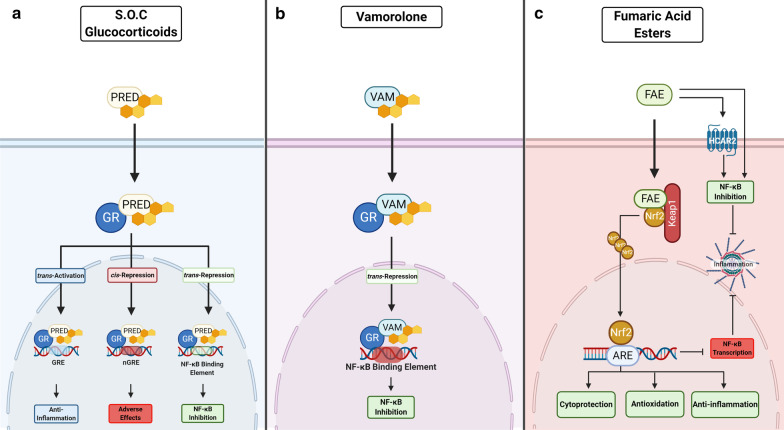
Fig. 1
Fig. 1
Comparing the mechanisms of action of standard of care (S.O.C) glucocorticoids (i.e., prednisone and deflazacort) with novel dissociative steroid vamorolone and fumaric acid esters (FAE). a Glucocorticoids like prednisone (PRED), diffuse through the cell membrane, bind to the cytoplasmic nuclear hormone receptor (glucocorticoid receptor (GR)) to form a receptor-ligand complex, which translocates to the nucleus. This complex indirectly binds to the glucocorticoid response element (GRE), activating target genes that are associated with broad spectrum anti-inflammation (trans-activation), as well as the nuclear factor kappa B (NF-κB) binding element to supress transcription of master inflammatory regulator, NF-κB (trans-repression). These mechanisms elicit the beneficial effects of glucocorticoids in DMD. In contrast, adverse effects are mediated through direct binding of the GR-ligand complex to negative GRE on other target genes, which represses their transcription (cis-repression). b Similarly, vamorolone binds to the GR and retains the anti-inflammatory effects characteristic of standard of care glucocorticoids, inducing transrepression with hardly any transactivation or cis-repression to elicit fewer adverse effects. c Therapeutic efficacy of FAEs is mediated through the dual activation of the nuclear factor erythroid 2-related factor 2 (Nrf2) transcriptional pathway and hydroxycarboxylic acid receptor 2 (HCAR2). Nrf2 regulates the essential cellular defence system when electrophiles/FAE bind and disrupt the interaction between Nrf2 and its negative repressor (Kelch-like ECH-associated protein 1 (Keap1)). This disruption allows Nrf2 to translocate to the nucleus, bind to the antioxidant response element (ARE) resulting in cytoprotection. Nrf2 and HCAR2 both strongly inhibit NF-κB signalling within the cellular inflammatory response. Created with BioRender.com

References

    1. Nowak KJ, Davies KE. Duchenne muscular dystrophy and dystrophin: pathogenesis and opportunities for treatment. EMBO Rep. 2004;5:872–876. doi: 10.1038/sj.embor.7400221. - DOI - PMC - PubMed
    1. Nicolas A, Lucchetti-Miganeh C, Yaou RB, Kaplan J-C, Chelly J, Leturcq F, Barloy-Hubler F, Le Rumeur E. Assessment of the structural and functional impact of in-frame mutations of the DMD gene, using the tools included in the eDystrophin online database. Orphanet J Rare Dis. 2012;7:45. doi: 10.1186/1750-1172-7-45. - DOI - PMC - PubMed
    1. Aartsma-Rus A, Ginjaar IB, Bushby K. The importance of genetic diagnosis for Duchenne muscular dystrophy. J Med Genet. 2016;53:145–151. doi: 10.1136/jmedgenet-2015-103387. - DOI - PMC - PubMed
    1. Walter MC, Reilich P. Recent developments in Duchenne muscular dystrophy: facts and numbers. J Cachexia Sarcopenia Muscle. 2017;8:681–685. doi: 10.1002/jcsm.12245. - DOI - PMC - PubMed
    1. Ryder S, Leadley RM, Armstrong N, Westwood M, de Kock S, Butt T, Jain M, Kleijnen J. The burden, epidemiology, costs and treatment for Duchenne muscular dystrophy: an evidence review. Orphanet J Rare Dis. 2017;12:79. doi: 10.1186/s13023-017-0631-3. - DOI - PMC - PubMed

MeSH terms

LinkOut - more resources
