


Social Media and Health Care, Part I: Literature Review of Social Media Use by Health Care Providers
- PMID: 33664014
- PMCID: PMC8056296
- DOI: 10.2196/23205
Social Media and Health Care, Part I: Literature Review of Social Media Use by Health Care Providers
Abstract
Background: As the world continues to advance technologically, social media (SM) is becoming an essential part of billions of people's lives worldwide and is affecting almost every industry imaginable. As the world is becoming more digitally oriented, the health care industry is increasingly visualizing SM as an important channel for health care promotion, employment, recruiting new patients, marketing for health care providers (HCPs), building a better brand name, etc. HCPs are bound to ethical principles toward their colleagues, patients, and the public in the digital world as much as in the real world.
Objective: This review aims to shed light on SM use worldwide and to discuss how it has been used as an essential tool in the health care industry from the perspective of HCPs.
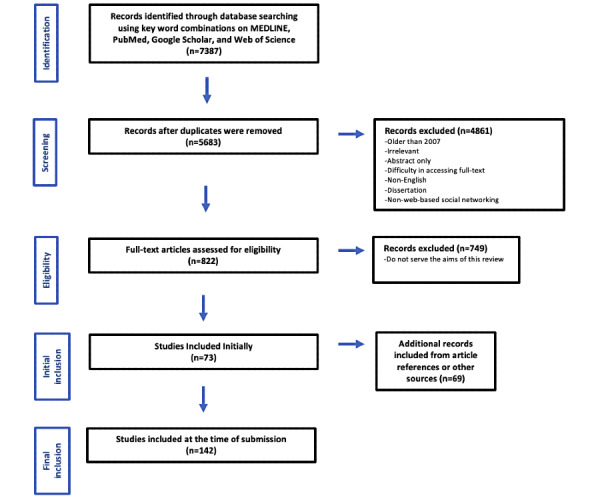
Methods: A literature review was conducted between March and April 2020 using MEDLINE, PubMed, Google Scholar, and Web of Science for all English-language medical studies that were published since 2007 and discussed SM use in any form for health care. Studies that were not in English, whose full text was not accessible, or that investigated patients' perspectives were excluded from this part, as were reviews pertaining to ethical and legal considerations in SM use.
Results: The initial search yielded 83 studies. More studies were included from article references, and a total of 158 studies were reviewed. SM uses were best categorized as health promotion, career development or practice promotion, recruitment, professional networking or destressing, medical education, telemedicine, scientific research, influencing health behavior, and public health care issues.
Conclusions: Multidimensional health care, including the pairing of health care with SM and other forms of communication, has been shown to be very successful. Striking the right balance between digital and traditional health care is important.
Keywords: COVID-19; health care; internet; medical education; mobile phone; research activity; social media; social networking; telemedicine.
©Deema Farsi. Originally published in the Journal of Medical Internet Research (http://www.jmir.org), 05.04.2021.
Conflict of interest statement
Conflicts of Interest: None declared.
Figures
References
-
- Kaplan AM, Haenlein M. Users of the world, unite! The challenges and opportunities of Social Media. Business Horizons. 2010 Jan;53(1):59–68. doi: 10.1016/j.bushor.2009.09.003. - DOI
-
- Ventola CL. Social media and health care professionals: benefits, risks, and best practices. P T. 2014 Jul;39(7):491–520. http://europepmc.org/abstract/MED/25083128 - PMC - PubMed
-
- Dictionary M. Merriam-Webster. Social Media. https://www.merriam-webster.com/dictionary/social%20media.
Publication types
MeSH terms
LinkOut - more resources
Full Text Sources
Medical
Research Materials
Miscellaneous
