. 2021 Mar 4;11(1):5114.
doi: 10.1038/s41598-021-84505-1.

Paracetamol modulates biofilm formation in Staphylococcus aureus clonal complex 8 strains

Affiliations

Paracetamol modulates biofilm formation in Staphylococcus aureus clonal complex 8 strains

Andi R Sultan et al. Sci Rep. .

Abstract

Staphylococcus aureus biofilms are a major problem in modern healthcare due to their resistance to immune system defenses and antibiotic treatments. Certain analgesic agents are able to modulate S. aureus biofilm formation, but currently no evidence exists if paracetamol, often combined with antibiotic treatment, also has this effect. Therefore, we aimed to investigate if paracetamol can modulate S. aureus biofilm formation. Considering that certain regulatory pathways for biofilm formation and virulence factor production by S. aureus are linked, we further investigated the effect of paracetamol on immune modulator production. The in vitro biofilm mass of 21 S. aureus strains from 9 genetic backgrounds was measured in the presence of paracetamol. Based on biofilm mass quantity, we further investigated paracetamol-induced biofilm alterations using a bacterial viability assay combined with N-Acetylglucosamine staining. Isothermal microcalorimetry was used to monitor the effect of paracetamol on bacterial metabolism within biofilms and green fluorescent protein (GFP) promoter fusion technology for transcription of staphylococcal complement inhibitor (SCIN). Clinically relevant concentrations of paracetamol enhanced biofilm formation particularly among strains belonging to clonal complex 8 (CC8), but had minimal effect on S. aureus planktonic growth. The increase of biofilm mass can be attributed to the marked increase of N-Acetylglucosamine containing components of the extracellular matrix, presumably polysaccharide intercellular adhesion. Biofilms of RN6390A (CC8) showed a significant increase in the immune modulator SCIN transcription during co-incubation with low concentrations of paracetamol. Our data indicate that paracetamol can enhance biofilm formation. The clinical relevance needs to be further investigated.


Conflict of interest statement

The authors declare no competing interests.

Figures

Figure 1
Figure 1
Broth microdilution assays with paracetamol. Broth microdilution susceptibility tests were performed on all study strains. (A) Strains with genetic backgrounds of CC1, CC5, CC15, CC20, CC30 and CC45. (B) Strains with genetic backgrounds of CC45, CC72, CC223 and CC8. The results are depicted as the percentage of paracetamol treated S. aureus MICs relative to its control (untreated). The red horizontal line represents the control. The black box outlines CC8 strains. Each black circle represents one experiment. Data points are presented with SEM of all three separate experiments performed for each dilution.
Figure 2
Figure 2
Staphylococcus aureus biofilm mass changes in response to various concentrations of paracetamol. Paracetamol stimulates and reduces biofilm formation at clinical doses in strains with different genetic backgrounds, most notably those belonging to CC8 including ST239. Biofilms were grown and co-incubated with 0.5 (A), 1 (B), 2 (C), 4 (D), 8 (E), 16 (F), and 32 (G) μg/mL of paracetamol. Red boxes outline the biofilm mass increase of CC8 strains above control mass. Data from at least three separate experiments are presented as aligned dot plots with a blue line indicating the mean value.
Figure 3
Figure 3
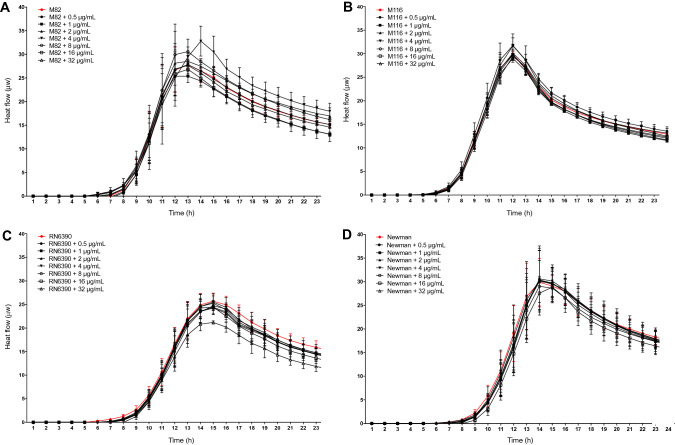
The metabolic rate of biofilms in the presence of different dosages of paracetamol. Metabolic heat flow generated during overnight biofilm formation at 37 °C and co-incubation without (red line) or with 0.5–32 µg/mL paracetamol of S. aureus CC20 strain M82 (A) and CC8 strains; M116 (B), RN6390 (C), and Newman (D) were monitored with isothermal microcalorimetry in real-time. Data from three separate experiments are presented as mean value and SEM.
Figure 4
Figure 4
The effect of paracetamol on staphylococcal biofilm matrix composition. Biofilms of S. aureus strain M116 (CC8, ST239) were grown at 37 °C without (A,C,E) and with (B,D,F) paracetamol (2 μg/ml). Fluorescent images of stained biofilms were captured using inverted light fluorescence microscopy (A,B) and confocal laser scanning (CF) microscopy with corresponding three-dimensional volume rendering (E,F) acquired using a Nikon A1R + microscope with NIS-Elements Advanced Research software (Version 4.50; Nikon Instruments). For all images, green fluorescence (SYTO 9 stained) are live bacteria, red fluorescence (PI stained) are dead bacteria and/or eDNA, and blue fluorescence (WGA stained) are N-Acetylglucosamine. All images are representative of three separate experiments.
Figure 5
Figure 5
Transcription of the SCIN promoter following paracetamol incubation. Transcription of the SCIN gene promoter—GFP (scn-GFP +) in strain RN6390 (CC8) was monitored during overnight incubation at 37 °C without and with 0.5 (A), 1 (B), 2 (C) or 4 (D) μg/mL of paracetamol. A single asterisk (p < 0.05) and two asterisks (p < 0.01) represent a statistically significant difference between without and with paracetamol treatment. Data from three separate experiments are presented as mean value and SEM.

References

    1. Archer NK, et al. Staphylococcus aureus biofilms: Properties, regulation, and roles in human disease. Virulence. 2011;2:445–459. doi: 10.4161/viru.2.5.17724. - DOI - PMC - PubMed
    1. Yarwood JM, Schlievert PM. Quorum sensing in Staphylococcus infections. J. Clin. Invest. 2003;112:1620–1625. doi: 10.1172/JCI200320442. - DOI - PMC - PubMed
    1. Luther MK, et al. Clinical and genetic risk factors for biofilm-forming Staphylococcus aureus. Antimicrob. Agents Chemother. 2018;62:17. doi: 10.1128/AAC.02252-17. - DOI - PMC - PubMed
    1. Barsoumian AE, et al. Clinical infectious outcomes associated with biofilm-related bacterial infections: A retrospective chart review. BMC Infect. Dis. 2015;15:223. doi: 10.1186/s12879-015-0972-2. - DOI - PMC - PubMed
    1. Tong SY, Davis JS, Eichenberger E, Holland TL, Fowler VG., Jr Staphylococcus aureus infections: Epidemiology, pathophysiology, clinical manifestations, and management. Clin. Microbiol. Rev. 2015;28:603–661. doi: 10.1128/CMR.00134-14. - DOI - PMC - PubMed

Publication types

MeSH terms