. 2021 Mar 4;11(1):5236.
doi: 10.1038/s41598-021-84670-3.

High resolution biologging of breaching by the world's second largest shark species

Affiliations

High resolution biologging of breaching by the world's second largest shark species

Jessica L Rudd et al. Sci Rep. .

Abstract

Basking sharks, the world's second largest fish, are endangered globally following two centuries of large-scale exploitation for their oily livers. In the northeast Atlantic, they seasonally gather in key sites, including the western Scottish Isles, where they feed on plankton, but their breeding grounds are currently completely unknown. Using high-resolution three-axis accelerometry and depth logging, we present the first direct records of breaching by basking sharks over 41 days. We show that basking sharks breach both during the night and day, starting at approximately 20 m depth and can breach multiple times in short succession. We also present early evidence of potential lateralisation in basking sharks. Given the energetic nature of breaching, it should have an important biological function, but this remains unclear.


Conflict of interest statement

The authors declare no competing interests.

Figures
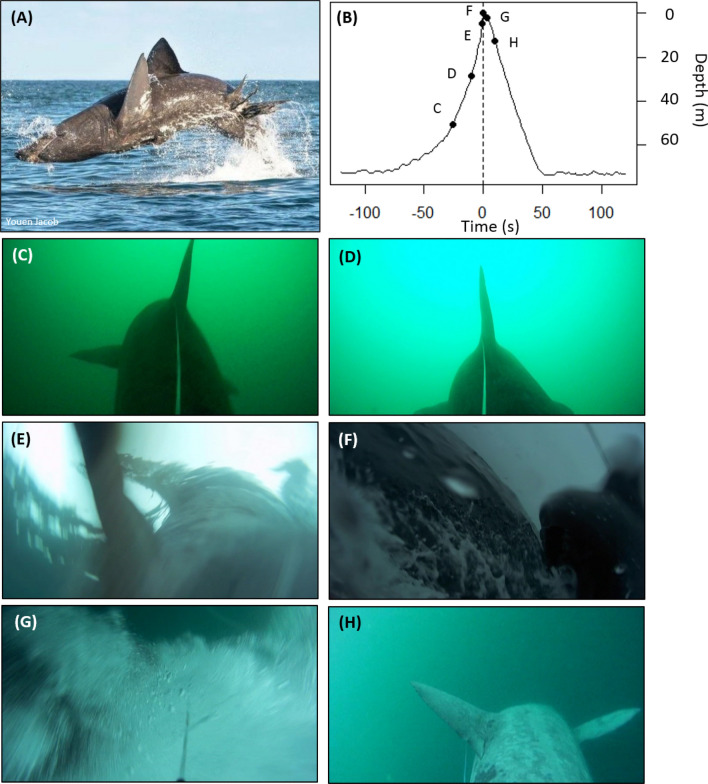
Figure 1
Figure 1
Basking shark breaching. Breaching recorded by a towed camera tag deployed in 2018. These data are from a shark that was not instrumented with an accelerometer, they are included to aid visualisation of the breaching process from a point-of-view perspective. For sharks instrumented with accelerometers in 2017, tags where attached flush to the surface of the animal at the base of the dorsal fin. (A) Basking shark breaching (photo: Youen Jacob). The timing and depth associated with each image (CH) are identified on the breaching depth profile (B). (C,D) the shark starts to ascend from 72 m depth at 0.94 m of vertical gain per second, reaching the surface (in view, E) in 77 s. The shark can be seen completely out of the water (F), before descending (G,H) to depth again.
Figure 2
Figure 2
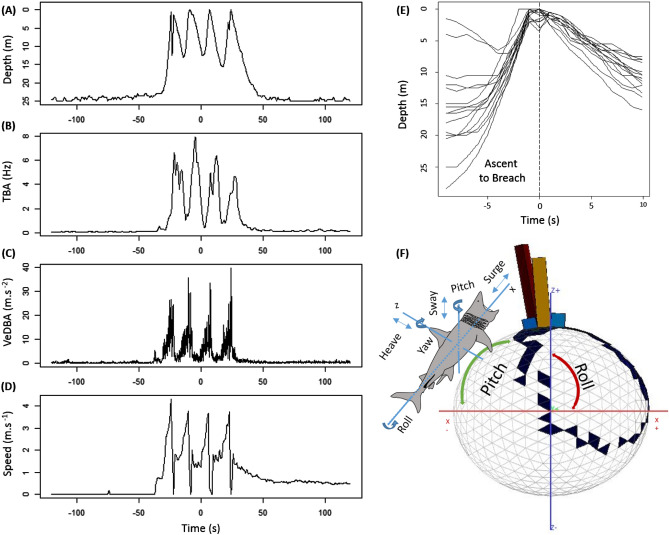
Characteristics of breaching. (AD) A quadruple breach by a six-metre basking shark over 47 s showing changes in depth (A), tail beat amplitude (B), VeDBA (C) and speed (D) over the series of breaches. (E) Depth profiles of 16 single breaching events performed by a single shark, with time (in seconds) centred on the breach, overlaid on a common timescale showing repeatability of ascent angle and subsequent descent after breaching. (F) Dubai plot showing tri-axial acceleration data as a 3-dimensional histogram, with time spent by sharks in a particular posture on each facet of the sphere extruded as triangular bars, and colour scaling with the cumulative time in a given facet. Data show a right-handed breach of a single shark, where rapid rolling is indicated by short dark blue bars on the right face of the sphere.

References

    1. Cooke SJ, et al. Remote bioenergetics measurements in wild fish: opportunities and challenges. Comp. Biochem. Physiol. Part A Mol. Integr. Physiol. 2016;202:23–37. doi: 10.1016/j.cbpa.2016.03.022. - DOI - PubMed
    1. Hussey NE, et al. Aquatic animal telemetry: a panoramic window into the underwater world. Science. 2015;348:1255642. doi: 10.1126/science.1255642. - DOI - PubMed
    1. Sims DW. Sieving a living: a review of the biology, ecology and conservation status of the plankton-feeding basking shark Cetorhinus maximus. Adv. Mar. Biol. 2008;54:171–220. doi: 10.1016/S0065-2881(08)00003-5. - DOI - PubMed
    1. Doherty PD, et al. Testing the boundaries: seasonal residency and inter-annual site fidelity of basking sharks in a proposed Marine Protected Area. Biol. Conserv. 2017;209:68–75. doi: 10.1016/j.biocon.2017.01.018. - DOI
    1. Dolton HR, et al. Assessing the importance of Isle of Man waters for the basking shark Cetorhinus maximus. Endanger. Species Res. 2020;41:209–223. doi: 10.3354/esr01018. - DOI

Publication types

LinkOut - more resources