


Responsiveness to bepridil predicts atrial substrate in patients with persistent atrial fibrillation
- PMID: 33664889
- PMCID: PMC7896463
- DOI: 10.1002/joa3.12492
Responsiveness to bepridil predicts atrial substrate in patients with persistent atrial fibrillation
Abstract
Background: The low voltage zone (LVZ) detected with three-dimensional electroanatomical mapping is a surrogate marker of atrial scar in patients with persistent atrial fibrillation (PeAF) and is associated with poor clinical outcomes after catheter ablation. However, fewer studies have reported the relationship between responsiveness to antiarrhythmic drugs and the LVZ.
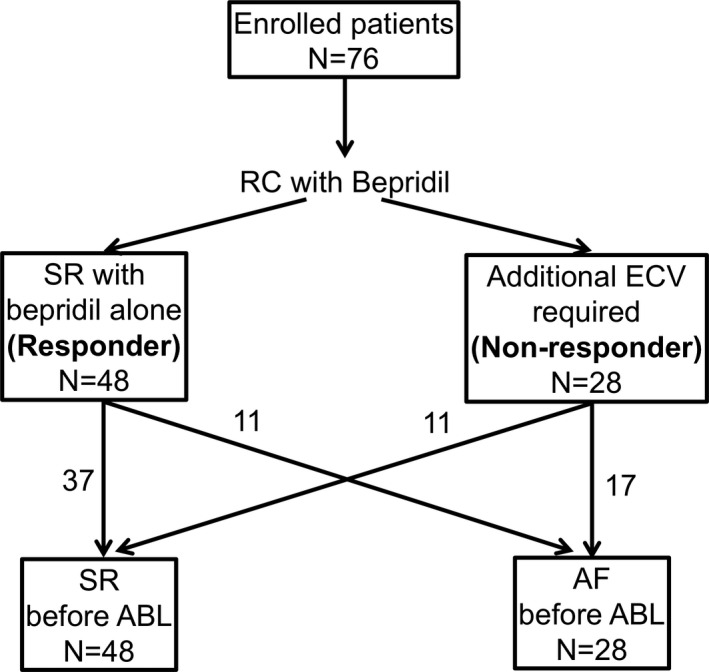
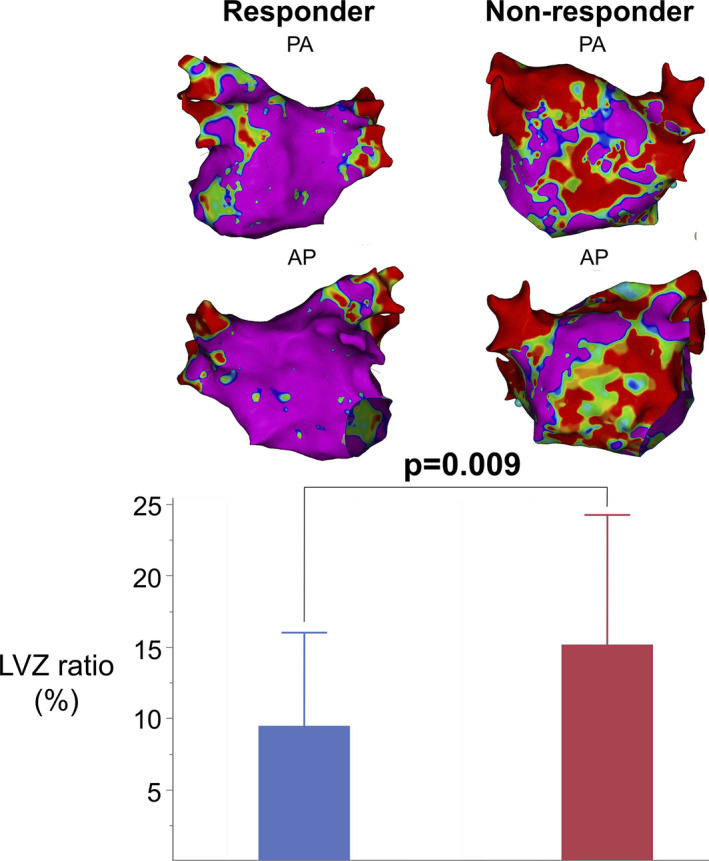
Methods: We retrospectively analyzed 76 patients who underwent catheter ablation for PeAF at our center. Rhythm control with bepridil was initiated before ablation in all patients, and electrical cardioversion was performed in cases of failure to restore sinus rhythm with bepridil alone. Patients with successful sinus restoration with bepridil alone (≤200 mg/d) were defined as "responders", while those who required electrical cardioversion as well were defined as "non-responders". We compared the LVZ ratio (ratio of the LVZ surface area to the left atrium surface area on three-dimensional electroanatomical mapping) and the recurrence-free rate after ablation between the two groups.
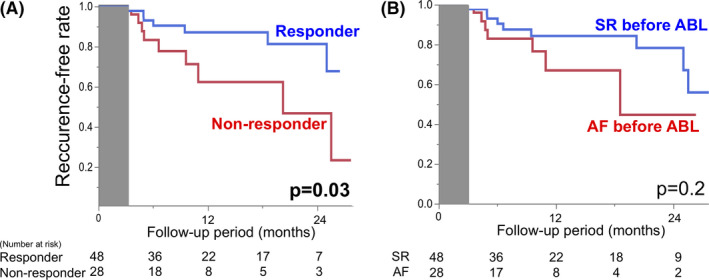
Results: Of the 76 patients, 48 (63.2%) were responders to bepridil. The median LVZ ratio was significantly lower in the responder group than in the nonresponder group (7.5% vs 14.0%, P = .009). Multivariate analysis revealed that response to bepridil was an independent predictor of normal voltage (P = .02, odds ratio = 0.20, 95% confidence interval = 0.04-0.76). The recurrence-free rate at 1 year after catheter ablation was significantly higher in the responder group than in the nonresponder group (87.1% vs 62.3%, P = .03).
Conclusions: Response to bepridil is a marker of normal voltage in electroanatomical mapping and is significantly associated with better clinical outcomes after catheter ablation.
Keywords: atrial fibrillation; atrial remodeling; bepridil hydrochloride; catheter ablation; low voltage zone.
© 2021 The Authors. Journal of Arrhythmia published by John Wiley & Sons Australia, Ltd on behalf of the Japanese Heart Rhythm Society.
Conflict of interest statement
The authors declare no conflicts of interests for this article. The protocol for this study was approved by the Ethics Committee of our center on 22 April 2020 (Approval number: 20C009).
Figures
References
-
- Wijffels MC, Kirchhof CJ, Dorland R, Allessie MA. Atrial fibrillation begets atrial fibrillation. A study in awake chronically instrumented goats. Circulation. 1995;92:1954–68. - PubMed
-
- Nattel S, Burstein B, Dobrev D. Atrial remodeling and atrial fibrillation: mechanisms and implications. Circ Arrhythm Electrophysiol. 2008;1:62–73. - PubMed
-
- Nattel S, Dobrev D. The multidimensional role of calcium in atrial fibrillation pathophysiology: mechanistic insights and therapeutic opportunities. Eur Heart J. 2012;33:1870–7. - PubMed
-
- Marrouche NF, Wilber D, Hindricks G, Jais P, Akoum N, Marchlinski F, et al. Association of atrial tissue fibrosis identified by delayed enhancement MRI and atrial fibrillation catheter ablation: the DECAAF study. JAMA. 2014;311:498–506. - PubMed
-
- Rolf S, Kircher S, Arya A, Eitel C, Sommer P, Richter S, et al. Tailored atrial substrate modification based on low‐voltage areas in catheter ablation of atrial fibrillation. Circ Arrhythm Electrophysiol. 2014;7:825–33. - PubMed
LinkOut - more resources
Full Text Sources
Other Literature Sources
