


Knowledge, attitude and practice of physicians regarding periconceptional folic acid for women at low risk of a neural tube defect affected pregnancy
- PMID: 33665065
- PMCID: PMC7903458
- DOI: 10.1016/j.pmedr.2021.101327
Knowledge, attitude and practice of physicians regarding periconceptional folic acid for women at low risk of a neural tube defect affected pregnancy
Abstract
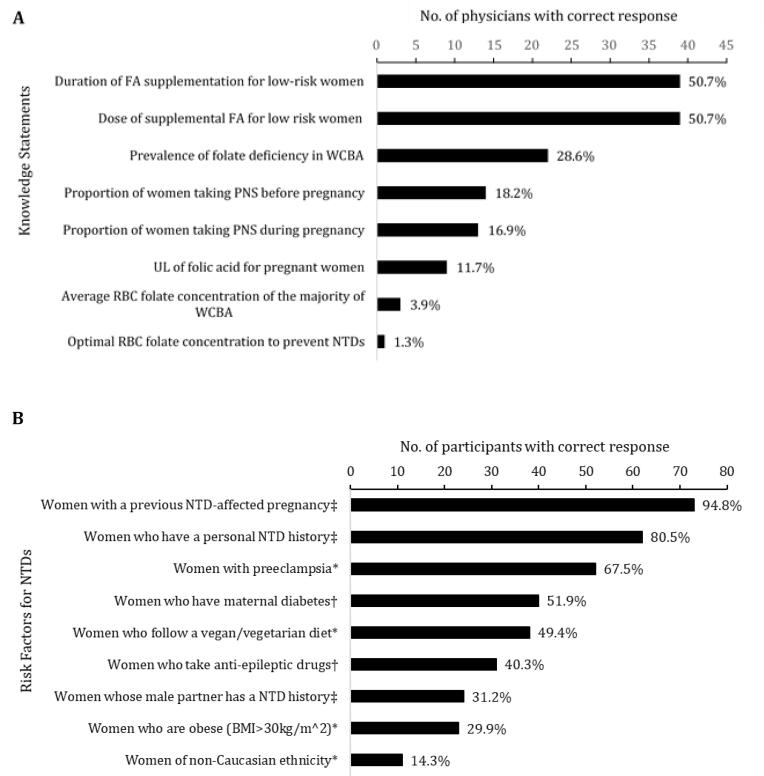
Canadian expert guidelines recommend low-risk women to consume a daily multivitamin supplement containing 400 µg of folic acid (FA) to prevent neural tube defects. Mandatory food fortification coupled with intake of prenatal vitamin/mineral supplements (PVS), most of which contain ≥ 1000 µg-FA, has resulted in an unprecedented shift in Canadian pregnant women folate status. This study assessed the knowledge, attitude and practice (KAP) of physicians regarding periconceptional FA recommendations, intake and health related outcomes, since they play an essential role in promoting appropriate FA intake. Seventy-seven physicians answered the self-administered KAP survey. Only half of physicians knew the correct dose and duration of FA for low-risk women. Approximately 70% were unsure of, or unfamiliar with the most recent guidelines and 60% of physicians most often recommend a ≥ 1000 µg-FA supplement. Knowledge score 1 (KS1), which related to low-risk women, was associated with physicians' attitude toward believing that most PVS contain the recommended amount of FA (p = 0.004). Significant correlations were also found between KS1 and the total practice score (TPS) (r = 0.45, p < 0.0001) as well as between the total knowledge score and TPS (r = 0.38, p = 0.0007). Our findings show that physicians lacking knowledge regarding periconceptional FA is associated with their attitude and practice. Despite a vast majority of physicians being unsure or uncomfortable recommending PVS that are not in line with recommendations, a lack of knowledge and a widely accessible 400 µg-FA PVS, enables a contradictory practice in reality.
Keywords: Attitude; Folic Acid; Guidelines; Knowledge; Periconception; Physicians; Practice; Pregnancy.
Crown Copyright © 2021 Published by Elsevier Inc.
Conflict of interest statement
The authors declare that they have no known competing financial interests or personal relationships that could have appeared to influence the work reported in this paper.
Figures
References
-
- Aggarwal A., Kumhar G.D., Harit D., Faridi M.M.A. Role of folic acid supplementation in prevention of neural tube defects: physicians yet unaware! J. Prevent. Med. 2010;51(3):131–132. - PubMed
-
- Amitai Y., Fisher N., Haringman M., Meiraz H., Baram N., Leventhal A. Increased awareness, knowledge and utilization of preconceptional folic acid in Israel following a national campaign. Prev. Med. 2004;39(4):731–737. - PubMed
-
- Bailey L.B., editor. Folate in health and disease. 2nd ed. Taylor & Francis; Boca Raton: 2010. p. 583 p..
LinkOut - more resources
Full Text Sources
Other Literature Sources
Research Materials
