


Multicenter randomized phase II study comparing docetaxel plus curcumin versus docetaxel plus placebo in first-line treatment of metastatic castration-resistant prostate cancer
- PMID: 33666378
- PMCID: PMC7982628
- DOI: 10.1002/cam4.3806
Multicenter randomized phase II study comparing docetaxel plus curcumin versus docetaxel plus placebo in first-line treatment of metastatic castration-resistant prostate cancer
Abstract
Background: Metastatic castration-resistant prostate cancer (mCRPC) patients have a poor prognosis, and curcumin is known to have antineoplastic properties. On the basis of previous phase I and phase II studies, we investigated whether the association of curcumin with docetaxel could improve prognosis among mCRPC patients.
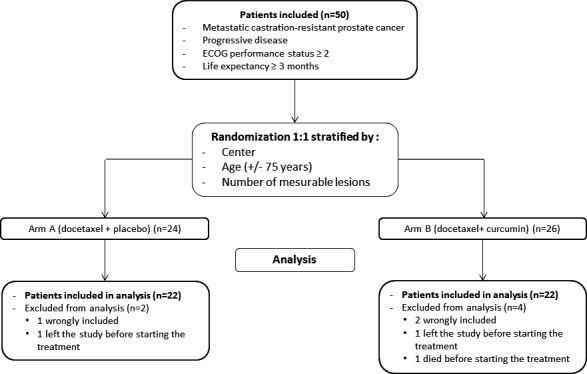
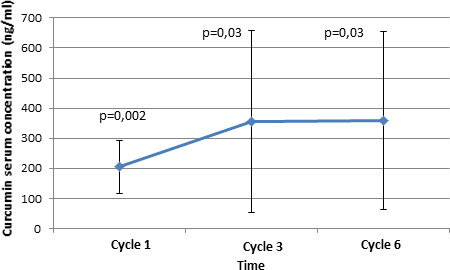
Methods: A total of 50 mCRPC patients (included from June 2014 to July 2016) treated with docetaxel in association with oral curcumin (6 g/d for 7 days every 3 weeks) versus placebo were included in this double-blind, randomized, phase II study. The primary endpoint was to evaluate the time to progression. Among the secondary endpoints, compliance, overall survival, prostate-specific antigen (PSA) response, safety, curcumin absorption, and quality of life were investigated. An interim analysis was planned in the modified intention-to-treat population with data at 6 months (22 patients per arm).
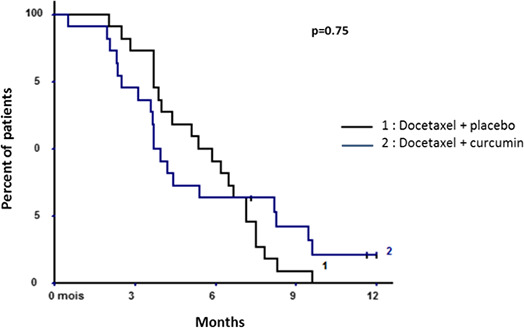
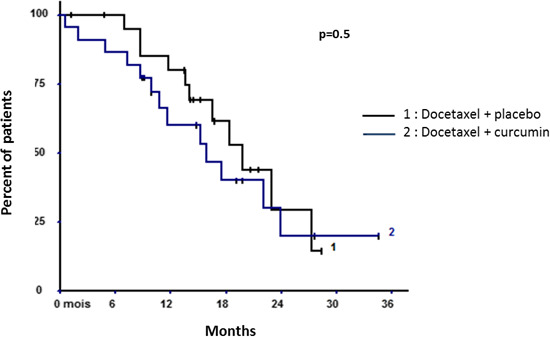
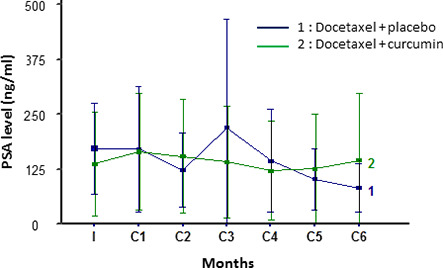
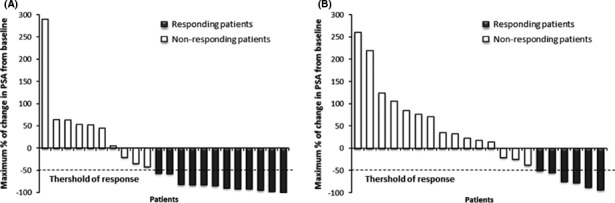
Results: Despite good compliance and a verified absorption of curcumin, no difference was shown for our primary endpoint: progression-free survival (PFS) between the placebo and curcumin groups was, respectively, 5.3 months versus 3.7 months, p = 0.75. Similarly, no difference was observed for the secondary objectives: PSA response rate (p = 0.88), overall survival (p = 0.50), and quality of life (p = 0.49 and p = 0.47).
Conclusion: Even though our previous studies and data in the literature seemed to support an association between curcumin and cancer therapies in order to improve patient outcome and prognosis, the results from this interim analysis clearly showed that adding curcumin to mCRPC patients' treatment strategies was not efficacious. The study was discontinued on the grounds of futility.
Keywords: chemotherapy; curcumin; docetaxel; metastatic castration-resistant prostate cancer; phase II; randomized trial.
© 2021 The Authors. Cancer Medicine published by John Wiley & Sons Ltd.
Figures
References
-
- Globocan . Cancer today. 2018. http://gco.iarc.fr/today/home Accessed 14 Aug 2019.
-
- Huggins C, Hodges CV. Studies on prostatic cancer: I. The effect of castration, of estrogen and of androgen injection on serum phosphatases in metastatic carcinoma of the prostate. 1941. J Urol. 2002;168:9‐12. - PubMed
-
- Tannock IF, de Wit R, Berry WR, et al. Docetaxel plus prednisone or mitoxantrone plus prednisone for advanced prostate cancer. N Engl J Med. 2004;351:1502‐1512. - PubMed
-
- Cornford P, Bellmunt J, Bolla M, et al. EAU‐ESTRO‐SIOG guidelines on prostate cancer. Part II: treatment of relapsing, metastatic, and castration‐resistant prostate cancer. Eur Urol. 2017;71:630‐642. - PubMed
-
- Fizazi K, Scher HI, Molina A, et al. Abiraterone acetate for treatment of metastatic castration‐resistant prostate cancer: final overall survival analysis of the COU‐AA‐301 randomised, double‐blind, placebo‐controlled phase 3 study. Lancet Oncol. 2012;13:983‐992. - PubMed
Publication types
MeSH terms
Substances
LinkOut - more resources
Full Text Sources
Other Literature Sources
Research Materials
Miscellaneous
