


Nature's Role in Supporting Health during the COVID-19 Pandemic: A Geospatial and Socioecological Study
- PMID: 33668228
- PMCID: PMC7967714
- DOI: 10.3390/ijerph18052227
Nature's Role in Supporting Health during the COVID-19 Pandemic: A Geospatial and Socioecological Study
Abstract
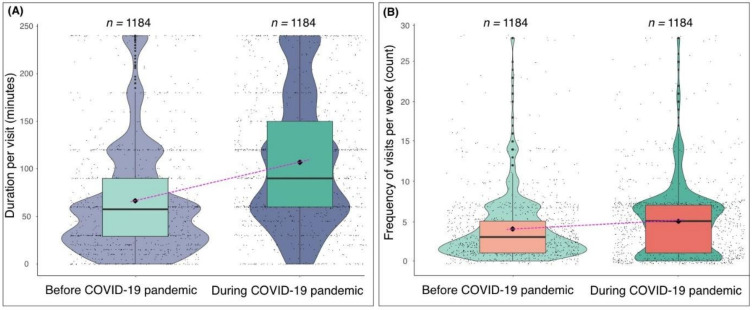
The COVID-19 pandemic has brought about unprecedented changes to human lifestyles across the world. The virus and associated social restriction measures have been linked to an increase in mental health conditions. A considerable body of evidence shows that spending time in and engaging with nature can improve human health and wellbeing. Our study explores nature's role in supporting health during the COVID-19 pandemic. We created web-based questionnaires with validated health instruments and conducted spatial analyses in a geographic information system (GIS). We collected data (n = 1184) on people's patterns of nature exposure, associated health and wellbeing responses, and potential socioecological drivers such as relative deprivation, access to greenspaces, and land-cover greenness. The majority of responses came from England, UK (n = 993). We applied a range of statistical analyses including bootstrap-resampled correlations and binomial regression models, adjusting for several potential confounding factors. We found that respondents significantly changed their patterns of visiting nature as a result of the COVID-19 pandemic. People spent more time in nature and visited nature more often during the pandemic. People generally visited nature for a health and wellbeing benefit and felt that nature helped them cope during the pandemic. Greater land-cover greenness within a 250 m radius around a respondent's postcode was important in predicting higher levels of mental wellbeing. There were significantly more food-growing allotments within 100 and 250 m around respondents with high mental wellbeing scores. The need for a mutually-advantageous relationship between humans and the wider biotic community has never been more important. We must conserve, restore and design nature-centric environments to maintain resilient societies and promote planetary health.
Keywords: COVID-19; coronavirus; green space; nature connectedness; nature-based interventions; planetary health; public health.
Conflict of interest statement
The authors declare no conflict of interest regarding this study. J.M.R. is affiliated with inVIVO Planetary Health and is an Assistant Guest Editor on this Special Issue.
Figures
References
-
- Venter Z., Barton D., Figari H., Nowell M. Urban nature in a time of crisis: Recreational use of green space in-creases during the COVID-19 outbreak in Oslo, Norway. Environ. Res. Let. 2020;15:104075. doi: 10.1088/1748-9326/abb396. - DOI
-
- Batlle-Bayer L., Aldaco R., Bala A., Puig R., Laso J., Margallo M., Vázquez-Rowe I., Antó J.M., Fullana-I-Palmer P. Environmental and nutritional impacts of dietary changes in Spain during the COVID-19 lockdown. Sci. Total. Environ. 2020;748:141410. doi: 10.1016/j.scitotenv.2020.141410. - DOI - PMC - PubMed
-
- Rossi R., Socci V., Talevi D., Mensi S., Niolu C., Pacitti F., Di Marco A., Rossi A., Siracusano A., Di Lorenzo G. COVID-19 Pandemic and Lockdown Measures Impact on Mental Health Among the General Population in Italy. Front. Psychiatry. 2020;11:790. doi: 10.3389/fpsyt.2020.00790. - DOI - PMC - PubMed
Publication types
MeSH terms
Grants and funding
LinkOut - more resources
Full Text Sources
Other Literature Sources
Medical
