Review
. 2021 Feb 24;10(3):337.
doi: 10.3390/antiox10030337.

Mitochondrial Dysfunction and Oxidative Stress Caused by Cryopreservation in Reproductive Cells

Affiliations
Review

Mitochondrial Dysfunction and Oxidative Stress Caused by Cryopreservation in Reproductive Cells

Roberto Gualtieri et al. Antioxidants (Basel). .

Abstract

Mitochondria, fundamental organelles in cell metabolism, and ATP synthesis are responsible for generating reactive oxygen species (ROS), calcium homeostasis, and cell death. Mitochondria produce most ROS, and when levels exceed the antioxidant defenses, oxidative stress (OS) is generated. These changes may eventually impair the electron transport chain, resulting in decreased ATP synthesis, increased ROS production, altered mitochondrial membrane permeability, and disruption of calcium homeostasis. Mitochondria play a key role in the gamete competence to facilitate normal embryo development. However, iatrogenic factors in assisted reproductive technologies (ART) may affect their functional competence, leading to an abnormal reproductive outcome. Cryopreservation, a fundamental technology in ART, may compromise mitochondrial function leading to elevated intracellular OS that decreases sperm and oocytes' competence and the dynamics of fertilization and embryo development. This article aims to review the role played by mitochondria and ROS in sperm and oocyte function and the close, biunivocal relationships between mitochondrial damage and ROS generation during cryopreservation of gametes and gonadal tissues in different species. Based on current literature, we propose tentative hypothesis of mechanisms involved in cryopreservation-associated mitochondrial dysfunction in gametes, and discuss the role played by antioxidants and other agents to retain the competence of cryopreserved reproductive cells and tissues.

Keywords: cryopreservation; gonadal tissue; mitochondria; oocyte; oxidative stress; sperm.


Conflict of interest statement

The authors declare no conflict of interest.

Figures
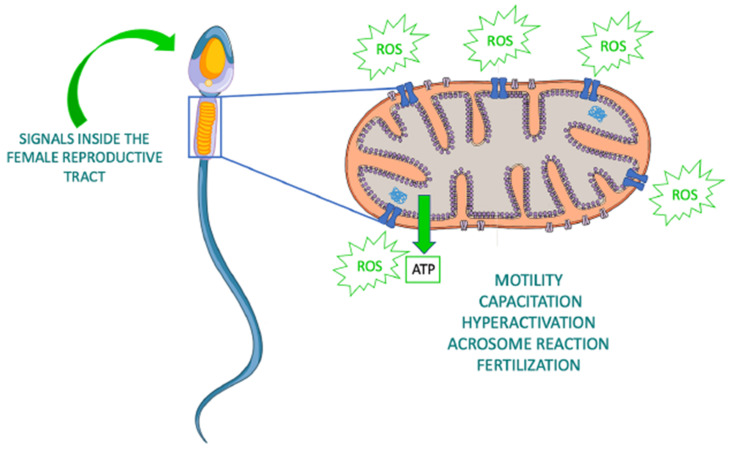
Figure 1
Figure 1
Roles of sperm mitochondria in health. Production of ATP and ROS by sperm mitochondria is involved in several sperm functions. Modified from https://www.vecteezy.com/vector-art/1434164-human-sperm-or-spermatozoa-cell-structure (accessed on 28 December 2020).
Figure 2
Figure 2
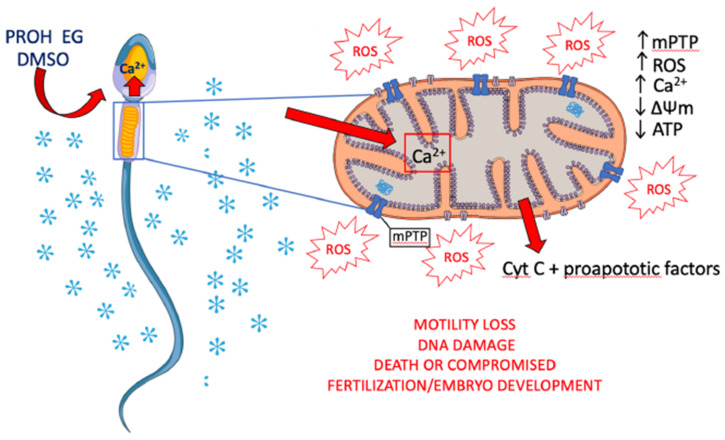
Possible mechanisms of sperm mitochondrial dysfunction associated with cryopreservation. Exposure to permeant cryoprotectants cause intracellular Ca2+ increase. Prolonged openings of mPTP due to Ca2+ overload trigger ROS and Ca2+ release, loss of ΔΨm, decreased ATP content, and release of Cyt C. Such events may culminate in DNA damage and apoptosis. Depending on the extent of mitochondrial damage, the sperm can die or survive to cryopreservation. Oocytes fertilized by survived, DNA damaged sperm, could hesitate into a compromised embryo development. PROH, propanediol; EG, ethylene glycol; DMSO, dimethyl sulfoxide. Modified from https://www.vecteezy.com/vector-art/1434164-human-sperm-or-spermatozoa-cell-structure (accessed on 28 December 2020).
Figure 3
Figure 3
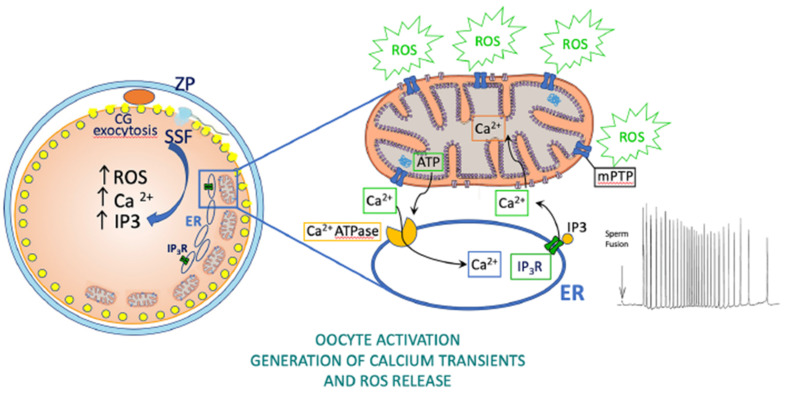
Roles of oocyte mitochondria in health. Production of ATP and ROS by oocyte mitochondria is involved in fertilization and embryo development. Upon gamete fusion, diffusion of a sperm soluble factor (SSF) into the oocyte cytosol generates IP3 which binds endoplasmic reticulum (ER) IP3 receptors (IP3R) causing cytosolic Ca2+ oscillations. Cytosolic Ca2+ rise drives numerous events among which the exocytosis of cortical granules (CG) and the consequent hardening and polyspermy block of the zona pellucida (ZP). Ca2+ potentiates the mitochondrial production of ATP which is needed for Ca2+ reuptake into the endoplasmic reticulum through Ca2+ ATPase allowing the recovery of cytosolic Ca2+ levels after each transient. Evidence in oocytes from different species indicates that sperm-induced Ca2+ rise triggers a release of ROS from mitochondria which is required for embryo development.
Figure 4
Figure 4
Possible mechanisms of oocyte mitochondrial disfunctions associated with cryopreservation. Exposure to permeant cryoprotectants causes intracellular Ca2+ increase. Propanediol (PROH) and ethylene glycol (EG) vehiculate external Ca2+, whereas dimethyl sulfoxide (DMSO) triggers Ca2+ release from the endoplasmic reticulum (ER). Premature Ca2+ rise causes partial cortical granule (CG) exocytosis and zona pellucida (ZP) hardening. Prolonged openings of mPTP due to Ca2+ overload trigger ROS and Ca2+ release, loss of ΔΨm, decreased ATP content, and release of Cyt C. Such events may culminate in DNA damage and apoptosis. The extent of mitochondrial injury in cryopreserved oocytes determines whether the oocyte dies or survives. Substantial mitochondrial damage might lead to altered Ca2+ and ROS signaling at fertilization, and compromised embryo development. Inset, intact (green asterisk) and damaged (red asterisk) mitochondria in a human oocyte cryopreserved through slow cooling (bar = 0.5 μm).

References

    1. Spallanzani L. Opuscoli di Fisica Animale e Vegetabile. Volume 2. Presso la Società Tipografica; Modena, Italy: 1776. p. 2.
    1. Polge C., Smith A., Parkes A. Revival of spermatozoa after vitrification and dehydration at low temperatures. Nature. 1949;164:666. doi: 10.1038/164666a0. - DOI - PubMed
    1. Plotnikov E.Y., Zorov D.B. Pros and cons of use of mitochondria-targeted antioxidants. Antioxidants. 2019;8:316. doi: 10.3390/antiox8080316. - DOI - PMC - PubMed
    1. Collin F. Chemical basis of reactive oxygen species reactivity and involvement in neurodegenerative diseases. Int. J. Mol. Sci. 2019;20:2407. doi: 10.3390/ijms20102407. - DOI - PMC - PubMed
    1. Zinovkin R.A., Zamyatnin A.A. Mitochondria-Targeted Drugs. Curr. Mol. Pharmacol. 2019;12:202–214. doi: 10.2174/1874467212666181127151059. - DOI - PMC - PubMed

LinkOut - more resources