. 2021 Feb 24;11(3):130.
doi: 10.3390/metabo11030130.

Development of a Microfluidic Platform for Trace Lipid Analysis

Affiliations

Development of a Microfluidic Platform for Trace Lipid Analysis

Andrew Davic et al. Metabolites. .

Abstract

The inherent trace quantity of primary fatty acid amides found in biological systems presents challenges for analytical analysis and quantitation, requiring a highly sensitive detection system. The use of microfluidics provides a green sample preparation and analysis technique through small-volume fluidic flow through micron-sized channels embedded in a polydimethylsiloxane (PDMS) device. Microfluidics provides the potential of having a micro total analysis system where chromatographic separation, fluorescent tagging reactions, and detection are accomplished with no added sample handling. This study describes the development and the optimization of a microfluidic-laser induced fluorescence (LIF) analysis and detection system that can be used for the detection of ultra-trace levels of fluorescently tagged primary fatty acid amines. A PDMS microfluidic device was designed and fabricated to incorporate droplet-based flow. Droplet microfluidics have enabled on-chip fluorescent tagging reactions to be performed quickly and efficiently, with no additional sample handling. An optimized LIF optical detection system provided fluorescently tagged primary fatty acid amine detection at sub-fmol levels (436 amol). The use of this LIF detection provides unparalleled sensitivity, with detection limits several orders of magnitude lower than currently employed LC-MS techniques, and might be easily adapted for use as a complementary quantification platform for parallel MS-based omics studies.

Keywords: bioactive lipids; laser induced fluorescence; microfluidics; primary fatty acid amides.


Conflict of interest statement

The authors declare no conflict of interest.

Figures
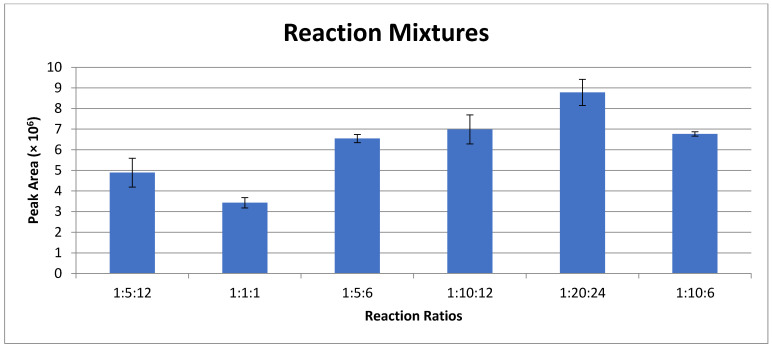
Figure 1
Figure 1
Reaction mixtures as a function of reactants stoichiometry. All solutions were prepared with reactants added in equimolar concentrations following the format of decylamine:potassium cyanide (KCN):naphthalene-2,3-dicarboxaldehyde (NDA) by volume. Average peak area of fluorescently tagged decylamine diluted to a concentration of 1 µM is shown for each reaction mixture, with standard deviations depicted (n = 3).
Figure 2
Figure 2
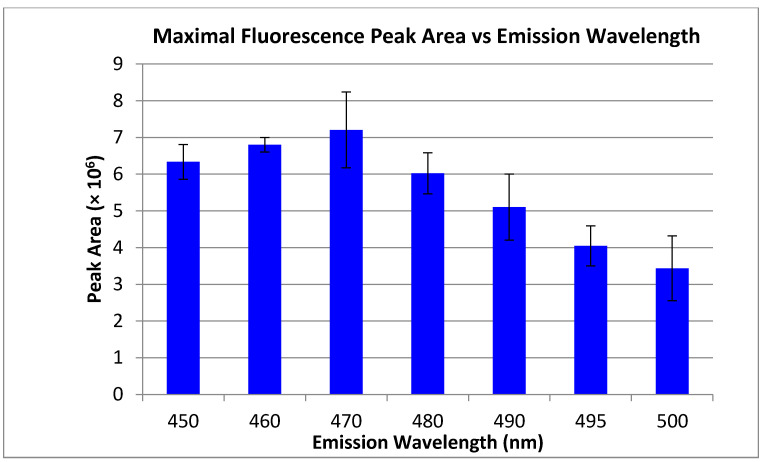
Average HPLC peak areas are shown at varying intervals of fluorescence emission wavelength. Dodecylamine was fluorescently tagged with NDA and diluted to a concentration of 1 µM. Fluorescence emission wavelengths ranged from 450 to 500 nm with the excitation wavelength held at 405 nm. Standard deviations are shown (n = 3).
Figure 3
Figure 3
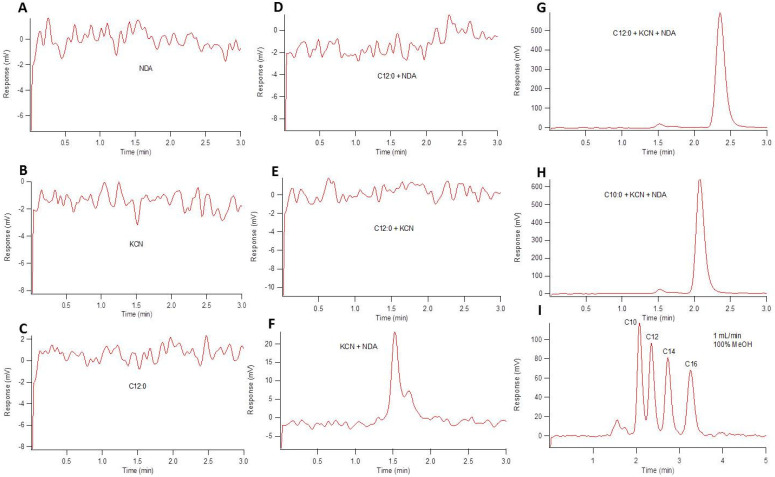
HPLC chromatograms showing native fluorescence of reactants and varying reactant mixtures. All reactants were prepared to 100 µM and incubated at 50 °C for 45 min. For mixtures, 1:10:12 (v/v/v) equimolar amine:KCN:NDA reaction conditions were used. (AC) show fluorescence chromatograms of NDA, KCN, and dodecylamine, respectively. (D,E) show dodecylamine reacted with NDA and dodecylamine reacted with KCN, respectively. (F) shows the fluorescence response of KCN and NDA reacted with one another. (G,H) show the full reaction of NDA-tagged dodecylamine and decylamine, respectively, for perspective with respect to retention time. (I) NDA-tagged amines (decylamine, dodecylamine, tetradecylamine, and octadecylamine). All elution profiles were isocratic with flow rates of 1 mL/min.
Figure 4
Figure 4
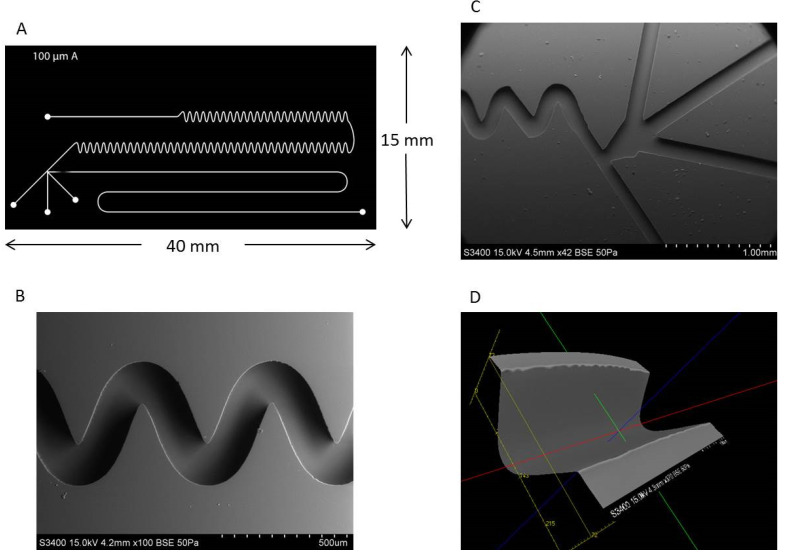
SEM imaging of channel features of a microfluidic device fabricated using SU-8 2075 photoresist as a mold master. (A) Cartoon schematic of final photomask used for polydimethylsiloxane (PDMS) microfluidic chip fabrication. (B) The four inlet channels, the T-junction, and the beginning of the mixing region are shown in a zoomed out image. (C) A zoomed in image of the mixing channel shows consistent curving features which allow for on-chip mixing and reactions. (D) The three dimensional image can be used to calculate distances between two points, enabling the determination of channel width and depth.
Figure 5
Figure 5
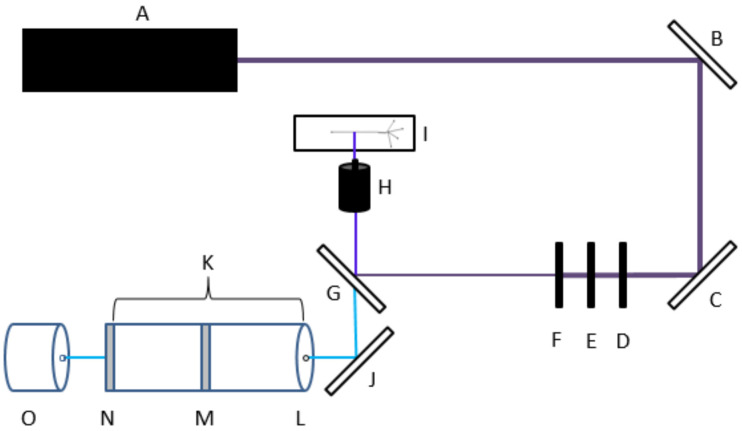
Schematic representation of the laser induced fluorescence (LIF) detection system. A 405 nm excitation laser beam was emitted from a solid-state laser (A) and reflected off of two mirrors (B,C). The beam then passed through a 405 nm emission bandpass filter (D), rotationally-mounted polarizer (E), and pinhole filter (F). The beam reflected off of a 425 nm dichroic lens (G) and focused onto the sample (I) using a microscope objective (H). The resonant fluorescence beam then passed back through the objective and the dichroic lens, then was reflected off of another mirror (J) and into the optics tube (K) through a pinhole filter (L). Inside of the tube was a 472 nm emission bandpass filter (M) and achromatic focusing lenses (N). The focused beam was detected by a single photon counting silicon avalanche photodiode array detector (APD) (O).
Figure 6
Figure 6
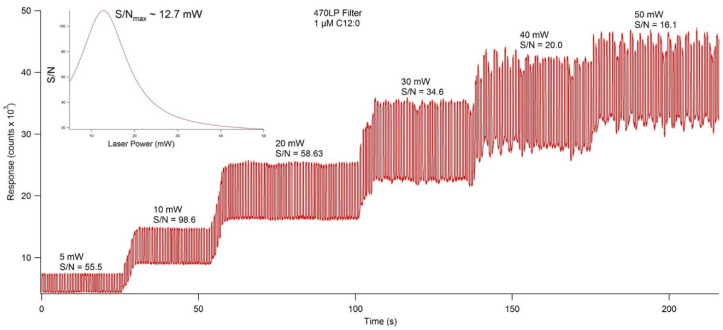
Fluorescence chronogram showing the effect on response and signal to noise ratio (S/N) caused by lasing power. Using the variable power controller, the lasing power was set to 5, 10, 20, 30, 40, and 50 mW, and fluorescence response was recorded at each increment. Of the individual power settings, 10 mW showed the highest S/N at 98.6, but extrapolation of the data fit to a Gaussian distribution showed the S/Nmax to be at 12.7 mW (inset).
Figure 7
Figure 7
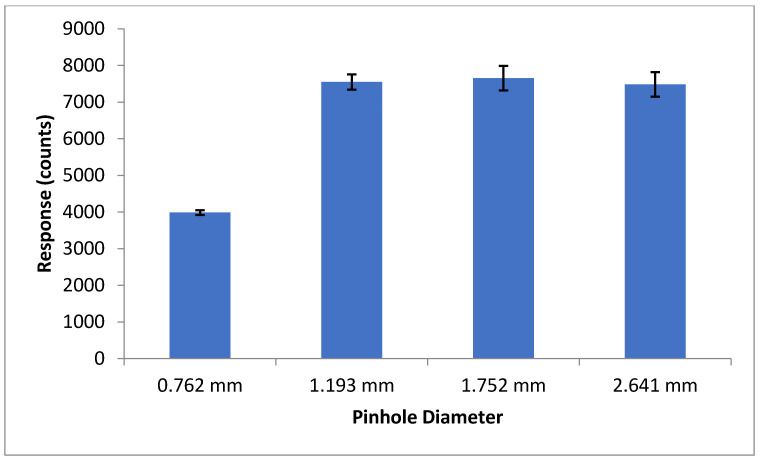
Average fluorescence response shown at each pinhole diameter setting. At a diameter of 0.762 mm, the average response was nearly half of that at 1.193 mm. Further opening the pinhole filter past 1.193 mm did not significantly increase the average response, but, given the increase in the error, appeared to increase the droplet-to-droplet variability (n = 7–10).
Figure 8
Figure 8
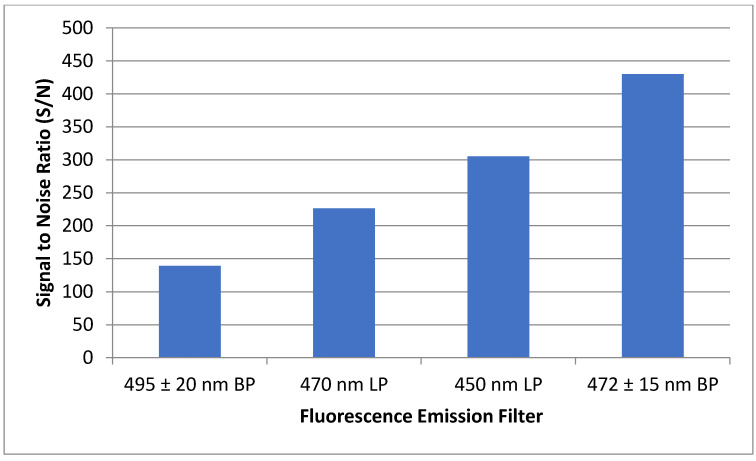
Four different emission filters were tested to determine maximum S/N of a 5 µM NDA-tagged hexadecylamine solution. The 472 nm bandpass filter showed the greatest S/N, with 450 nm longpass, 470 nm longpass, and 495 nm bandpass filters showing progressive decreasing of the S/N.
Figure 9
Figure 9
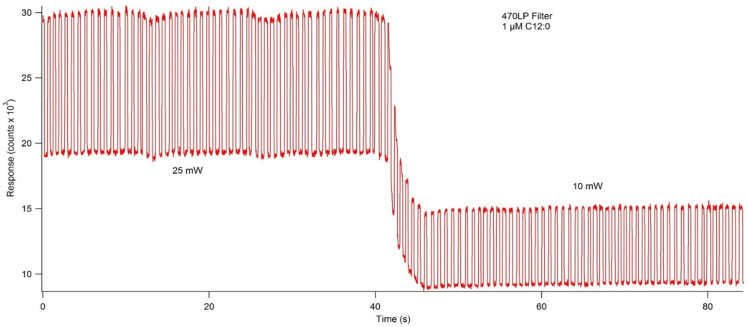
An example of a fluorescence chronogram showing consistent droplet formation. The lasing power was abruptly changed mid-acquisition and resulted in an immediate adjustment in response. Consistent droplet formation was determined by equal spacing between peaks (frequency) and equal peak widths (size).
Figure 10
Figure 10
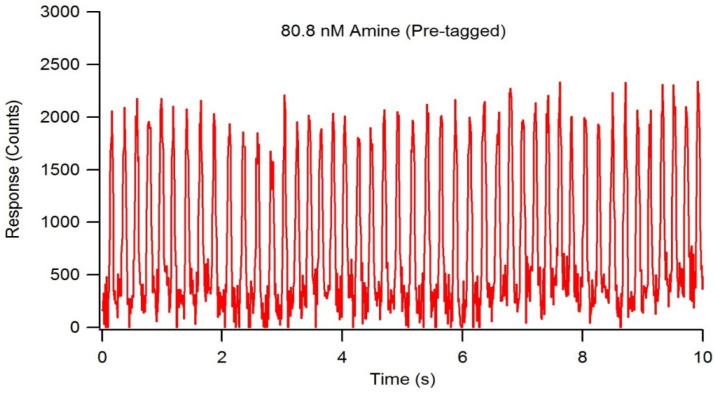
Fluorescence chronogram showing NDA-tagged decylamine approaching the detection limit of the LIF detection system. The tagging reaction occurred pre-chip, and the total amine concentration was serially diluted to 80.8 nM. The droplet frequency was determined to be 4.6 droplets/second, and average droplet volume was 5.4 nL/droplet, resulting in approximately 436 amol of amine per droplet.
Figure 11
Figure 11
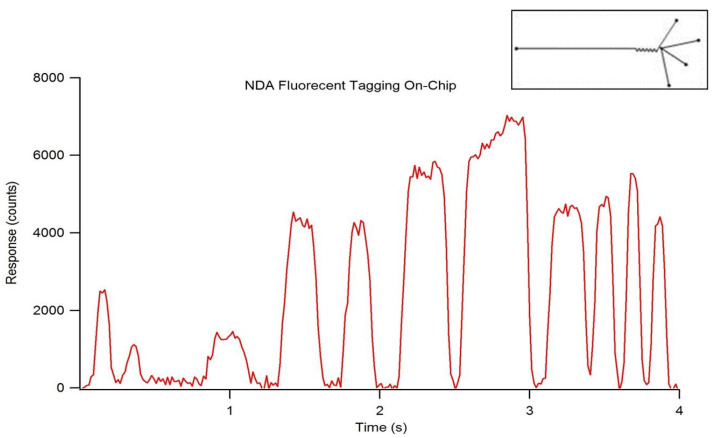
Fluorescence chronogram showing NDA-tagging reaction efficiency performed on-chip. Reactants were maintained in a 1:20:24 amine:KCN:NDA molar ratio and applied to the chip independently at 0.5 µL/min. Using a chip design with 10 turns in the mixing region (inset) resulted in an incomplete reaction, indicative of inconsistent maximum peak responses.
Figure 12
Figure 12
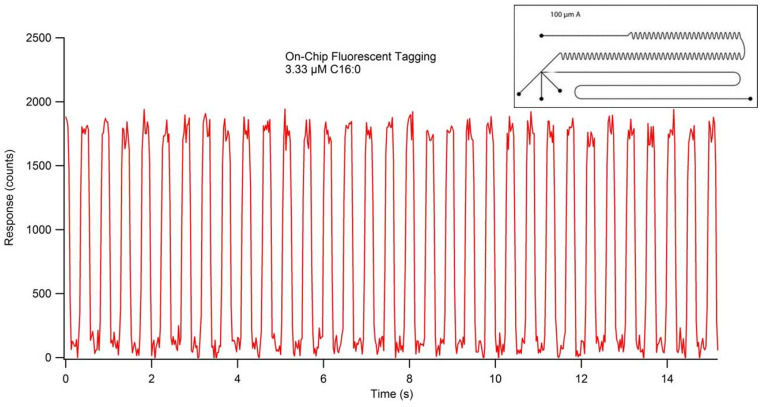
Fluorescence chronogram showing NDA-tagging reaction efficiency performed on-chip. Reactants were maintained in a 1:20:24 amine:KCN:NDA molar ratio and applied to the chip independently at 0.5 µL/min. Using a modified chip design with 130 turns in the mixing region (inset) resulted in complete reaction, indicative of consistent maximum peak responses.
Figure 13
Figure 13
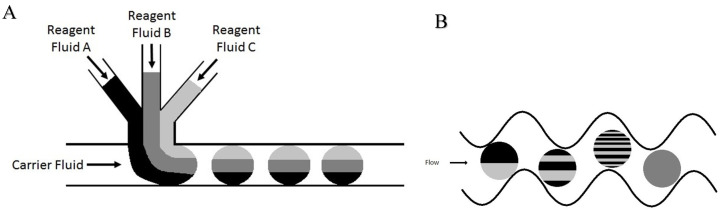
Illustration of droplet formation within microfluidic devices using a T-junction and mixing. (A) The use of a standard T-junction introduces the reagent fluid to the carrier fluid in an orthogonal manner. When the carrier fluid flow rate is greater than that of the sum of all of the reagent fluids, the reagent fluids taper off into individual droplets. (B) Process of chaotic advection within droplets in a mixing region of a microfluidic device. Beginning with a droplet containing two discrete fluidic layers, the frictional forces induced on the droplet by the channel walls cause continuous refolding and recirculation of the droplet. As mixing within droplets is primarily based on inter-layer diffusion, the multiplication and the subsequent thinning of fluidic layers result in highly efficient mixing within droplets.

Similar articles

Cited by

References

    1. Divito E.B., Cascio M. Metabolism, physiology, and analyses of primary fatty acid amides. Chem. Rev. 2013;113:7343–7353. doi: 10.1021/cr300363b. - DOI - PubMed
    1. Arafat E.S., Trimble J.W., Andersen R.N., Dass C., Desiderio D.M. Identification of fatty acid amides in human plasma. Life Sci. 1989;45:1679–1687. doi: 10.1016/0024-3205(89)90278-6. - DOI - PubMed
    1. Cravatt B.F., Prospero-Garcia O., Siuzdak G., Gilula N.B., Henriksen S.J., Boger D.L., Lerner R.A. Chemical characterization of a family of brain lipids that induce sleep. Science. 1995;268:1506–1509. doi: 10.1126/science.7770779. - DOI - PubMed
    1. Lerner R.A., Siuzdak G., Prospero-Garcia O., Henriksen S.J., Boger D.L., Cravatt B.F. Cerebrodiene: A brain lipid isolated from sleep-deprived cats. Proc. Natl. Acad. Sci. USA. 1994;91:9505–9508. doi: 10.1073/pnas.91.20.9505. - DOI - PMC - PubMed
    1. Cravatt B.F., Lerner R.A., Boger D.L. Structure Determination of an Endogenous Sleep-Inducing Lipid, cis-9-Octadecanamide (Oleamide): A Synthetic Approach to the Chemical Analysis of Trace Quantities of a Natural Product. J. Am. Chem. Soc. 1996;118:580–590. doi: 10.1021/ja9532345. - DOI

LinkOut - more resources