


Adenovirus and the Cornea: More Than Meets the Eye
- PMID: 33668417
- PMCID: PMC7917768
- DOI: 10.3390/v13020293
Adenovirus and the Cornea: More Than Meets the Eye
Abstract
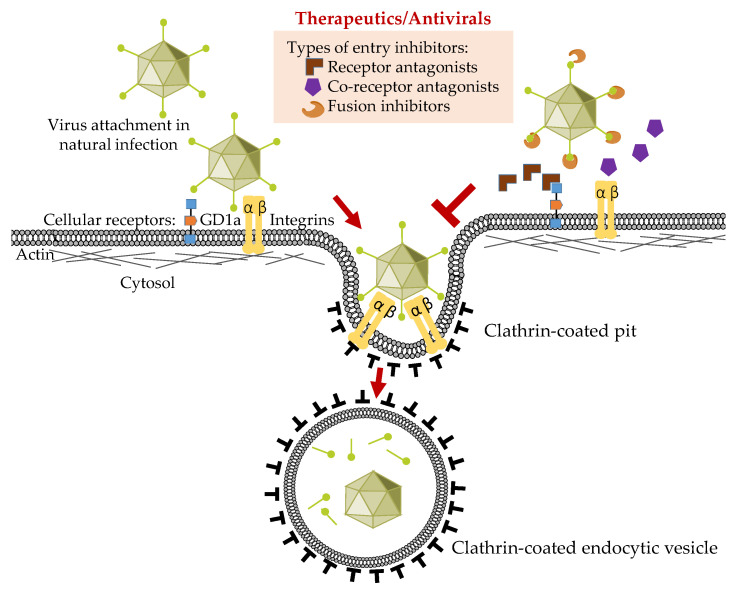
Human adenoviruses cause disease at multiple mucosal sites, including the respiratory, gastrointestinal, and genitourinary tracts, and are common agents of conjunctivitis. One site of infection that has received sparse attention is the cornea, a transparent tissue and the window of the eye. While most adenovirus infections are self-limited, corneal inflammation (keratitis) due to adenovirus can persist or recur for months to years after infection, leading to reduced vision, discomfort, and light sensitivity. Topical corticosteroids effectively suppress late adenovirus keratitis but are associated with vision-threatening side effects. In this short review, we summarize current knowledge on infection of the cornea by adenoviruses, including corneal epithelial cell receptors and determinants of corneal tropism. We briefly discuss mechanisms of stromal keratitis due to adenovirus infection, and review an emerging therapy to mitigate adenovirus corneal infections based on evolving knowledge of corneal epithelial receptor usage.
Keywords: adenovirus; epidemic keratoconjunctivitis; human corneal epithelium; viral receptor.
Conflict of interest statement
The authors declare no conflict of interest. The funders had no role in the design of the study; in the collection, analyses, or interpretation of data; in the writing of the manuscript, or in the decision to publish the results.
Figures
References
-
- Shenk T. Adenoviridae: The Viruses and Their Replication. In: Fields B.N., Knipe D.M., Howley P.M., editors. Fields Virology. Volume 2. Lippincott-Raven; Philadelphia, PA, USA: 1996. pp. 2111–2148.
Publication types
MeSH terms
Grants and funding
LinkOut - more resources
Full Text Sources
Other Literature Sources
Medical
