Review
. 2021 Feb 13;10(2):200.
doi: 10.3390/pathogens10020200.

Regulation of Latency and Reactivation by Human Cytomegalovirus miRNAs

Affiliations
Review

Regulation of Latency and Reactivation by Human Cytomegalovirus miRNAs

Nicole L Diggins et al. Pathogens. .

Abstract

Human cytomegalovirus (HCMV) encodes 22 mature microRNAs (miRNAs), which regulate a myriad of cellular processes, including vesicular trafficking, cell cycle progression, apoptosis, and immune evasion, as well as viral gene expression. Recent evidence points to a critical role for HCMV miRNAs in mediating latency in CD34+ hematopoietic progenitor cells through modulation of cellular signaling pathways, including attenuation of TGFβ and EGFR signaling. Moreover, HCMV miRNAs can act in concert with, or in opposition to, viral proteins in regulating host cell functions. Here, we comprehensively review the studies of HCMV miRNAs in the context of latency and highlight the novel processes that are manipulated by the virus using these small non-coding RNAs.

Keywords: cytomegalovirus; latency; miRNA; signaling.


Conflict of interest statement

The authors declare no conflict of interest.

Figures
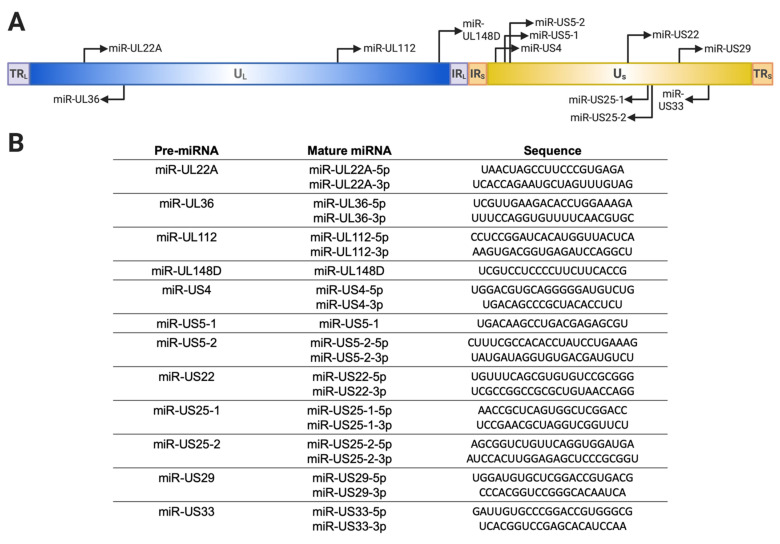
Figure 1
Figure 1
Schematic of microRNAs (miRNAs) encoded by Human cytomegalovirus (HCMV). (A) Locations and orientations of pre-miRNAs are shown as black arrows on the HCMV genome. TRL/S, tandem repeat long/short; UL/S, unique long/short; IRL/S, internal repeat long/short. (B) List of pre-miRNAs, associated mature miRNAs, and corresponding mature miRNA sequences are shown.
Figure 2
Figure 2
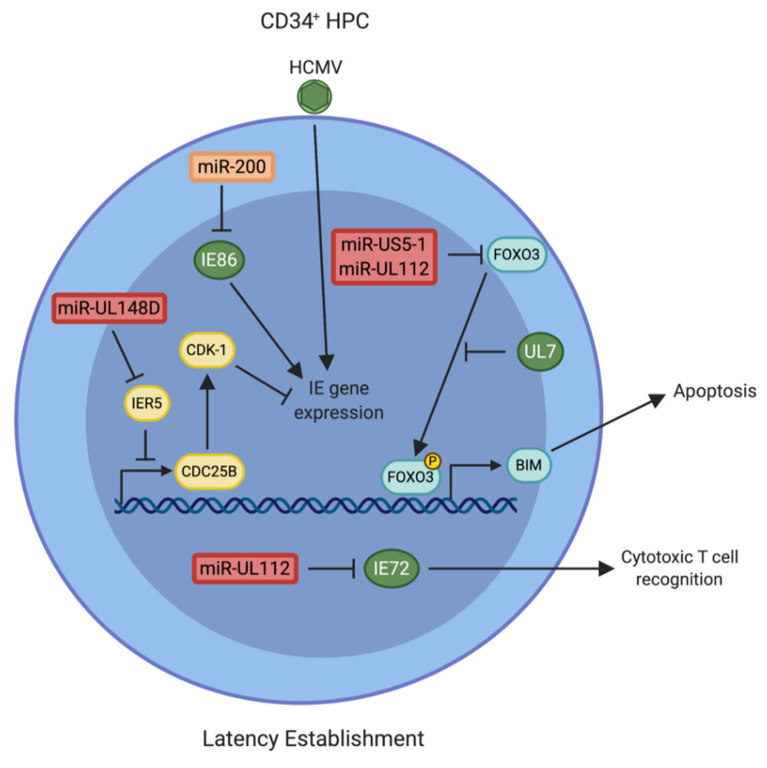
A model of Human cytomegalovirus (HCMV) microRNA (miRNA) regulation of latency establishment. Following viral entry into a CD34+ hematopoietic progenitor cell (HPC), HCMV immediate early (IE) gene expression must be silenced and host cell signaling must be remodeled to prevent apoptosis and immune recognition to promote latent HCMV infection. Furthermore, miR-UL112 directly targets HCMV immediate early gene IE72 to avoid recognition by cytotoxic T cells [67], while miR-UL148D targets Immediate early response 5 (IER5) to indirectly regulate IE gene expression through Cyclin-dependant Kinase-1 (CDK-1) [51]. In addition, a cellular miRNA family expressed in CD34+ HPCs targets HCMV IE86 to prevent lytic replication [84]. Additionally, miR-US5-1 and miR-UL112 act synergistically with HCMV US7 to downregulate Forkhead Box O3 (FOXO3a) and thereby prevent apoptosis during latency establishment [77]. HCMV proteins are shown in green and HCMV miRNAs are shown in red.
Figure 3
Figure 3
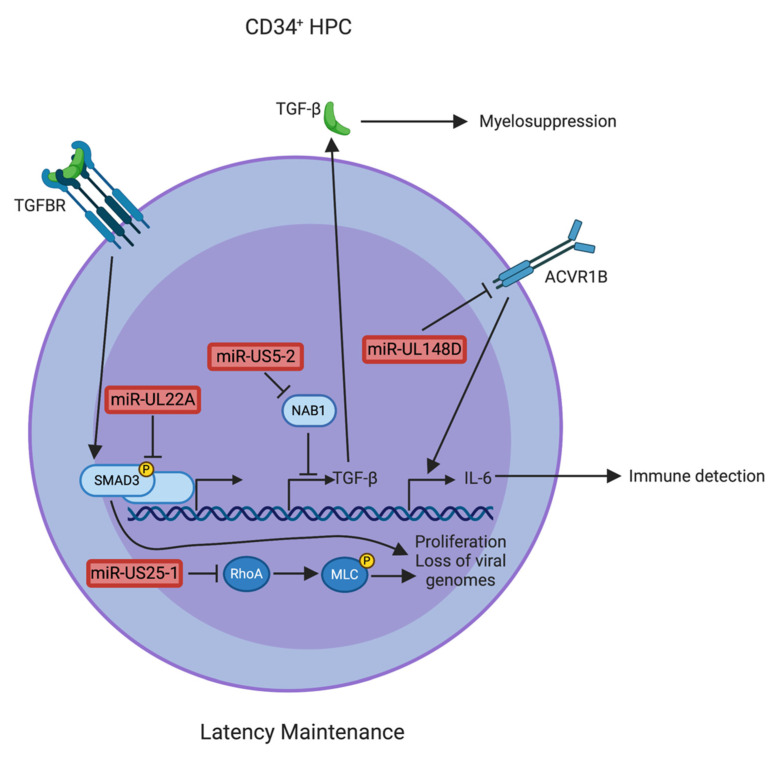
A model of Human cytomegalovirus (HCMV) factors that contribute to latency maintenance. Host cell signaling is modulated by HCMV proteins and microRNAs (miRNAs) to evade immune detection, limit proliferation, and suppress myeloid differentiation. Furthermore, miR-UL148D inhibits activin signaling to limit pro-inflammatory cytokine release from the latently infected cell [50]. Additionally, miR-US5-2 targets the transcriptional repressor NGFI-A-binding protein 1 (NAB1) to increase Transforming Growth Factor beta (TGFβ) production and secretion, resulting in myelosuppression. However, miR-UL22A blocks the TGFβ pathway to protect the infected cell from the effects of TGFβ and to maintain viral genomes during latency [16]. Moreover, miR-US25-1 also prevents the loss of viral genomes during latency by targeting the GTPase Ras homology family member A (RhoA) and inhibiting proliferation of latently infected CD34+ hematopoietic progenitor cells (HPCs) [88]. HCMV miRNAs are shown in red.
Figure 4
Figure 4
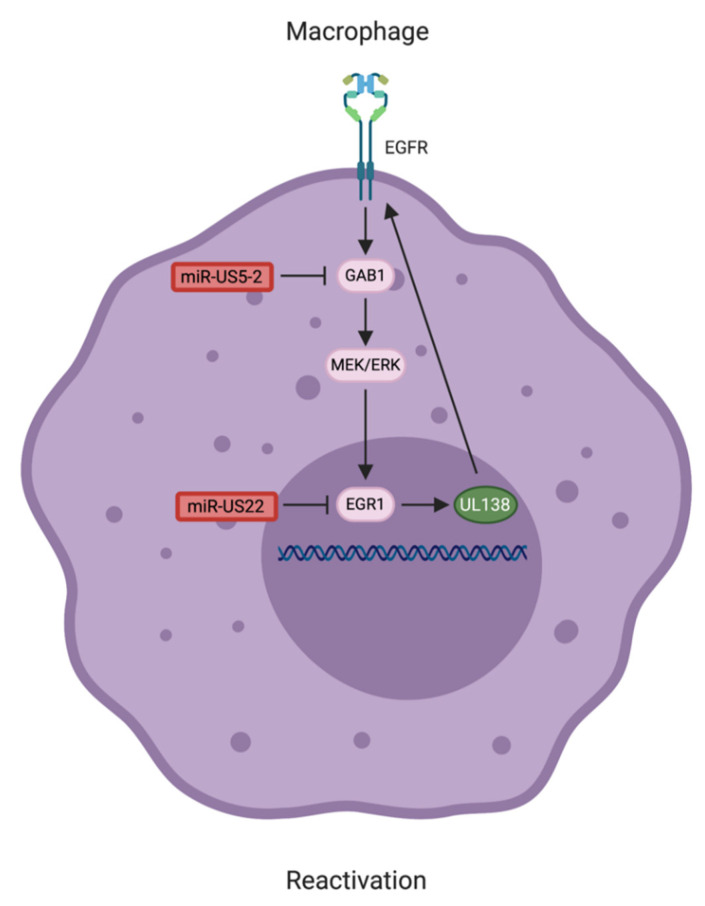
A model of Human cytomegalovirus (HCMV) microRNA- (miRNA)-mediated reactivation from latency. Reactivation from latency requires myeloid differentiation and attenuation of host cell signaling important for latency maintenance. HCMV miRNAs target multiple components of the Epidermal growth factor receptor (EGFR)/Mitogen activated protein kinase kinase (MEK)/Extracellular signal-regulated kinase (ERK) signaling pathway to interfere with UL138 expression. HCMV UL138 promotes EGFR signaling, which is critical for latency maintenance [98]. EGFR signaling through Early growth response-1 (EGR-1), in turn, promotes expression of HCMV UL138, creating a feed-forward loop [14]. Although miR-US22 is not expressed during latency, it may instead act to block EGFR signaling during the early steps of reactivation [15]. Furthermore, miR-US5-2 also inhibits a component of the EGFR pathway and may contribute to HCMV reactivation [99]. HCMV proteins are shown in green and HCMV miRNAs are shown in red.

References

    1. Murphy E., Yu D., Grimwood J., Schmutz J., Dickson M., Jarvis M.A., Hahn G., Nelson J.A., Myers R.M., Shenk T.E. Coding potential of laboratory and clinical strains of human cytomegalovirus. Proc. Natl. Acad. Sci. USA. 2003;100:14976–14981. doi: 10.1073/pnas.2136652100. - DOI - PMC - PubMed
    1. Gatherer D., Seirafian S., Cunningham C., Holton M., Dargan D.J., Baluchova K., Hector R.D., Galbraith J., Herzyk P., Wilkinson G.W., et al. High-resolution human cytomegalovirus transcriptome. Proc. Natl. Acad. Sci. USA. 2011;108:19755–19760. doi: 10.1073/pnas.1115861108. - DOI - PMC - PubMed
    1. Stern-Ginossar N., Weisburd B., Michalski A., Le V.T., Hein M.Y., Huang S.X., Ma M., Shen B., Qian S.B., Hengel H., et al. Decoding human cytomegalovirus. Science. 2012;338:1088–1093. doi: 10.1126/science.1227919. - DOI - PMC - PubMed
    1. Manicklal S., Emery V.C., Lazzarotto T., Boppana S.B., Gupta R.K. The “silent” global burden of congenital cytomegalovirus. Clin. Microbiol. Rev. 2013;26:86–102. doi: 10.1128/CMR.00062-12. - DOI - PMC - PubMed
    1. Goodrum F. Human Cytomegalovirus Latency: Approaching the Gordian Knot. Annu. Rev. Virol. 2016;3:333–357. doi: 10.1146/annurev-virology-110615-042422. - DOI - PMC - PubMed

LinkOut - more resources