Review
. 2021 Feb 13;10(2):389.
doi: 10.3390/cells10020389.

Impacts of Environmental Factors on Head and Neck Cancer Pathogenesis and Progression

Affiliations
Review

Impacts of Environmental Factors on Head and Neck Cancer Pathogenesis and Progression

Marisol Miranda-Galvis et al. Cells. .

Abstract

Epidemiological and clinical studies over the past two decades have provided strong evidence that genetic elements interacting with environmental components can individually and collectively influence one's susceptibility to cancer. In addition to tumorigenic properties, numerous environmental factors, such as nutrition, chemical carcinogens, and tobacco/alcohol consumption, possess pro-invasive and pro-metastatic cancer features. In contrast to traditional cancer treatment, modern therapeutics not only take into account an individual's genetic makeup but also consider gene-environment interactions. The current review sharpens the focus by elaborating on the impact that environmental factors have on the pathogenesis and progression of head and neck cancer and the underlying molecular mechanisms involved. Recent advances, challenges, and future perspectives in this area of research are also discussed. Inhibiting key environmental drivers of tumor progression should yield survival benefits for patients at any stage of head and neck cancer.

Keywords: anticancer; environmental factors; head and neck cancer; metastasis; modern therapy.


Conflict of interest statement

The authors declare no conflict of interest.

Figures
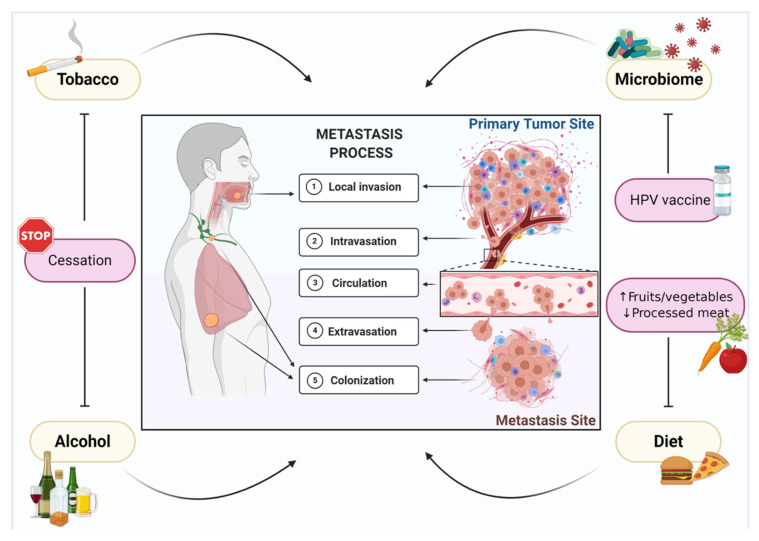
Figure 1
Figure 1
Environmental factors support metastasis of head and neck cancer. Metastasis is a complex and multi-step process that is orchestrated by tumor biology and supported by external environmental factors, such as tobacco and alcohol consumption, human papillomavirus (HPV) infection, the microbiome, and diet, which are involved in tumor cell invasion, intravasation, circulation, extravasation, and metastatic colonization. A precision-based model of metastasis prevention centered around modifiable risk factors involves smoking and alcohol cessation, HPV vaccination, and a diet that is high in fruits and vegetables and low in processed and red meats.
Figure 2
Figure 2
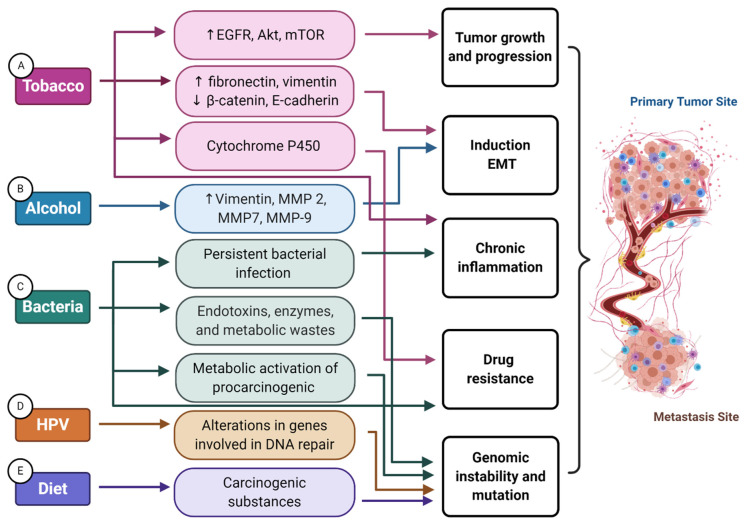
Mechanisms involved in environmental factor support of the onset and progression of head and neck cancer. (A) The expression of alpha-7 nicotinic acetylcholine receptors (nAChRs) promotes proliferation and migration through the phosphorylation of epidermal growth factor receptor (EGFR), protein kinase B (Akt), mammalian target of rapamycin (mTOR), and the stimulation of beta-adrenergic receptors. Nicotine upregulates the expression of mesenchymal proteins (fibronectin and vimentin), whereas it downregulates epithelial proteins (beta-catenin and E-cadherin), thereby supporting cell motility and invasion through induction of epithelial–mesenchymal transition (EMT). Nicotine can perturb drug efficacy via cytochrome P450 (CYP)-mediated metabolism, glucuronidation, and/or protein binding, which may impact the efficacy of anticancer drugs. Tobacco consumption also promotes a pro-inflammatory tumor microenvironment, further supporting tumor growth. (B) Alcohol is capable of directly upregulating vimentin, matrix metalloproteinase (MMP)-2, MMP-7, and MMP-9, promoting an EMT invasive phenotype and extracellular matrix remodeling. (C) Particular bacteria participate in the metabolic activation of carcinogenic chemicals, like acetaldehyde, that can promote tumorigenesis through genomic mutations. Chronic inflammation prompted by persistent bacterial infection also supports multiple hallmark capabilities. Bacteria products like endotoxins, enzymes, and metabolic wastes might cause DNA damage, consequently altering cell cycle control and signaling pathways that can lead to even further genomic instability and mutation. Certain immune cell responses to gut commensal bacteria are also associated with immunotherapy response. (D) HPV-related tumors carry more frequent alterations in genes involved in DNA repair, such as PRKDC, potentially hindering a cell’s capacity for DNA repair. (E) Lastly, red meat and processed meats also contain carcinogenic substances that can cause genomic instability and mutations.

References

    1. Bray F., Ferlay J., Soerjomataram I., Siegel R.L., Torre L.A., Jemal A. Global cancer statistics 2018: GLOBOCAN estimates of incidence and mortality worldwide for 36 cancers in 185 countries. CA Cancer J. Clin. 2018;68:394–424. doi: 10.3322/caac.21492. - DOI - PubMed
    1. El-Naggar A.K., Chan C.J., Grandis J.R., Takata T., Slootweg P.J. WHO Classification of Head and Neck Tumours. IARC; Lyon, France: 2017.
    1. Network C.G.A. Comprehensive genomic characterization of head and neck squamous cell carcinomas. Nature. 2015;517:576–582. doi: 10.1038/nature14129. - DOI - PMC - PubMed
    1. Leemans C.R., Snijders P.J.F., Brakenhoff R.H. The molecular landscape of head and neck cancer. Nat. Rev. Cancer. 2018;18:269–282. doi: 10.1038/nrc.2018.11. - DOI - PubMed
    1. Braakhuis B.J., Brakenhoff R.H., Leemans C.R. Treatment choice for locally advanced head and neck cancers on the basis of risk factors: Biological risk factors. Ann. Oncol. 2012;23(Suppl. 10):x173–x177. doi: 10.1093/annonc/mds299. - DOI - PubMed

Publication types

LinkOut - more resources