


Involvement of Cholinergic, Adrenergic, and Glutamatergic Network Modulation with Cognitive Dysfunction in Alzheimer's Disease
- PMID: 33668976
- PMCID: PMC7956475
- DOI: 10.3390/ijms22052283
Involvement of Cholinergic, Adrenergic, and Glutamatergic Network Modulation with Cognitive Dysfunction in Alzheimer's Disease
Abstract
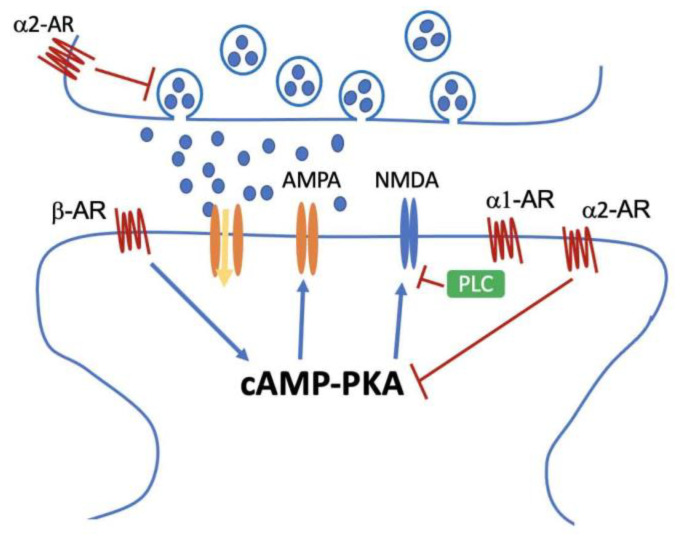
Alzheimer's disease (AD), the most common cause of dementia, is a progressive neurodegenerative disease. The number of AD cases has been rapidly growing worldwide. Several the related etiological hypotheses include atypical amyloid β (Aβ) deposition, neurofibrillary tangles of tau proteins inside neurons, disturbed neurotransmission, inflammation, and oxidative stress. During AD progression, aberrations in neurotransmission cause cognitive decline-the main symptom of AD. Here, we review the aberrant neurotransmission systems, including cholinergic, adrenergic, and glutamatergic network, and the interactions among these systems as they pertain to AD. We also discuss the key role of N-methyl-d-aspartate receptor (NMDAR) dysfunction in AD-associated cognitive impairment. Furthermore, we summarize the results of recent studies indicating that increasing glutamatergic neurotransmission through the alteration of NMDARs shows potential for treating cognitive decline in mild cognitive impairment or early stage AD. Future studies on the long-term efficiency of NMDA-enhancing strategies in the treatment of AD are warranted.
Keywords: Alzheimer’s disease; NMDAR; adrenergic; cholinergic; glutamatergic.
Conflict of interest statement
The authors declare no conflict of interest. The sponsors were not involved in the design of the study; the collection, analysis, and interpretation of the data; the writing of the report; and the decision to submit the article for publication.
Figures
References
-
- Epperly T., Dunay M.A., Boice J.L. Alzheimer Disease: Pharmacologic and Nonpharmacologic Therapies for Cognitive and Functional Symptoms. Am. Fam. Physician. 2017;95:771–778. - PubMed
-
- McKhann G.M., Knopman D.S., Chertkow H., Hyman B.T., Jack C.R., Jr., Kawas C.H., Klunk W.E., Koroshetz W.J., Manly J.J., Mayeux R., et al. The diagnosis of dementia due to Alzheimer’s disease: Recommendations from the National Institute on Aging-Alzheimer’s Association workgroups on diagnostic guidelines for Alzheimer’s disease. Alzheimers Dement. 2011;7:263–269. doi: 10.1016/j.jalz.2011.03.005. - DOI - PMC - PubMed
-
- The Alzheimer’s Association 2020 Alzheimer’s disease facts and figures. Alzheimers Dement. 2020 doi: 10.1002/alz.12068. - DOI
Publication types
MeSH terms
Substances
Grants and funding
- MOST 107-2628-B-182A-002/Ministry of Science and Technology, Taiwan
- 108-2628-B-182A-002/Ministry of Science and Technology, Taiwan
- 109-2628-B-182A-002/Ministry of Science and Technology, Taiwan
- 109-2314-B-039-039-MY3/Ministry of Science and Technology, Taiwan
- NHRI-EX110-10816NC/National Health Research Institutes
LinkOut - more resources
Full Text Sources
Other Literature Sources
Medical
