


Suitability of Bronchoscopic Biopsy Tissue Samples for Next-Generation Sequencing
- PMID: 33668993
- PMCID: PMC7996548
- DOI: 10.3390/diagnostics11030391
Suitability of Bronchoscopic Biopsy Tissue Samples for Next-Generation Sequencing
Abstract
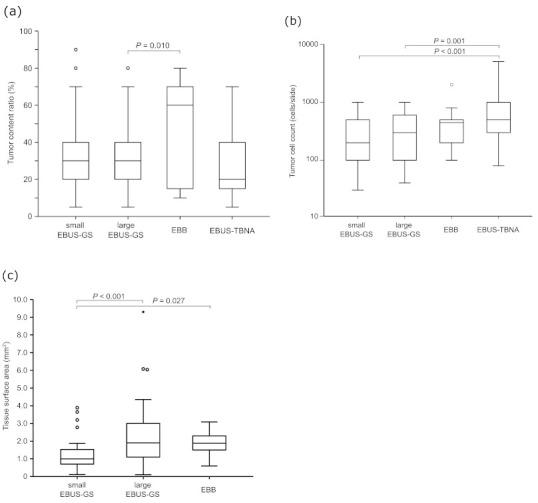
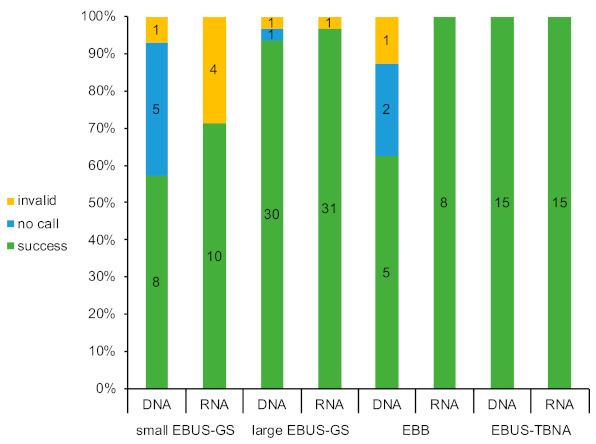
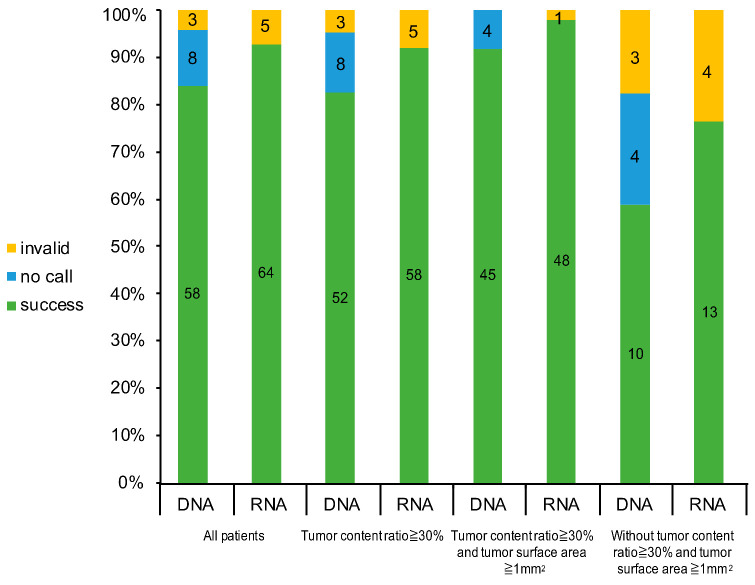
A sufficiently large tissue sample is required to perform next-generation sequencing (NGS) with a high success rate, but the majority of patients with advanced non-small-cell lung cancer (NSCLC) are diagnosed with small biopsy specimens. Biopsy samples were collected from 184 patients with bronchoscopically diagnosed NSCLC. The tissue surface area, tumor cell count, and tumor content rate of each biopsy sample were evaluated. The impact of the cut-off criteria for the tissue surface area (≥1 mm2) and tumor content rate (≥30%) on the success rate of the Oncomine Dx Target Test (ODxTT) was evaluated. The mean tissue surface area of the transbronchial biopsies was 1.23 ± 0.85 mm2 when small endobronchial ultrasonography with a guide sheath (EBUS-GS) was used, 2.16 ± 1.49 mm2 with large EBUS-GS, and 1.81 ± 0.75 mm2 with endobronchial biopsy (EBB). The proportion of samples with a tissue surface area of ≥1 mm2 was 48.8% for small EBUS-GS, 79.2% for large EBUS-GS, and 78.6% for EBB. Sixty-nine patients underwent ODxTT. The success rate of DNA sequencing was 84.1% and that of RNA sequencing was 92.7% over all patients. The success rate of DNA (RNA) sequencing was 57.1% (71.4%) for small EBUS-GS (n = 14), 93.4% (96.9%) for large EBUS-GS (n = 32), 62.5% (100%) for EBB (n = 8), and 100% (100%) for endobronchial ultrasound-guided transbronchial needle aspiration (EBUS-TBNA) (n = 15). Regardless of the device used, a tissue surface area of ≥ 1 mm2 is adequate for samples to be tested with NGS.
Keywords: Oncomine Dx Target Test; bronchoscopy; next-generation sequencing; non-small-cell lung cancer.
Conflict of interest statement
Murakami reports the receipt of personal fees from AstraZeneca, Chugai Pharmaceutical, Boehringer Ingelheim, Taiho Pharmaceutical, and Ono Pharmaceutical. Dr. Kato reports grants and personal fees from MSD, Novartis, Ono Pharmaceutical, Pfizer, and Taiho Pharmaceutical; personal fees from Daiichi-Sankyo, F. Hoffmann–La Roche, Nippon Kayaku, Nitto Denko, Shionogi Pharmaceutical, Sumitomo Dainippon, and Takeda; and grants from Astellas, Kyorin, Kyowa Kirin, and Regeneron. Saito reports grants from Chugai Pharmaceutical and AstraZeneca; and personal fees from Ono Pharmaceutical, Nippon Boehringer Ingelheim, MSD, and Novartis Pharma. The other authors report no conflicts of interest.
Figures
References
-
- Ohe Y., Ohashi Y., Kubota K., Tamura T., Nakagawa K., Negoro S., Nishiwaki Y., Saijo N., Ariyoshi Y., Fukuoka M. Randomized phase III study of cisplatin plus irinotecan versus carboplatin plus paclitaxel, cisplatin plus gemcitabine, and cisplatin plus vinorelbine for advanced non-small-cell lung cancer: Four-Arm Cooperative Study in Japan. Ann. Oncol. 2007;18:317–323. doi: 10.1093/annonc/mdl377. - DOI - PubMed
LinkOut - more resources
Full Text Sources
Other Literature Sources
