Review
. 2021 Feb 19;21(4):1443.
doi: 10.3390/s21041443.

A Review on Functionalized Graphene Sensors for Detection of Ammonia

Affiliations
Review

A Review on Functionalized Graphene Sensors for Detection of Ammonia

Xiaohui Tang et al. Sensors (Basel). .

Abstract

Since the first graphene gas sensor has been reported, functionalized graphene gas sensors have already attracted a lot of research interest due to their potential for high sensitivity, great selectivity, and fast detection of various gases. In this paper, we summarize the recent development and progression of functionalized graphene sensors for ammonia (NH3) detection at room temperature. We review graphene gas sensors functionalized by different materials, including metallic nanoparticles, metal oxides, organic molecules, and conducting polymers. The various sensing mechanism of functionalized graphene gas sensors are explained and compared. Meanwhile, some existing challenges that may hinder the sensor mass production are discussed and several related solutions are proposed. Possible opportunities and perspective applications of the graphene NH3 sensors are also presented.

Keywords: ammonia detection; chemical vapor deposition graphene; conducting polymers; field-effect transistor sensor; functionalized graphene; reduced graphene oxide.


Conflict of interest statement

The authors declare no conflict of interest.

Figures

Figure 1
Figure 1
Schematic diagram for band structure of single-layer graphene. The inset on the lower right highlights the linear dispersion at the Dirac point. Reproduced from (Ernie W. Hill, [31]), Copyright 2011, IEEE.
Figure 2
Figure 2
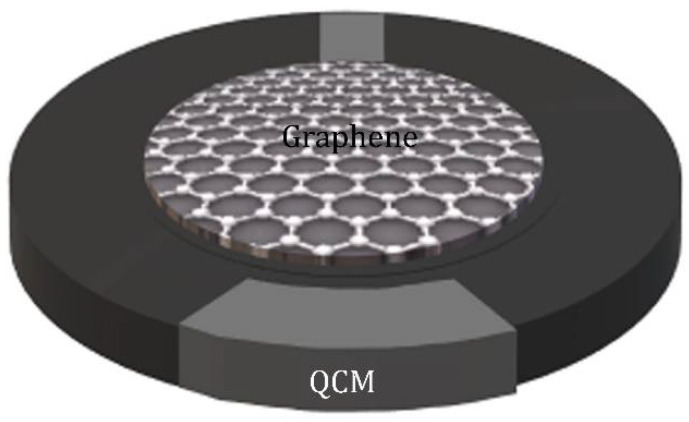
Schematic diagram of a graphene-based quartz crystal microbalance sensor.
Figure 3
Figure 3
Schematic diagram for a graphene-based surface acoustic wave sensor.
Figure 4
Figure 4
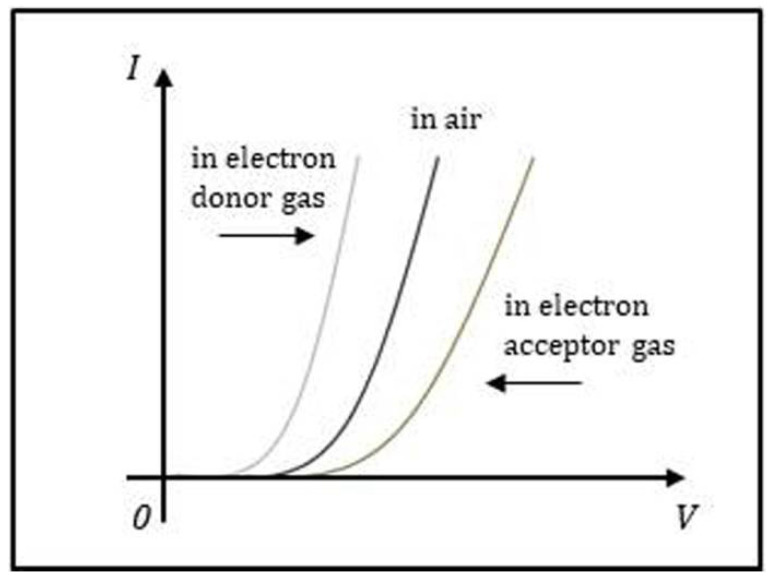
Schematic energy band diagram of the graphene/n-type Si interface for the pristine graphene state (middle), the graphene exposed to electron-donor gas (left) and the graphene exposed to electron-acceptor gas (right). EVAC, EC, ΦG, EF, and ψSBH indicate the vacuum energy, conduction band, graphene work function, Fermi level, and Schottky barrier height, respectively. Reproduced from (Hye-Young Kim, [55]), Copyright 2013, American Chemical Society.
Figure 5
Figure 5
Schematic illustration of the IV characteristics for a graphene/n-type Si Schottky diode sensor in air, exposed to electron-donor gas and electron-acceptor gas.
Figure 6
Figure 6
Optical image of Au interdigitated electrode (IDEs) on SiO2/Si substrate for a graphene chemiresistor sensor. The sensing area is of 200 × 200 µm2. The finger width and finger space are consistent (2 µm).
Figure 7
Figure 7
(a) Energy band diagrams of graphene: pristine graphene (middle), n-type graphene (left), and p-type graphene (right). (b) Graphene resistance as a function of gate voltage. EF and ED indicate Fermi level and Dirac point, respectively.
Figure 8
Figure 8
Schematic cross-sections of a graphene FET sensor applied by: (a) positive gate voltage for NH3 off; (b) negative gate voltage for NH3 off; (c) positive gate voltage for NH3 on; (d) negative gate voltage for NH3 on.
Figure 9
Figure 9
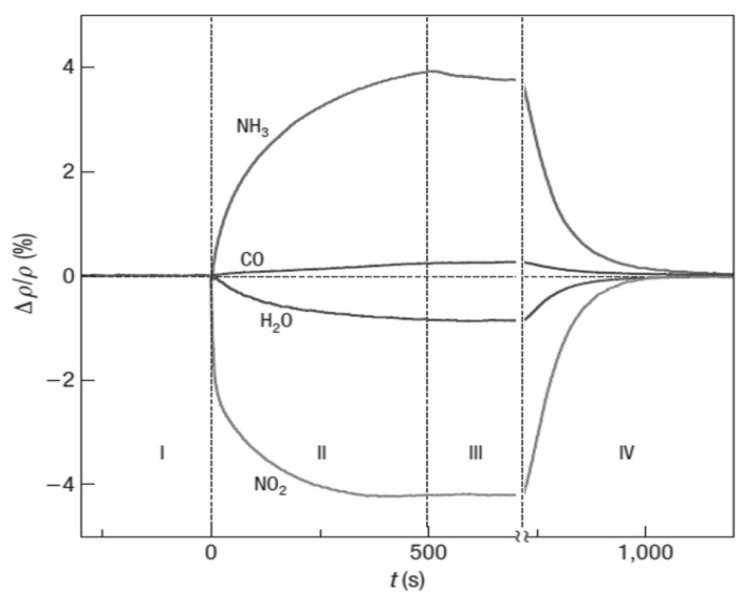
Resistance responses of a pristine graphene sensor to 1 ppm ammonia (NH3), carbon monoxide (CO), nitric oxide (NO), and water vapor (H2O) in pure helium or nitrogen at atmospheric pressure, at 150 °C. Reproduced from (F. SCHEDIN, [23]), Copyright 2007, Nature Publishing Group.
Figure 10
Figure 10
Energy band diagrams (a) for Pt and p-type graphene and (b) for Pt-NH3 phase and p-type graphene. EVAC, ΦPt, EFPt, ΦG, EFG, ΦPt-NH3 indicate the vacuum energy, Pt work function, Pt Fermi level, graphene work function, graphene Fermi level, and Pt-NH3 work function, respectively.
Figure 11
Figure 11
Sensing behaviors of a typical PPy/reduced graphene oxide (rGO) sensor at relative humidity of 50% and at 20 °C: (a) The sensor resistance behavior to 1 ppm NH3 for 10 cycles. (b) The sensor resistance response as a function of NH3 concentration. Reproduced from (Xiaohui Tang, [135]), Copyright 2020, Elsevier.
Figure 12
Figure 12
Optical image of graphene oxide (GO), dispersions (in water) on interdigitated electrodes over SiO2/Si substrate. The GO dispersions (deposited by ultrasonic spray pyrolysis) are agglomerated to form clusters. Reproduced from (Xiaohui Tang, [135]), Copyright 2020, Elsevier.

References

    1. Werner M., Ambelas Skjøth C., Kryza M., Dore A.J. Understanding emissions of ammonia from buildings and the application of fertilizers: An example from Poland. Biogeosciences. 2015;12:3623–3638. doi: 10.5194/bg-12-3623-2015. - DOI
    1. Risby T.H., Solga S.F. Current status of clinical breath analysis. Appl. Phys. B. 2006;85:421–426. doi: 10.1007/s00340-006-2280-4. - DOI
    1. Ishpal, Kaur A. Spectroscopic investigations of ammonia gas sensing mechanism in polypyrrole nanotubes/nanorods. J. Appl. Phys. 2013;113:094504. doi: 10.1063/1.4793994. - DOI
    1. Bevc S., Mohorko E., Kolar M., Brglez P., Holobar A., Kniepeiss D., Podbregar M., Piko N., Hojs N., Knehtl M., et al. Measurement of breath ammonia for detection of patients with chronic kidney disease. Clin. Nephrol. 2017;88:14–17. doi: 10.5414/CNP88FX04. - DOI - PubMed
    1. Turner C., Španěl P., Smith D. A longitudinal study of ammonia, acetone and propanol in the exhaled breath of 30 subjects using selected ion flow tube mass spectrometry, SIFT-MS. Physiol. Meas. 2006;27:321–337. doi: 10.1088/0967-3334/27/4/001. - DOI - PubMed

LinkOut - more resources