Review
. 2021 Feb 19;13(4):874.
doi: 10.3390/cancers13040874.

Organoid and Spheroid Tumor Models: Techniques and Applications

Affiliations
Review

Organoid and Spheroid Tumor Models: Techniques and Applications

Sreenivasulu Gunti et al. Cancers (Basel). .

Abstract

Techniques to develop three-dimensional cell culture models are rapidly expanding to bridge the gap between conventional cell culture and animal models. Organoid and spheroid cultures have distinct and overlapping purposes and differ in cellular sources and protocol for establishment. Spheroids are of lower complexity structurally but are simple and popular models for drug screening. Organoids histologically and genetically resemble the original tumor from which they were derived. Ease of generation, ability for long-term culture and cryopreservation make organoids suitable for a wide range of applications. Organoids-on-chip models combine organoid methods with powerful designing and fabrication of micro-chip technology. Organoid-chip models can emulate the dynamic microenvironment of tumor pathophysiology as well as tissue-tissue interactions. In this review, we outline different tumor spheroid and organoid models and techniques to establish them. We also discuss the recent advances and applications of tumor organoids with an emphasis on tumor modeling, drug screening, personalized medicine and immunotherapy.

Keywords: air–liquid interface; drug screening; immunotherapy; microfluidics; organoid biobanks; organoids; organoids-on-chip; personalized medicine; spheroids; tumor modeling.


Conflict of interest statement

N. London holds stock in Navigen Pharmaceuticals and was a consultant for Cooltech Inc., neither of which are relevant to this study. All other authors declare no conflicts of interest.

Figures
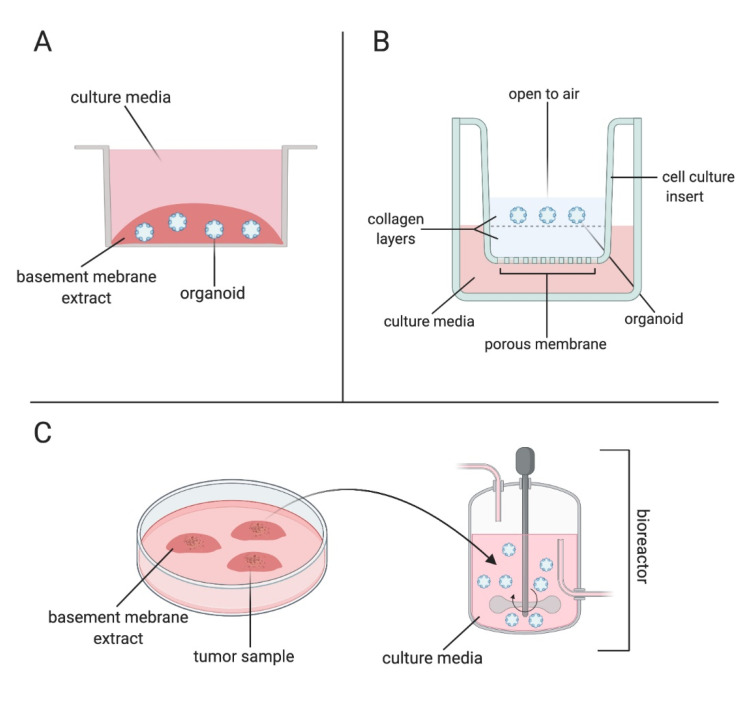
Figure 1
Figure 1
Methods of organoid culture. (A) Organoids can be cultured in the submerged method by disrupting tissue mechanically and enzymatically into single-cell suspensions, followed by embedding them in basement membrane extract (BME) and submerging in the culture media. (B) In the air–liquid interface (ALI) method, tissue is minced into smaller fragments and embedded in a layer of collagen, which is assembled in a cell culture insert that has a layer of acellular collagen. The cell culture insert is placed in a culture dish with media. (C) Alternatively, tissue fragments can be embedded in BME and followed by transferring into a bioreactor.
Figure 2
Figure 2
Microfluidic devices and organoids on chips. Microfluidic chips can be designed to culture organoids in a chamber connected to an inlet that can circulate culture media. In a vascular organoid-on-chip model, tumoroids are cultured in a central chamber. Adjacent chambers are connected to the central chamber and endothelial cells with fibroblasts are cultured in hydrogel. The tumoroid cultures are perfused with vasculature and can model angiogenesis.
Figure 3
Figure 3
Potential applications of patient-derived organoids (PDOs). PDOs can be derived from surgically resected tumor tissue or tumor biopsy and organoids can also be derived from the normal tissue surrounding the tumor. Gene-editing and screening methods allows the introduction of oncogenic mutations and thus have the potential for studying the tumorigenesis process. Identification of gene–drug associations through genomic profiling permits precision oncology through drug and immunotherapeutic screens. PDOs can be expanded and cryopreserved to establish living organoid biobanks for basic and clinical research purposes.

References

    1. American Cancer Socieity . Global Cancer Facts & Figures. 4th ed. American Cancer Society; Atlanta, AT, USA: 2018.
    1. Fogel D.B. Factors associated with clinical trials that fail and opportunities for improving the likelihood of success: A review. Contemp. Clin. Trials Commun. 2018;11:156–164. doi: 10.1016/j.conctc.2018.08.001. - DOI - PMC - PubMed
    1. Gillet J.-P., Varma S., Gottesman M.M. The Clinical Relevance of Cancer Cell Lines. J. Natl. Cancer Inst. 2013;105:452–458. doi: 10.1093/jnci/djt007. - DOI - PMC - PubMed
    1. Olson B., Li Y., Lin Y., Liu E.T., Patnaik A. Mouse Models for Cancer Immunotherapy Research. Cancer Discov. 2018;8:1358–1365. doi: 10.1158/2159-8290.CD-18-0044. - DOI - PMC - PubMed
    1. Hinshaw D.C., Shevde L.A. The tumor microenvironment innately modulates cancer progression. Cancer Res. 2019;79:4557–4566. doi: 10.1158/0008-5472.CAN-18-3962. - DOI - PMC - PubMed

LinkOut - more resources
