Review
. 2021 Feb 21;22(4):2128.
doi: 10.3390/ijms22042128.

Non-Musculoskeletal Benefits of Vitamin D beyond the Musculoskeletal System

Affiliations
Review

Non-Musculoskeletal Benefits of Vitamin D beyond the Musculoskeletal System

Sicheng Zhang et al. Int J Mol Sci. .

Abstract

Vitamin D, a fat-soluble prohormone, is endogenously synthesized in response to sunlight or taken from dietary supplements. Since vitamin D receptors are present in most tissues and cells in the body, the mounting understanding of the role of vitamin D in humans indicates that it does not only play an important role in the musculoskeletal system, but has beneficial effects elsewhere as well. This review summarizes the metabolism of vitamin D, the research regarding the possible risk factors leading to vitamin D deficiency, and the relationships between vitamin D deficiency and numerous illnesses, including rickets, osteoporosis and osteomalacia, muscle weakness and falls, autoimmune disorders, infectious diseases, cardiovascular diseases (CVDs), cancers, and neurological disorders. The system-wide effects of vitamin D and the mechanisms of the diseases are also discussed. Although accumulating evidence supports associations of vitamin D deficiency with physical and mental disorders and beneficial effects of vitamin D with health maintenance and disease prevention, there continue to be controversies over the beneficial effects of vitamin D. Thus, more well-designed and statistically powered trials are required to enable the assessment of vitamin D's role in optimizing health and preventing disease.

Keywords: 1α,25-dihydroxyvitamin D (1α,25(OH)2D); 25-hydroxyvitamin D (25(OH)D); musculoskeletal; nonmusculoskeletal; sunlight; vitamin D.


Conflict of interest statement

The authors declare no conflict of interest.

Figures

Figure 1
Figure 1
The photoproduction and metabolism of vitamin D. Vitamin D3 is produced in the skin via a two-step process from the vitamin D substrate 7-DHC, which is converted to previtamin D3 upon exposure to solar ultraviolet B (UVB) radiation, followed by thermal conversion to vitamin D3. Vitamin D2 and vitamin D3 from dietary sources together with endogenous vitamin D3 are diffused into the circulatory system and bound to vitamin D binding protein (DBP). Vitamin D (hereafter “D” represents D2 or D3) is firstly converted by 25-hydroxylase to 25(OH)D primarily, but not exclusively, in the liver. 25(OH)D is biologically inactive, and it must be further hydroxylated by 1α-hydroxylase (CYP27B1) into the active form 1α,25(OH)2D in the kidney or other targeted cells and tissues. This active form can induce the expression of the enzyme 24-hydroxylase (24-OHase) upon completion of the task. The 24-OHAse enhances the catabolism of 1α,25(OH)2D into 1,24,25-hydroxyvitamin D, which can then be successively oxidized into the biologically inert calcitroic acid.
Figure 2
Figure 2
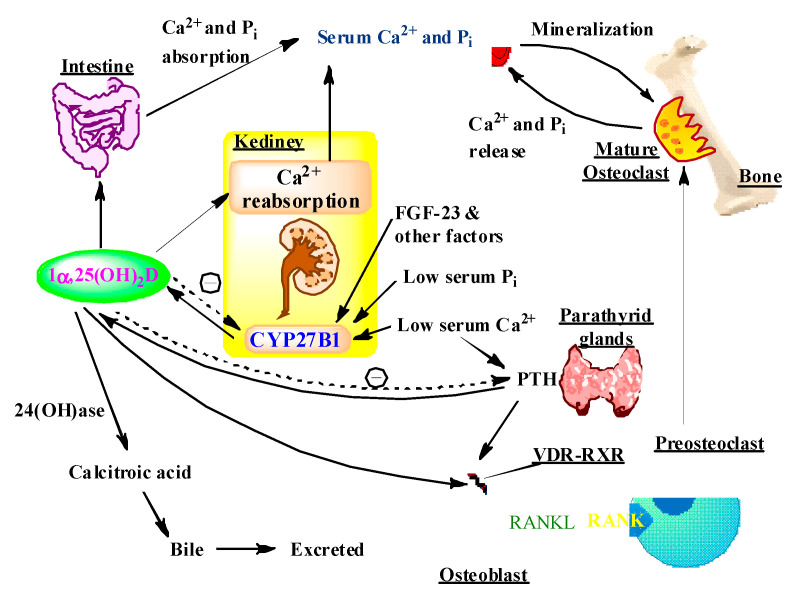
The effects of 1α,25(OH)2D on calcium and phosphorus homeostasis. 1α,25(OH)2D is produced by the kidney under the control of PTH by the parathyroid glands. PTH stimulates its production and 1α,25(OH)2D in turn inhibits the synthesis and secretion of PTH. 1α,25(OH)2D can also decrease its own synthesis through negative feedback. 1α,25(OH)2D enhances intestinal calcium and phosphorus absorption in the small intestine and calcium reabsorption in the kidney. 1α,25(OH)2D regulates bone formation and resorption by stimulation of preosteoblast proliferation and differentiation into osteoblasts. 1α,25(OH)2D also stimulates the expression of RANKL by osteoblasts, which stimulates the differentiation and subsequent activation of preosteoclasts into mature osteoclasts, the bone-forming cells which release calcium (Ca2+) and inorganic phosphorus (Pi) from the bone to maintain calcium and phosphorus levels in the blood. Adequate calcium and phosphorus levels promote the mineralization of the skeleton. 1α,25(OH)2D stimulates the expression of the renal 24-hydroxylase (24-OHase) to catabolize 1α,25(OH)2D to the water-soluble, biologically inactive calcitroic acid, which is excreted in the bile. Other factors, such as serum phosphorus, calcium, and fibroblast growth factor 23 can either increase or decrease the renal production of 1α,25(OH)2D.
Figure 3
Figure 3
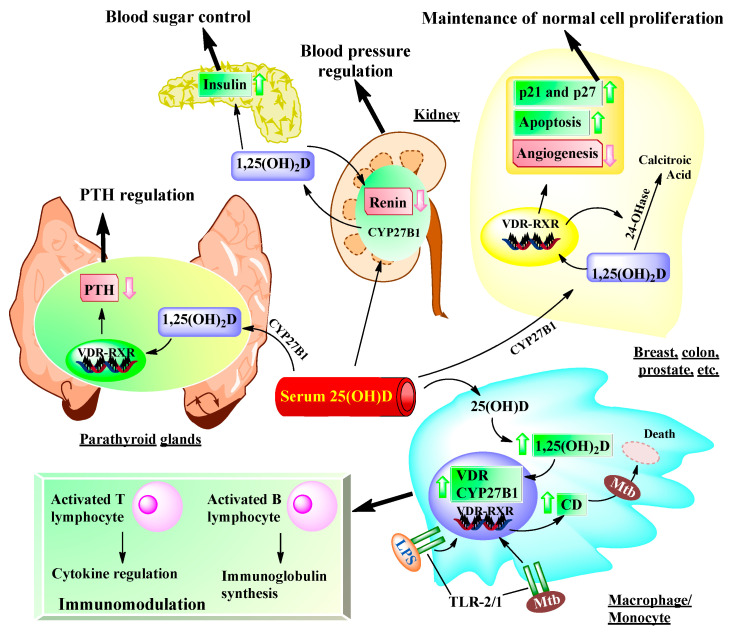
Metabolism of 25(OH)D to 1α,25(OH)2D for non-musculoskeletal functions. 1α,25(OH)2D not only regulates calcium and phosphorus homeostasis but can inhibit renin production in the kidney and stimulate the pancreas to secret insulin. 1α,25(OH)2D can also be converted from 25(OH)D through autocrine production and interacts with VDR in the breast, colon, prostate, and other tissues to regulate a wide variety of genes that control proliferation (such as enhancing expression of p21 and p27), inhibit angiogenesis, and induce differentiation and apoptosis. It is believed that the regulation of cell growth and maturation is important for decreasing risk of the cell becoming malignant. The upregulation of VDR and CYP27B1 expression occurs after the activation of toll-like receptor 2/1 (TLR2/1) in a macrophage or monocyte by an infectious agent such as Mycobacterium tuberculosis (Mtb) or its lipopolysaccharide. This results in an increase in the nuclear expression of cathelicidin, a cationic peptide capable of promoting innate immunity and the destruction of the infectious agents. The regulation of cytokine synthesis and immunoglobulin synthesis by activated T lymphocytes and activated B lymphocytes, respectively, is associated with the 1α,25(OH)2D, which is locally produced in monocytes and macrophages.
Figure 4
Figure 4
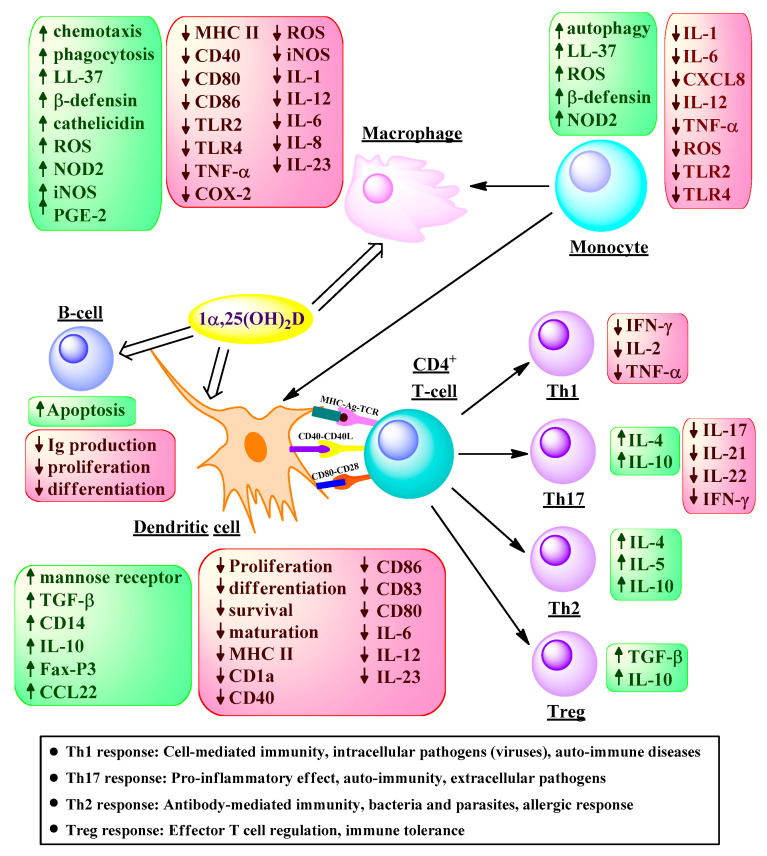
Mechanisms for adaptive immune responses to 1α,25(OH)2D. Monocytes produce more LL-37 and β-defensin, enhance autophagy and NOD2 (nucleotide‑binding oligomerization domain‑containing protein 2) expression, decrease the production of inflammatory cytokines and downregulate TLR2/4 expression. Differentiation into macrophages is increased; the chemotactic and phagocytotic responses of macrophages and the production of antimicrobial proteins such as cathelicidin are upregulated. However, the stimulatory capacity of the antigen-presenting cells (APCs) and T cells is decreased. At the level of the APC, 1α,25(OH)2D inhibits the differentiation into DCs, and thus stimulates effector CD4+ cells to differentiate into one of the four types of Th cells. Activated T cells also express VDR. 1α,25(OH)2D inhibits the development of Th1 cells associated with the cellular immune response, and promotes Th2 cells associated with humoral (antibody) mediated immunity, thereby indirectly promoting the T cell shift from a Th1 towards a Th2 phenotype. 1α,25(OH)2D also inhibits the development of Th17 cells, which play an essential role in combating certain pathogens and are linked to tissue damage and inflammation. Moreover, 1α,25(OH)2D favors Treg cell development via modulating DCs and by directly targeting T cells. Finally, B cells are also affected by 1α,25(OH)2D, demonstrating decreased immunoglobulin production, proliferation and differentiation, but increased apoptosis.

References

    1. Rajakumar K. Vitamin D, cod-liver oil, sunlight, and rickets: A historical perspective. Pediatrics. 2003;112:e132–e135. doi: 10.1542/peds.112.2.e132. - DOI - PubMed
    1. Chesney R.W. Rickets: An old form for a new century. Pediatrics Int. 2003;45:509–511. doi: 10.1046/j.1442-200X.2003.01783.x. - DOI - PubMed
    1. Holick M.F., Shils M., Shike M., Ross A., Caballero B., Cousins R. Modern nutrition in health and disease. Shils OJME. 2006:329–345.
    1. Hess A.F. Rickets Including Osteomalacia and Tetany. Henty Kimpton; London, UK: 1930.
    1. Nair R., Maseeh A. Vitamin D: The “sunshine” vitamin. J. Pharmacol. Pharmacother. 2012;3:118–126. - PMC - PubMed

LinkOut - more resources