


A Review of Clinical Outcomes of CAR T-Cell Therapies for B-Acute Lymphoblastic Leukemia
- PMID: 33670075
- PMCID: PMC7926700
- DOI: 10.3390/ijms22042150
A Review of Clinical Outcomes of CAR T-Cell Therapies for B-Acute Lymphoblastic Leukemia
Abstract
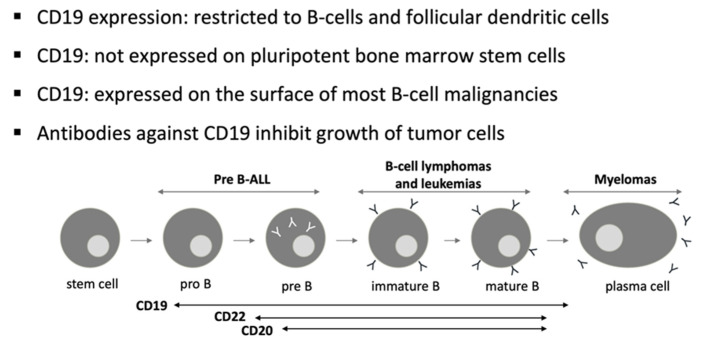
Treatment of relapsed and refractory (R/R) B acute lymphoblastic leukemia (B-ALL) represents an unmet medical need in children and adults. Adoptive T cells engineered to express a chimeric antigen receptor (CAR-T) is emerging as an effective technique for treating these patients. Areas covered: Efficacy and safety of CAR-T therapy in R/R B-ALL patients. Expert opinion: CD19 CAR-T infusion induce high CR rates in patients with poor prognosis and few therapeutic options, while real-life data demonstrate similar results with an interestingly lower incidence of grade 3/4 toxicity. Nevertheless, despite impressive in-depth responses, more than half of patients will experience a relapse. Therefore, rather than using CAR-T cell therapy as a stand-alone option, consolidation with allogeneic stem-cell transplant (Allo-SCT) after CAR-T treatment might increase long-term outcome. Moreover, CD19 is one target, but several other targets are being examined, such as CD20 and CD22 and dual-targeting CARs or combination therapy. Another issue is the time consuming process of CAR-T engineering. New platforms have shortened the CAR-T cell manufacturing process, and studies are underway to evaluate the effectiveness. Another way to mitigate waiting is the development of allogeneic "off the shelf" therapy. In conclusion, CD19-targeted CAR-modified T-cell therapy has shown unprecedented results in patients without curative options. Future work focusing on target identification, toxicity management and reducing manufacturing time will broaden the clinical applicability and bring this exciting therapy to more patients, with longer-term remissions without additional Allo-SCT.
Keywords: B-acute lymphoblastic leukemia; CD19-targeted CAR-modified T-cell; chimeric antigen receptor (CAR-T); relapsed and refractory ALL.
Conflict of interest statement
The authors declare no conflict of interest.
Figures
References
-
- Cancer Stat Facts: Leukemia—Acute Lymphocytic Leukemia (ALL) [(accessed on 1 January 2021)]; Available online: https://seer.cancer.gov/statfacts/html/alyl.html.
-
- Harris N.L., Jaffe E.S., Diebold J., Flandrin G., Muller-Hermelink H.K., Vardiman J., Lister T.A., Bloomfield C.D. World Health Organization classification of neoplastic diseases of the hematopoietic and lymphoid tissues: Report of the Clinical Advisory Committee meeting-Airlie House, Virginia, November 1997. J. Clin. Oncol. 1999;17:3835–3849. doi: 10.1200/JCO.1999.17.12.3835. - DOI - PubMed
-
- Vardiman J.W., Thiele J., Arber D.A., Brunning R.D., Borowitz M.J., Porwit A., Harris N.L., Le Beau M.M., Hellström-Lindberg E., Tefferi A., et al. The 2008 revision of the World Health Organization (WHO) classification of myeloid neoplasms and acute leukemia: Rationale and important changes. Blood. 2009;114:937–951. doi: 10.1182/blood-2009-03-209262. - DOI - PubMed
Publication types
MeSH terms
Substances
LinkOut - more resources
Full Text Sources
Other Literature Sources
