. 2021 Feb 18;7(2):149.
doi: 10.3390/jof7020149.

Versatile CRISPR/Cas9 Systems for Genome Editing in Ustilago maydis

Affiliations

Versatile CRISPR/Cas9 Systems for Genome Editing in Ustilago maydis

Sarah-Maria Wege et al. J Fungi (Basel). .

Abstract

The phytopathogenic smut fungus Ustilago maydis is a versatile model organism to study plant pathology, fungal genetics, and molecular cell biology. Here, we report several strategies to manipulate the genome of U. maydis by the CRISPR/Cas9 technology. These include targeted gene deletion via homologous recombination of short double-stranded oligonucleotides, introduction of point mutations, heterologous complementation at the genomic locus, and endogenous N-terminal tagging with the fluorescent protein mCherry. All applications are independent of a permanent selectable marker and only require transient expression of the endonuclease Cas9hf and sgRNA. The techniques presented here are likely to accelerate research in the U. maydis community but can also act as a template for genome editing in other important fungi.

Keywords: CRISPR/Cas9; Ustilago maydis; deletion; genetic manipulation; point mutation.


Conflict of interest statement

The authors declare no conflict of interest.

Figures
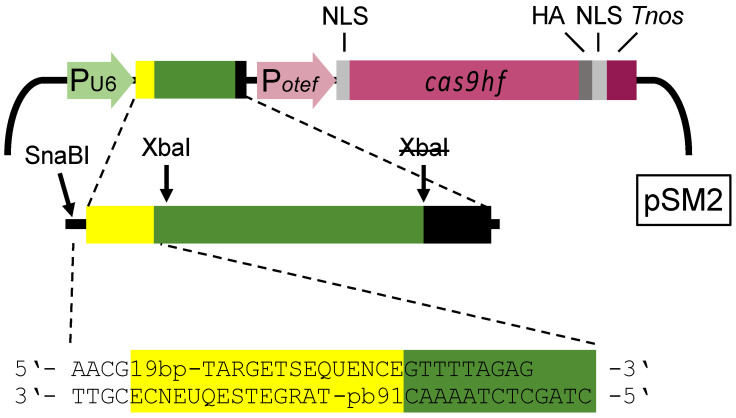
Figure 1
Figure 1
Schematic drawing of the Cas9 expression cassette and the RNA polymerase III U6 promoter (light green; PU6) driven sgDNA (pSM2) according to Schuster et al., 2016 [23]. Yellow: 19 bp target sequence; dark green: scaffold sequence; black: U6 terminator; light purple: constitutive otef-promoter (Potef); light gray: nuclear localization signal (NLS); purple: open reading frame (ORF) of high fidelity cas9; dark gray: HA-tag; dark purple: nos terminator. The former XbaI-site inside of the U6 terminator was inactivated by a point mutation. The 32/36 bp flanking sequences for the oligonucleotides are given.
Figure 2
Figure 2
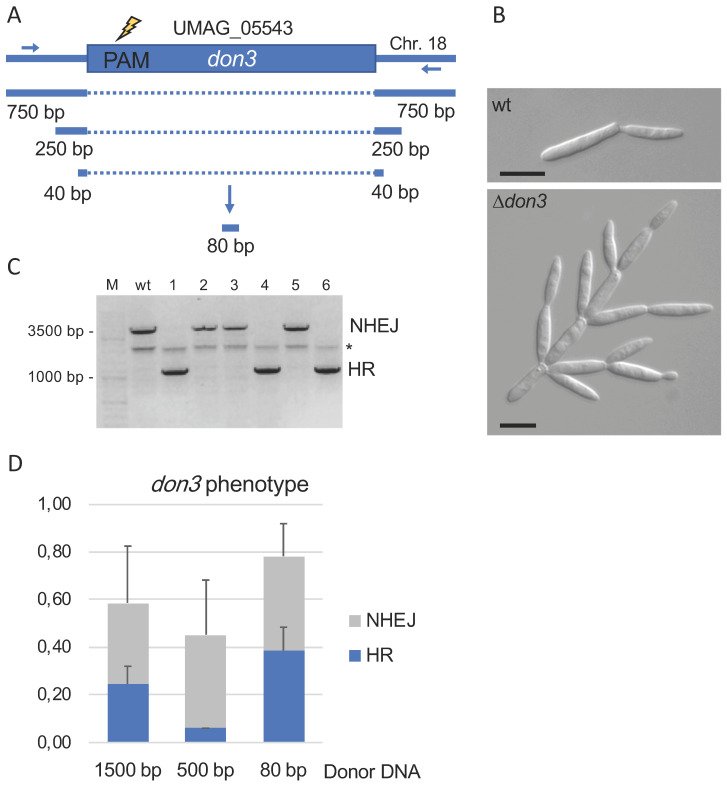
Generation of don3 deletion mutants via donor DNA of different length. (A): Schematic drawing of the don3 gene indicating the protospacer adjacent motif (PAM) in the 5′-region of the ORF, which was used. Flanking sequences of 1500 bp and 500 bp, respectively, were amplified by a two-step PCR approach. The 80 bp dsDNA was generated by hybridization of oligonucleotides. (B): Microscopic image (DIC) of the don3 phenotype used for identification of deletion mutants (Scale bar 10 µm). (C): PCR test of six don3 mutants either resulting from non-homologous end joining (NHEJ) or homologous recombination using donor DNA (HR). Wildtype Bub8 (wt) was used as a control. * unspecific PCR product. (D): Summery of three independent transformation experiments using 0.2–0.6 pmol for the PCR based donor DNAs 1500 bp and 500 bp and using 65–70 pmol hybridized oligonucleotides (80 bp).
Figure 3
Figure 3
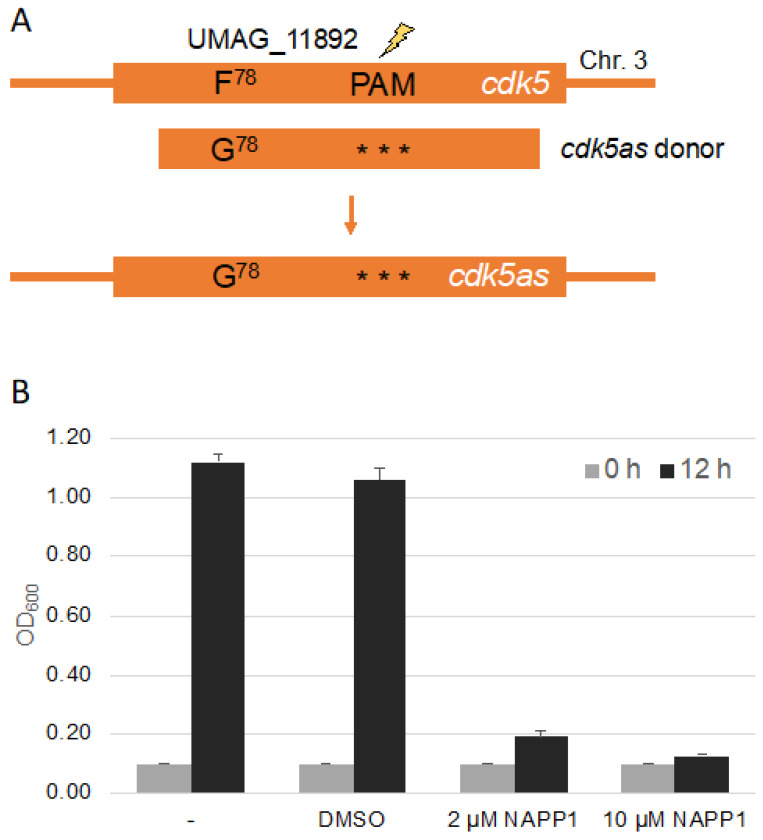
Site directed mutagenesis to generate an analog sensitive Cdk5 kinase. (A): Schematic drawing of the cdk5 gene highlighting the position of the region encoding the gatekeeper and the PAM site. The donor DNA encoded the F78G mutation and contained three silent mutations within the sequence corresponding to the sgRNA. Further details are depicted in Figure S1 and Table S3. (B): Quantification of growth assays of Bub8 cdk5as in the absence or presence of NA-PP1 inhibitor starting with an OD600 of 0.1. DMSO is the solvent of NA-PP1 and served as control. Three independent experiments were analyzed.
Figure 4
Figure 4
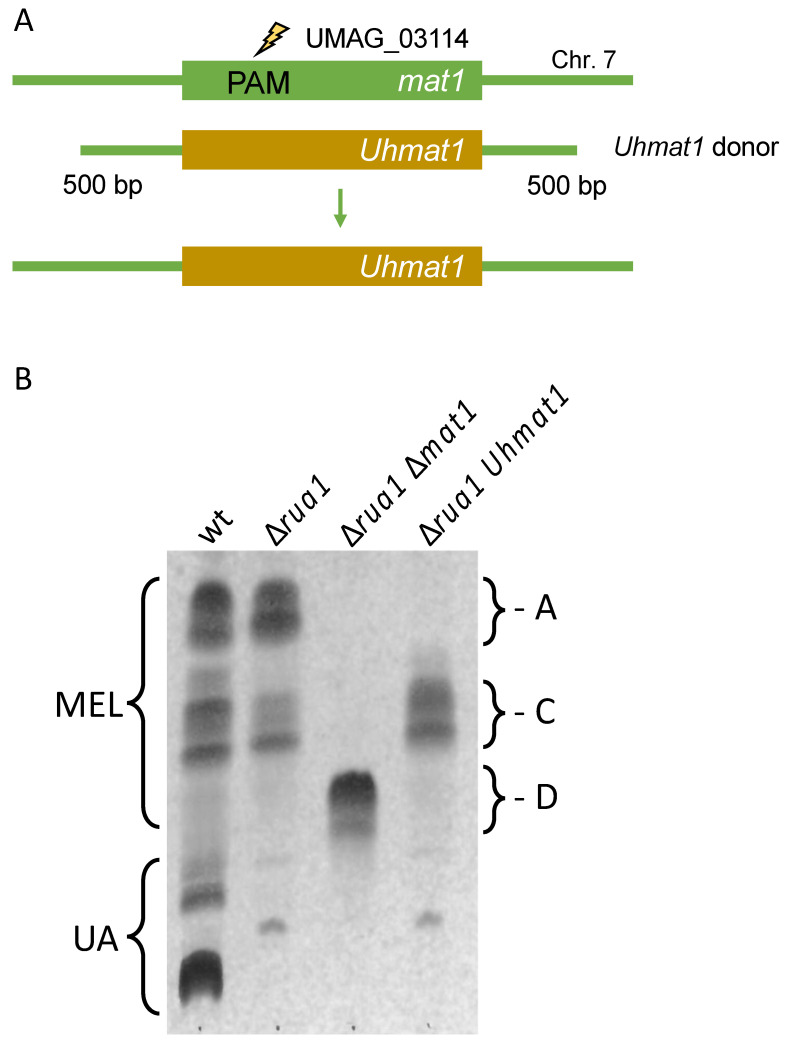
Heterologous complementation at the genomic locus. (A): Schematic drawing of the U. maydis (Um) mat1 gene indicating the position of the PAM site. Donor DNA contained the ORF for Mat1 from U. hordei (Uh) and 500 bp upstream and downstream flanking sequence of the U. maydis ORF. Further details are depicted in Figure S2 and Table S3. (B): Thin layer chromatography of glycolipids from MB215 (wt), ∆rua1, ∆rua1mat1 and ∆rua1 Uhmat1. MEL variants (A,C,D) can be separated according to their acetylation patterns.
Figure 5
Figure 5
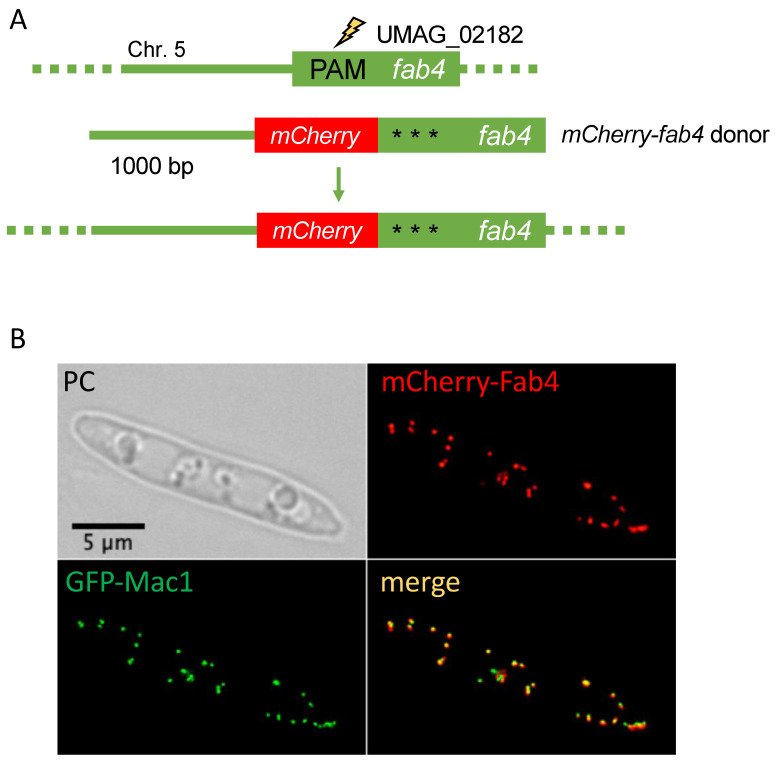
N-terminal tagging at the endogenous locus (A): Schematic drawing of the fab4 gene indicating the position of the PAM site. Donor DNA consisted of 1000 bp upstream and downstream flanking sequence, the ORF for mCherry. Three silent mutations were introduced in the sequences corresponding to the sgRNA. For further details see Figure S3 and Table S3. (B): Phase contrast (PC) and fluorescent imaging of mCherry-fab4 expressing cells. mCherry-Fab4 co-localized with GFP-Mac1 in peroxisomes [17,49]. Scale bar: 5 µm.

References

    1. Barrangou R., Fremaux C., Deveau H., Richards M., Boyaval P., Moineau S., Romero D.A., Horvath P. CRISPR Provides Acquired Resistance Against Viruses in Prokaryotes. Science. 2007;315:1709–1712. doi: 10.1126/science.1138140. - DOI - PubMed
    1. Horvath P., Barrangou R. CRISPR/Cas, the immune system of bacteria and archaea. Science. 2010;327:167–170. doi: 10.1126/science.1179555. - DOI - PubMed
    1. Haurwitz R.E., Jinek M., Wiedenheft B., Zhou K., Doudna J.A. Sequence-and structure-specific RNA processing by a CRISPR endonuclease. Science. 2010;329:1355–1358. doi: 10.1126/science.1192272. - DOI - PMC - PubMed
    1. Garneau J.E., Dupuis M.-È., Villion M., Romero D.A., Barrangou R., Boyaval P., Fremaux C., Horvath P., Magadán A.H., Moineau S. The CRISPR/Cas bacterial immune system cleaves bacteriophage and plasmid DNA. Nature. 2010;468:67–71. doi: 10.1038/nature09523. - DOI - PubMed
    1. Jinek M., Chylinski K., Fonfara I., Hauer M., Doudna J.A., Charpentier E. A programmable dual-RNA--guided DNA endonuclease in adaptive bacterial immunity. Science. 2012;337:816–821. doi: 10.1126/science.1225829. - DOI - PMC - PubMed

LinkOut - more resources