. 2021 Feb 18;10(2):220.
doi: 10.3390/pathogens10020220.

Exposure to Quaternary Ammonium Compounds Selects Resistance to Ciprofloxacin in Listeria monocytogenes

Affiliations

Exposure to Quaternary Ammonium Compounds Selects Resistance to Ciprofloxacin in Listeria monocytogenes

Alizée Guérin et al. Pathogens. .

Abstract

In this contribution, the antimicrobial susceptibility toward 11 antibiotics and four biocides of a panel of 205 Listeria monocytogenes (Lm) strains isolated from different ecological niches (i.e., food, animals and natural environment) was evaluated. The impact of exposure to biocides on the antibiotic susceptibilities of Lm was also investigated. Lm strains isolated from food exhibited overall a lower susceptibility (higher minimal inhibitory concentrations, MIC) for ammonium quaternary compounds (QACs) and peracetic acid (PAC) than strains isolated from animals and natural environments. Conversely, the ecological origins of Lm strains did not significantly affect their susceptibilities towards antibiotics. Interestingly, repeated exposure to QACs recurrently led to a decrease in susceptibility toward ciprofloxacin (CIP), a fluoroquinolone antibiotic, largely used in human medicine. Moreover, these lower levels of susceptibility to CIP remained stable in most Lm strains even after subcultures without biocide selection pressure, suggesting an adaptation involving modifications at the genetic level. Results underlined the ability of Lm to adapt to biocides, especially QACs, and the potential link between this adaptation and the selection of resistance toward critical antibiotics such as ciprofloxacin. These data support a potential role of the extensive use of QACs from "farm to fork" in the selection of biocide and antibiotic resistance in pathogenic bacteria such as Lm.

Keywords: Listeria monocytogenes; antimicrobial resistance; bacterial adaptation; benzalkonium chloride; biocides; ciprofloxacin; didecyl dimethylammonium chloride.


Conflict of interest statement

The authors declare no conflict of interest.

Figures
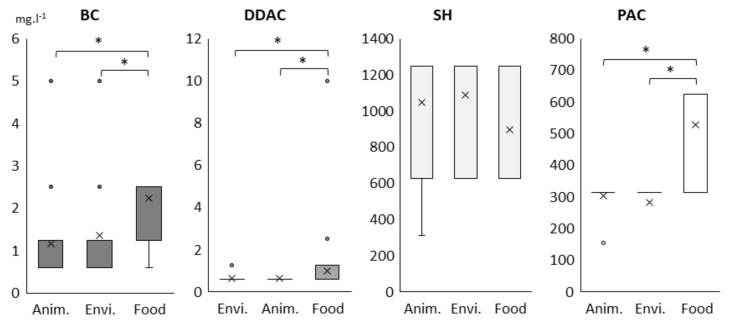
Figure 1
Figure 1
Distribution of minimal inhibitory concentration (MIC) values (mg·L−1) of the four biocides obtained for the 205 Lm strains depending on their ecological niches. Boxes range from the 25th to 75th percentile and whiskers extend below and above the box range from the lowest to the upper value, respectively. Cross indicates the median. Significant difference between distributions is indicated by star (Fisher’s exact test; * p-value < 0.00001). Cross (×) indicates the median, circles (∘) correspond to outlier values.
Figure 2
Figure 2
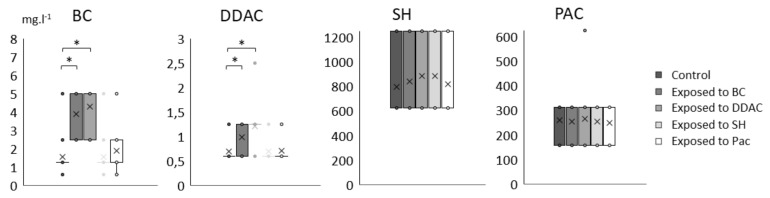
Variation of MIC values (mg·L−1) of benzalkonium chloride (BC), dimethylammonium chloride (DDAC), sodium hypochlorite (SH) and peracetic acid (PAC) for the 28 selected Lm strains exposed or not (control) to the 4 biocides. Significant difference with control is indicated by star (*, paired T-test, p-value < 0.01). Boxes range from the 25th to 75th percentile and whiskers extending below and above the box range from the lowest to the upper value, respectively. Cross (×) indicates the median, circles (∘) correspond to outlier values.
Figure 3
Figure 3
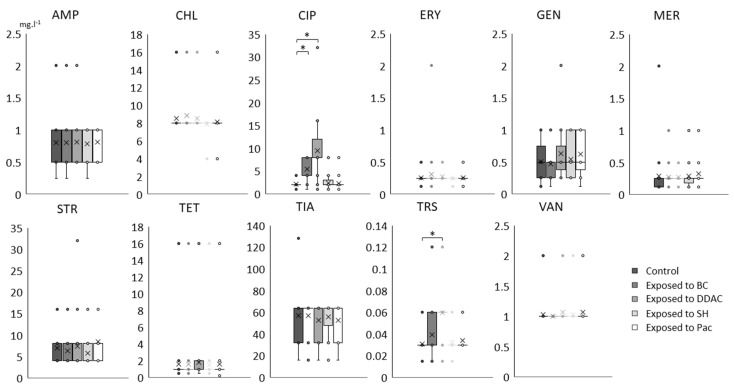
Variation of MIC values (mg·L−1) of the 11 antibiotics for the 28 selected Lm strains exposed or not (control) to the 4 biocides. Significant difference with control is indicated by star (*, paired T-test p-value < 0.01). Cross (×) indicates the median, circles (∘) correspond to outlier values.
Figure 4
Figure 4
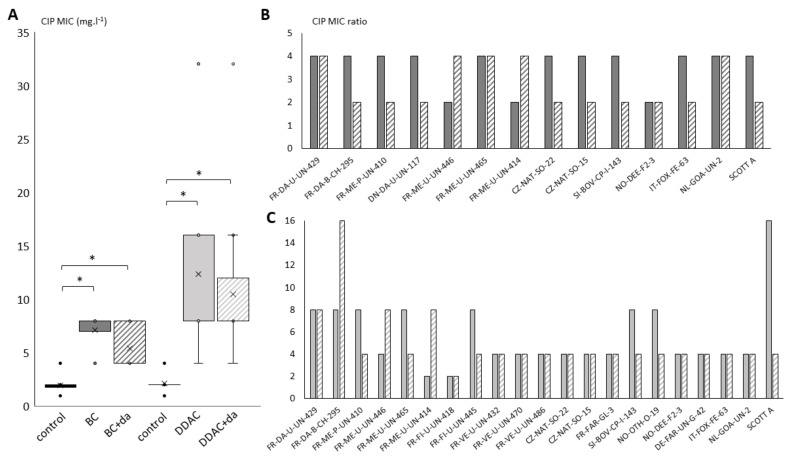
Stability of ciprofloxacin (CIP) MIC in Lm strains for which an increase in MIC was observed after exposition to BC (14 strains) and DDAC (21 strains). (A) Variation of CIP MIC values (mg·L−1) for Lm strains exposed to BC (dark grey) and DDAC (light grey). MIC values of corresponding strains unexposed to biocide for each biocide are also displayed (controls, black). Full bars correspond to values obtained after biocides exposition, and stripped bars correspond to values obtained after an additional de-adaptation step (+da), where strains were then subcultured in growth medium without biocides to assess the stability of the MIC increase. Significant difference with control is indicated by star (*, paired T-test p-value < 0.01). Cross (×) indicates the median, circles (∘) correspond to outlier values. (B) Increase MIC factor obtained for each Lm strain comparing CIP MIC after BC (B) or DDAC (C) exposure (full bars) and after de-adaptation steps (stripped bars) with CIP MIC of control Lm panel.

References

    1. The European Union One Health 2018 Zoonoses Report. [(accessed on 19 June 2020)];EFSA J. 2019 17:e05926. Available online: https://efsa.onlinelibrary.wiley.com/doi/epdf/10.2903/j.efsa.2019.5926. - DOI - PMC - PubMed
    1. De Noordhout C.M., Devleesschauwer B., Angulo F.J., Verbeke G., Haagsma J.A., Kirk M.D., Havelaar A.H., Speybroeck N. The global burden of listeriosis: A systematic review and meta-analysis. Lancet Infect. Dis. 2014;14:1073–1082. doi: 10.1016/S1473-3099(14)70870-9. - DOI - PMC - PubMed
    1. Rodríguez-López P., Rodríguez-Herrera J.J., Vázquez-Sánchez D., Cabo M.L. Current Knowledge on Listeria monocytogenes Biofilms in Food-Related Environments: Incidence, Resistance to Biocides, Ecology and Biocontrol. Foods. 2018;7:85. doi: 10.3390/foods7060085. - DOI - PMC - PubMed
    1. Roedel A., Dieckmann R., Brendebach H., Hammerl J.A., Kleta S., Noll M., Al Dahouk S., Vincze S. Biocide-Tolerant Listeria monocytogenes Isolates from German Food Production Plants Do Not Show Cross-Resistance to Clinically Relevant Antibiotics. Appl. Environ. Microbiol. 2019;85:1–15. doi: 10.1128/AEM.01253-19. - DOI - PMC - PubMed
    1. Vivant A.-L., Garmyn D., Piveteau P. Listeria monocytogenes, a down-to-earth pathogen. Front. Cell. Infect. Microbiol. 2013;3:87. doi: 10.3389/fcimb.2013.00087. - DOI - PMC - PubMed

LinkOut - more resources