


Crosstalk between MicroRNA and Oxidative Stress in Primary Open-Angle Glaucoma
- PMID: 33670885
- PMCID: PMC7957693
- DOI: 10.3390/ijms22052421
Crosstalk between MicroRNA and Oxidative Stress in Primary Open-Angle Glaucoma
Abstract
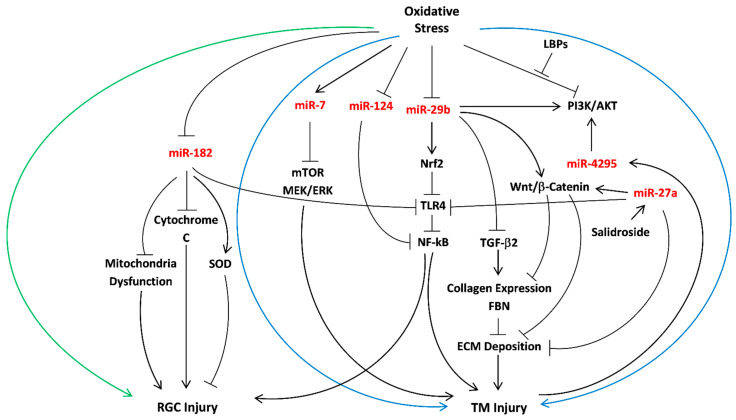
Reactive oxygen species (ROS) plays a key role in the pathogenesis of primary open-angle glaucoma (POAG), a chronic neurodegenerative disease that damages the trabecular meshwork (TM) cells, inducing apoptosis of the retinal ganglion cells (RGC), deteriorating the optic nerve head, and leading to blindness. Aqueous humor (AH) outflow resistance and intraocular pressure (IOP) elevation contribute to disease progression. Nevertheless, despite the existence of pharmacological and surgical treatments, there is room for the development of additional treatment approaches. The following review is aimed at investigating the role of different microRNAs (miRNAs) in the expression of genes and proteins involved in the regulation of inflammatory and degenerative processes, focusing on the delicate balance of synthesis and deposition of extracellular matrix (ECM) regulated by chronic oxidative stress in POAG related tissues. The neutralizing activity of a couple of miRNAs was described, suggesting effective downregulation of pro-inflammatory and pro-fibrotic signaling pathways, including nuclear factor kappa-light-chain-enhancer of activated B cells (NF-kB), transforming growth factor-beta 2 (TGF-β2), Wnt/β-Catenin, and PI3K/AKT. In addition, with regards to the elevated IOP in many POAG patients due to increased outflow resistance, Collagen type I degradation was stimulated by some miRNAs and prevented ECM deposition in TM cells. Mitochondrial dysfunction as a consequence of oxidative stress was suppressed following exposure to different miRNAs. In contrast, increased oxidative damage by inhibiting the mTOR signaling pathway was described as part of the action of selected miRNAs. Summarizing, specific miRNAs may be promising therapeutic targets for lowering or preventing oxidative stress injury in POAG patients.
Keywords: aqueous humor; intraocular pressure; miRNA; oxidative stress; primary open angle glaucoma; retinal ganglion cells; trabecular meshwork.
Conflict of interest statement
The authors declare no conflict of interest.
Figures
References
Publication types
MeSH terms
Substances
Grants and funding
LinkOut - more resources
Full Text Sources
Other Literature Sources
Miscellaneous
