


DAMPs and RAGE Pathophysiology at the Acute Phase of Brain Injury: An Overview
- PMID: 33670976
- PMCID: PMC7957733
- DOI: 10.3390/ijms22052439
DAMPs and RAGE Pathophysiology at the Acute Phase of Brain Injury: An Overview
Abstract
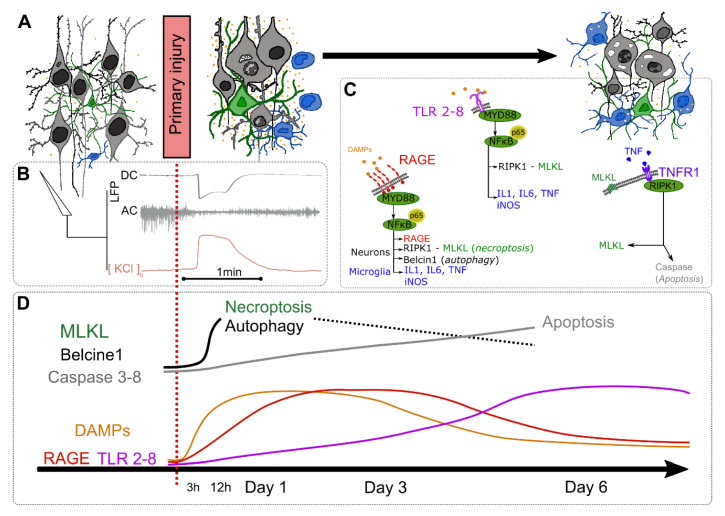
Early or primary injury due to brain aggression, such as mechanical trauma, hemorrhage or is-chemia, triggers the release of damage-associated molecular patterns (DAMPs) in the extracellular space. Some DAMPs, such as S100B, participate in the regulation of cell growth and survival but may also trigger cellular damage as their concentration increases in the extracellular space. When DAMPs bind to pattern-recognition receptors, such as the receptor of advanced glycation end-products (RAGE), they lead to non-infectious inflammation that will contribute to necrotic cell clearance but may also worsen brain injury. In this narrative review, we describe the role and ki-netics of DAMPs and RAGE at the acute phase of brain injury. We searched the MEDLINE database for "DAMPs" or "RAGE" or "S100B" and "traumatic brain injury" or "subarachnoid hemorrhage" or "stroke". We selected original articles reporting data on acute brain injury pathophysiology, from which we describe DAMPs release and clearance upon acute brain injury, and the implication of RAGE in the development of brain injury. We will also discuss the clinical strategies that emerge from this overview in terms of biomarkers and therapeutic perspectives.
Keywords: acute brain injuries; biomarkers; damage-associated molecular pattern molecules; receptor for advanced glycation end-products.
Conflict of interest statement
B.B. was invited by ROCHE Diagnostics (France) as a member of the S100B in the intensive care unit expert board. The other authors declare no conflict of interest. ROCHE Diagnostics had no role in the design of the study; in the collection, analyses, or interpretation of data; in the writing of the manuscript, or in the decision to publish the results.
Figures
References
-
- Khan M.A., Schultz S., Othman A., Fleming T., Lebrón-Galán R., Rades D., Clemente D., Nawroth P.P., Schwaninger M. Hyperglycemia in Stroke Impairs Polarization of Monocytes/Macrophages to a Protective Noninflammatory Cell Type. J. Neurosci. 2016;36:9313–9325. doi: 10.1523/JNEUROSCI.0473-16.2016. - DOI - PMC - PubMed
Publication types
MeSH terms
Substances
LinkOut - more resources
Full Text Sources
Other Literature Sources
Miscellaneous
