


Milk Composition of Free-Ranging Impala (Aepyceros melampus) and Tsessebe (Damaliscus lunatus lunatus), and Comparison with Other African Bovidae
- PMID: 33671145
- PMCID: PMC7922303
- DOI: 10.3390/ani11020516
Milk Composition of Free-Ranging Impala (Aepyceros melampus) and Tsessebe (Damaliscus lunatus lunatus), and Comparison with Other African Bovidae
Abstract
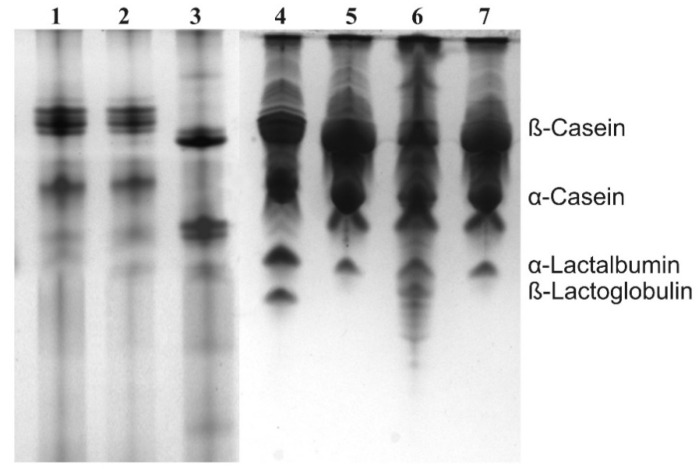
The major nutrient and fatty acid composition of the milk of impala and tsessebe is reported and compared with other Bovidae and species. The proximate composition of impala milk was 5.56 ± 1.96% fat, 6.60 ± 0.51% protein, and 4.36 ± 0.94% lactose, and that of tsessebe milk was 8.44 ± 3.19%, 5.15 ± 0.49%, and 6.10 ± 3.85%, respectively. The high protein content of impala milk accounted for 42% of gross energy, which is typical for African Bovids that use a "hider" postnatal care system, compared to the 25% of the tsessebe, a "follower". Electrophoresis showed that the molecular size and surface charge of the tsessebe caseins resembled that of other Alcelaphinae members, while that of the impala resembled that of Hippotraginae. The milk composition of these two species was compared by statistical methods with 13 other species representing eight suborders, families, or subfamilies of African Artiodactyla. This showed that the tsessebe milk resembled that of four other species of the Alcelaphinae sub-family and that the milk of this sub-family differs from other Artiodactyla by its specific margins of nutrient contents and milk fat with a high content of medium-length fatty acids (C8-C12) above 17% of the total fatty acids.
Keywords: Artiodactyla; fatty acid; impala; lactose; milk; oligosaccharide; protein; tsessebe.
Conflict of interest statement
The authors declare that there are no conflicts of interest. The funders had no role in the design of the study; in the collection, analyses, or interpretation of data; in the writing of the manuscript, or in the decision to publish the results.
Figures

References
-
- Jennes R., Patton S. Principles of Dairy Chemistry. Wiley & Son; New York, NY, USA: 1976.
-
- Oftedal O.T. Milk composition, milk yield and energy output at peak lactation: A comparative review. Symp. Zool. Soc. Lond. 1984;51:33–85.
-
- Casoli C., Duranti E., Morbidini L., Panella F., Vizioli V. Quantitative and compositional variations of Massesse sheep milk by parity and stage of lactation. Small Rumin. Res. 1989;2:47–62. doi: 10.1016/0921-4488(89)90016-3. - DOI
-
- Voutsinas L., Pappas C., Katsiari M. The composition of Alpine goats’ milk during lactation in Greece. J. Dairy Res. 1990;57:41–51. doi: 10.1017/S0022029900026595. - DOI
-
- Holand Ø., Gjøstein H., Nieminen M. Reindeer Milk. In: Park Y.W., Haenlein G.F.W., editors. Handbook of Milk of Non-Bovine Mammals. Blackwell; London, UK: 2006. pp. 355–370.
Grants and funding
LinkOut - more resources
Full Text Sources
Other Literature Sources
