


Pearls and Pitfalls of Introducing Ketogenic Diet in Adult Status Epilepticus: A Practical Guide for the Intensivist
- PMID: 33671485
- PMCID: PMC7926931
- DOI: 10.3390/jcm10040881
Pearls and Pitfalls of Introducing Ketogenic Diet in Adult Status Epilepticus: A Practical Guide for the Intensivist
Abstract
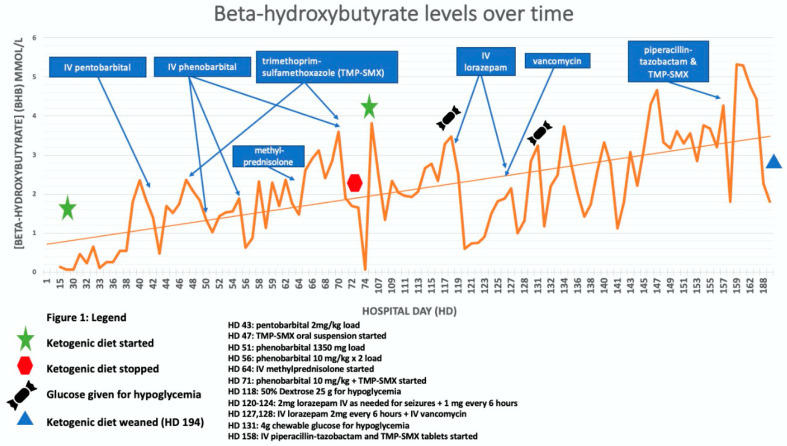
Background: Status epilepticus (SE) carries an exceedingly high mortality and morbidity, often warranting an aggressive therapeutic approach. Recently, the implementation of a ketogenic diet (KD) in adults with refractory and super-refractory SE has been shown to be feasible and effective. Methods: We describe our experience, including the challenges of achieving and maintaining ketosis, in an adult with new onset refractory status epilepticus (NORSE). Case Vignette: A previously healthy 29-year-old woman was admitted with cryptogenic NORSE following a febrile illness; course was complicated by prolonged super-refractory SE. A comprehensive work-up was notable only for mild cerebral spinal fluid (CSF) pleocytosis, elevated nonspecific serum inflammatory markers, and edematous hippocampi with associated diffusion restriction on magnetic resonance imaging (MRI). Repeat CSF testing was normal and serial MRIs demonstrated resolution of edema and diffusion restriction with progressive hippocampal and diffuse atrophy. She required prolonged therapeutic coma with high anesthetic infusion rates, 16 antiseizure drug (ASD) trials, empiric immunosuppression and partial bilateral oophorectomy. Enteral ketogenic formula was started on hospital day 28. However, sustained beta-hydroxybutyrate levels >2 mmol/L were only achieved 37 days later following a comprehensive adjustment of the care plan. KD was challenging to maintain in the intensive care unit (ICU) and was discontinued due to poor nutritional state and pressure ulcers. KD was restarted again in a non-ICU unit facilitating ASD tapering without re-emergence of SE. Discussion: There are inconspicuous carbohydrates in commonly administered medications for SE including antibiotics, electrolyte repletion formulations, different preparations of the same drug (i.e., parenteral, tablet, or suspension) and even solutions used for oral care-all challenging the use of KD in the hospitalized patient. Tailoring comprehensive care and awareness of possible complications of KD are important for the successful implementation and maintenance of ketosis.
Keywords: critical care; ketogenic diet; ketosis; new onset refractory status epilepticus; seizures; status epilepticus.
Conflict of interest statement
The authors declare no conflict of interest. Jason Katz reports no disclosures. Kent Owusu reports no disclosures. Ilisa Nussbaum reports consultation fees from AjinomotoCambrooke. Rachel Beekman reports no disclosures. Nicholas DeFilippo reports no disclosures. Emily J. Gilmore reports funding from NIH (R01NS117904) and is a speaker for UCB. Lawrence J. Hirsch reports consultation fees from Accure, Aquestive, Ceribell, Marinus, Medtronic, Monteris, Neuropace and UCB; Royalties from Wolters-Kluwer for authoring chapters for UpToDate-Neurology, and from Wiley for co-authoring the book “Atlas of EEG in Critical Care”, by Hirsch and Brenner; and Honoraria for speaking from Neuropace and Natus. Mackenzie C. Cervenka reports Grant Support from Nutricia, Vitaflo, The William and Ella Owens Medical Research Foundation, BrightFocus Foundation, The Carson Harris Fund, Johns Hopkins Center for Refractory Status Epilepticus and Neuroinflammation; consulting from Sage Therapeutics, Nutricia, Glut1 Deficiency Foundation; Medical Advisory Board for Glut1 Deficiency Foundation; Honoraria from Nutricia; Royalties from Demos/Springer Publishing Company. Carolina B. Maciel reports no disclosures.
Figures
References
-
- Cervenka M.C., Wood S., Bagary M., Balabanov A., Bercovici E., Brown M.-G., Devinsky O., Lorenzo C.D., Doherty C.P., Felton E., et al. International Recommendations for the Management of Adults Treated with Ketogenic Diet Therapies. Neurol. Clin. Pract. 2020 doi: 10.1212/CPJ.0000000000001007. - DOI - PMC - PubMed
-
- Cervenka M.C., Hocker S., Koenig M., Bar B., Henry-Barron B., Kossoff E.H., Hartman A.L., Probasco J.C., Benavides D.R., Venkatesan A., et al. Phase I/II multicenter ketogenic diet study for adult superrefractory status epilepticus. Neurology. 2017;88:938–943. doi: 10.1212/WNL.0000000000003690. - DOI - PMC - PubMed
Publication types
Grants and funding
LinkOut - more resources
Full Text Sources
Other Literature Sources
