. 2021 Feb 22;10(2):325.
doi: 10.3390/antiox10020325.

Protective Effects of Liposomal Curcumin on Oxidative Stress/Antioxidant Imbalance, Metalloproteinases 2 and -9, Histological Changes and Renal Function in Experimental Nephrotoxicity Induced by Gentamicin

Affiliations

Protective Effects of Liposomal Curcumin on Oxidative Stress/Antioxidant Imbalance, Metalloproteinases 2 and -9, Histological Changes and Renal Function in Experimental Nephrotoxicity Induced by Gentamicin

Adriana Elena Bulboacă et al. Antioxidants (Basel). .

Abstract

Background: Our study aimed to assess the efficiency of Curcumin nanoformulation (LCC) on experimental nephrotoxicity induced by Gentamicin in rats.

Methods: Six groups of seven rats were used: C-(control group) received saline solution i.p. (i.p. = intraperitoneal), G-gentamicin (G, 80 mg/kg body weight (b.w.)), GCC1 and GCC2-with G and CC solution (single dose of 10 mg/kg b.w.-CC1, or 20 mg/kg b.w.-CC2), GLCC1 (10 mg/kg b.w.) and GLCC2 (20 mg/kg b.w.) with G and LCC administration. Oxidative stress parameters (NOx = nitric oxide, MDA = malondialdehyde, TOS = total oxidative stress), antioxidant parameters (CAT = catalase, TAC = total antioxidant capacity), matrix metalloproteinases (MMP-2 and MMP-9), and renal function parameters (creatinine, blood urea nitrogen, and urea) were measured. Kidneys histopathologic examination was made for each group.

Results: Pretreatment with CC and LCC in both doses had significantly alleviating effects on assessed parameters (NOx, MDA, TOS, CAT, TAC, MMP-2, and -9) as compared with the untreated group (p < 0.006). Histopathological aspect and renal function were significantly improved in CC and LCC groups. Liposomal formulation (LCC) showed higher efficiency on all examined parameters compared to CC (p < 0.006).

Conclusions: Our results demonstrated improving renal function and kidney cytoarchitecture, oxidative stress/antioxidant/balance, and MMPs plasma concentrations with better dose-related efficacity of LCC than CC.

Keywords: Gentamicin induced nephrotoxicity; curcumin; oxidative stress.


Conflict of interest statement

The authors declare no conflict of interest.

Figures
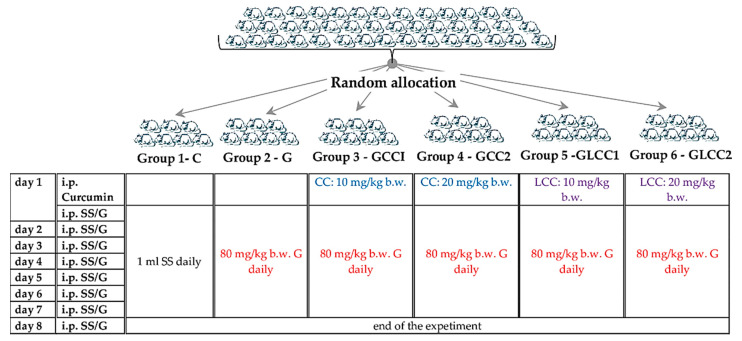
Figure 1
Figure 1
Experimental design schema. SS = saline solution, G = Gentamicin. curcumin solution (CC) and liposomal Curcumin (LCC) solutions were administrated as single dose 30 min before the first dose of Gentamicin, in the first day of the experiment. i.p. = intraperitoneal; b.w. = body weight.
Figure 2
Figure 2
Variation by groups of serum oxidative stress intensity: (a) MDA (malondialdehyde), (b) NOx (nitric oxide), (c) TOS (total oxidative status) by groups. Notes: The circles represent the individual values, and the horizontal line is given by the median. Abbreviations: C, Control; G, Gentamicin; GCC1, Gentamicin and CC1 solution; GCC2, Gentamicin and CC2 solution; GLCC1, Gentamicin and LCC1 solution; GLCC2, Gentamicin and LCC2 solution; The letter codes correspond to the p-values < 0.006: a G compared to C; b G compared to GCC1; c G compared to GCC2; d G compared to GLCC1; e G compared to GLCC2; A GCC1 compared to GCC2; B GCC1 compared to GLCC1; X GCC2 compared to GLCC2; α GLCC1 compared to GLCC2.
Figure 3
Figure 3
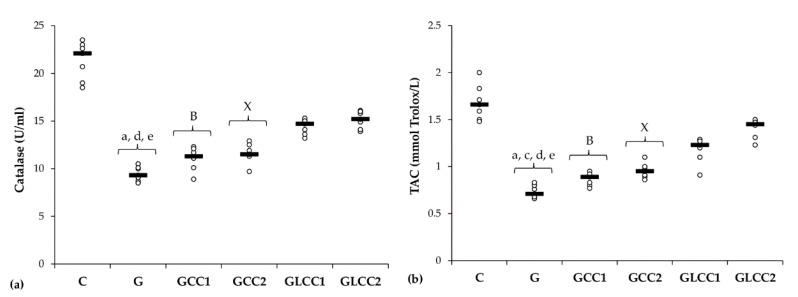
Variation by groups of serum antioxidant capacity: (a) Catalase and (b) TAC (total antioxidant capacity) by groups. Notes: The circles represent the individual values, and the horizontal line is given by the median. Abbreviations: C, Control; G, Gentamicin; GCC1, Gentamicin and CC1 solution; GCC2, Gentamicin and CC2 solution; GLCC1, Gentamicin and LCC1 solution; GLCC2, Gentamicin and LCC2 solution; The letter codes correspond to the p-values < 0.006: a G compared to C; c G compared to GCC2; d G compared to GLCC1; e G compared to GLCC2; B GCC1 compared to GLCC1; X GCC2 compared to GLCC2.
Figure 4
Figure 4
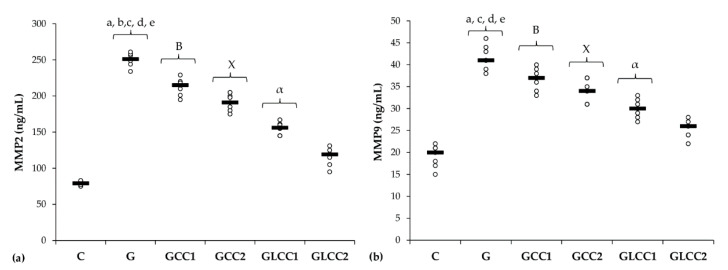
Variation by groups of matrix metalloproteinases: (a) MMP-2 (matrix metalloproteinases 2) (b) MMP-9 (matrix metalloproteinases 9) by groups. Notes: The circles represent the individual values, and the horizontal line is given by the median. Abbreviations: C, Control; G, Gentamicin; GCC1, Gentamicin and CC1 solution; GCC2, Gentamicin and CC2 solution; GLCC1, Gentamicin and LCC1 solution; GLCC2, Gentamicin and LCC2 solution; The letter codes correspond to the p-values < 0.006: a G compared to C; b G compared to GCC1; c G compared to GCC2; d G compared to GLCC1; e G compared to GLCC2; B GCC1 compared to GLCC1; X GCC2 compared to GLCC2; α GLCC1 compared to GLCC2.
Figure 5
Figure 5
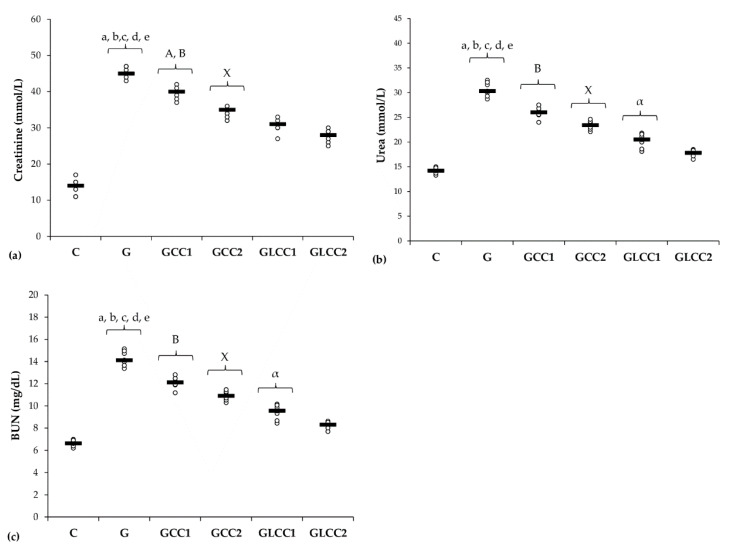
Variation by groups of serum levels of renal function parameters: (a) Creatinine, (b) Urea, (c) (BUN) blood urea nitrogen by groups. Notes: The circles represent the individual values, and the horizontal line is given by the median. Abbreviations: C, Control; G, Gentamicin; GCC1, Gentamicin and CC1 solution; GCC2, Gentamicin and CC2 solution; GLCC1, Gentamicin and LCC1 solution; GLCC2, Gentamicin and LCC2 solution; The letter codes correspond to the p-values < 0.006: a G compared to C; b G compared to GCC1; c G compared to GCC2; d G compared to GLCC1; e G compared to GLCC2; A GCC1 compared to GCC2; B GCC1 compared to GLCC1; X GCC2 compared to GLCC2; α GLCC1 compared to GLCC2.
Figure 6
Figure 6
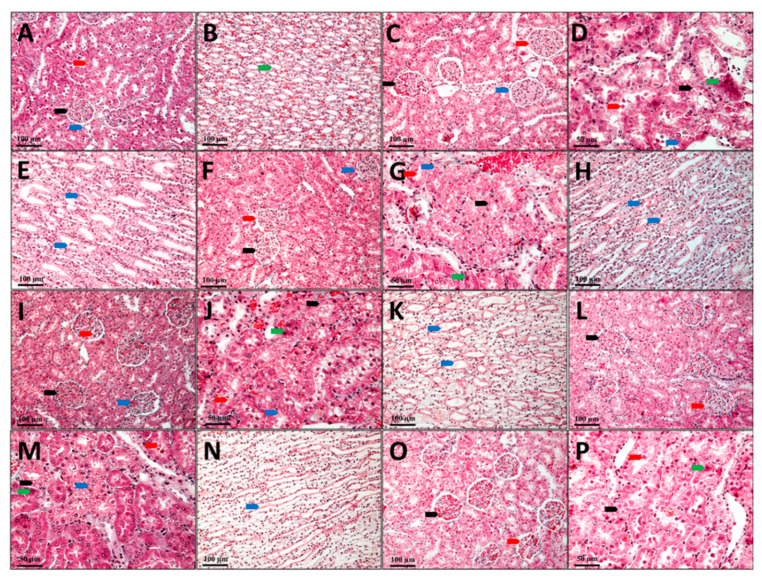
Kidney, Goldner trichrome coloration; (A,B) C, Control; (CE) G, Gentamicin; (FH) GCC1, Gentamicin and CC1 solution; (IK) GCC2, Gentamicin and CC2 solution; (LN) GLCC1, Gentamicin and LCC1 solution; (O,P) GLCC2, Gentamicin and LCC2 solution; (A), black arrow—renal corpuscle, red arrow—proximal tube, blue arrow—distal tube; (B), green arrow–collector tube; (C), black arrow—renal corpuscle with capillary ectasia, red arrow—renal corpuscle with glomerular edema, blue arrow—renal corpuscle with mesangial hyperplasia; (D), black arrow—nephrocytes with vacuolar degeneration, red arrow—cellular detritus in the lumen of the nephron, blue arrow—intracytolasmatic hyaline, green arrow—dead nephrocytes; (E), blue arrow—collector tube with protein precipitates; (F), black arrow—renal corpuscle with capillary ectasia, red arrow—renal corpuscle with glomerular edema, blue arrow—renal corpuscle with mesangial hyperplasia; (G), black arrow—nephrocytes with vacuolar degeneration, red arrow—cellular detritus in the lumen of the nephron, blue arrow—intracytolasmatic hyaline, green arrow—dead nephrocytes; (H), blue arrow—collector tube with protein precipitates; (I), black arrow—renal corpuscle with capillary ectasia, red arrow—renal corpuscle with glomerular edema, blue arrow—renal corpuscle with mesangial hyperplasia; (J), black arrow—nephrocytes with granulo-vacuolar degeneration, red arrow—cellular detritus in the nephron lumen, blue arrow—intracytolasmatic hyalinosis, green arrow—dead nephrocytes; (K), blue arrow—collector tube with protein precipitates; (L), black arrow—nephrocytes with vacuolar degeneration, red arrow—cellular detritus in the lumen of the nephron; (M), black arrow—nephrocytes with vacuolar degeneration, red arrow—cellular detritus in the lumen of the nephron, blue arrow—in-tracytolasmatic hyaline, green arrow—dead nephrocytes; (N), blue arrow—collector tube with protein precipitates; (O), black arrow—renal corpuscle with capillary ectasia, red arrow—renal corpuscle with glomerular edema; (P), black arrow—nephrocytes with granular degeneration, red arrow—cellular detritus in the nephron lumen, green arrow—dead nephrocytes.

References

    1. Wargo K.A., Edwards J.D. Aminoglycoside-induced nephrotoxicity. Int. J. Pharm. Pract. 2014;27:573–577. doi: 10.1177/0897190014546836. - DOI - PubMed
    1. Alhariri M., Majrashi M.A., Bahkali A.H., Almajed F.S., Azghani A.O., Khiyami M.A., Alyamani E.J., Aljohani S.M., Halwani M.A. Efficacy of neutral and negatively charged liposome-loaded Gentamicin on planktonic bacteria and biofilm communities. Int. J. Nanomed. 2017;12:6949–6961. doi: 10.2147/IJN.S141709. - DOI - PMC - PubMed
    1. Dozzo P., Moser H.E. New aminoglycoside antibiotics. Expert Opin. Ther. Pat. 2010;20:1321–1341. doi: 10.1517/13543776.2010.506189. - DOI - PubMed
    1. Kohanski M.A., Dwyer D.J., Collins J.J. How antibiotics kill bacteria: From targets to networks. Nat. Rev. Microbiol. 2010;8:423–435. doi: 10.1038/nrmicro2333. - DOI - PMC - PubMed
    1. Mancini S., Marchesi M., Imkamp F., Wagner K., Keller P.M., Quiblier C., Bodendoerfer E., Courvalin P., Böttger E.C. Population-based inference of aminoglycoside resistance mechanisms in Escherichia coli. EBioMedicine. 2019;46:184–192. doi: 10.1016/j.ebiom.2019.07.020. - DOI - PMC - PubMed

LinkOut - more resources