


Recapitulation of the Function and Role of ROS Generated in Response to Heat Stress in Plants
- PMID: 33671904
- PMCID: PMC7918971
- DOI: 10.3390/plants10020371
Recapitulation of the Function and Role of ROS Generated in Response to Heat Stress in Plants
Abstract
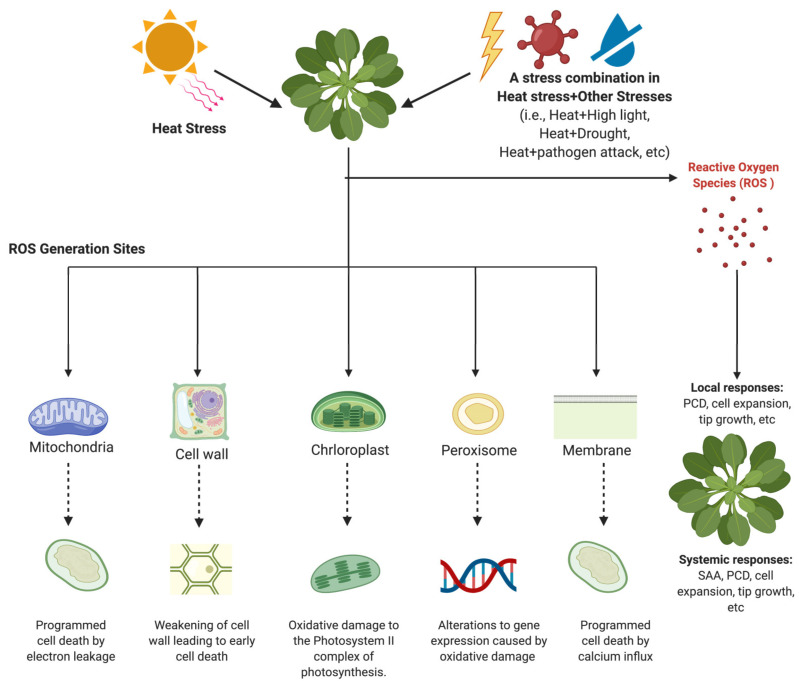
In natural ecosystems, plants are constantly exposed to changes in their surroundings as they grow, caused by a lifestyle that requires them to live where their seeds fall. Thus, plants strive to adapt and respond to changes in their exposed environment that change every moment. Heat stress that naturally occurs when plants grow in the summer or a tropical area adversely affects plants' growth and poses a risk to plant development. When plants are subjected to heat stress, they recognize heat stress and respond using highly complex intracellular signaling systems such as reactive oxygen species (ROS). ROS was previously considered a byproduct that impairs plant growth. However, in recent studies, ROS gained attention for its function as a signaling molecule when plants respond to environmental stresses such as heat stress. In particular, ROS, produced in response to heat stress in various plant cell compartments such as mitochondria and chloroplasts, plays a crucial role as a signaling molecule that promotes plant growth and triggers subsequent downstream reactions. Therefore, this review aims to address the latest research trends and understandings, focusing on the function and role of ROS in responding and adapting plants to heat stress.
Keywords: ROS signals; heat stress; reactive oxygen species (ROS); stress combination.
Conflict of interest statement
The authors declare no conflict of interest.
Figures
References
-
- Climate Change 2013 the Physical Science Basis: Working Group I Contribution to the Fifth Assessment Report of the Intergovernmental Panel on Climate Change. Cambridge University Press; Cambridge, UK: 2013. Long-term climate change: Projections, commitments and irreversibility.
-
- United Nations . World Popul. Prospect. 2017. United nations department of economic and social affairs population division: World population prospects 2017—Highlights.
-
- Sehgal A., Sita K., Siddique K.H.M., Kumar R., Bhogireddy S., Varshney R.K., HanumanthaRao B., Nair R.M., Prasad P.V.V., Nayyar H. Drought or/and heat-stress effects on seed filling in food crops: Impacts on functional biochemistry, seed yields, and nutritional quality. Front. Plant Sci. 2018;9:1705. doi: 10.3389/fpls.2018.01705. - DOI - PMC - PubMed
Publication types
Grants and funding
LinkOut - more resources
Full Text Sources
Other Literature Sources
