


Prolonged Running Using Bionic Footwear Influences Lower Limb Biomechanics
- PMID: 33672191
- PMCID: PMC7926525
- DOI: 10.3390/healthcare9020236
Prolonged Running Using Bionic Footwear Influences Lower Limb Biomechanics
Abstract
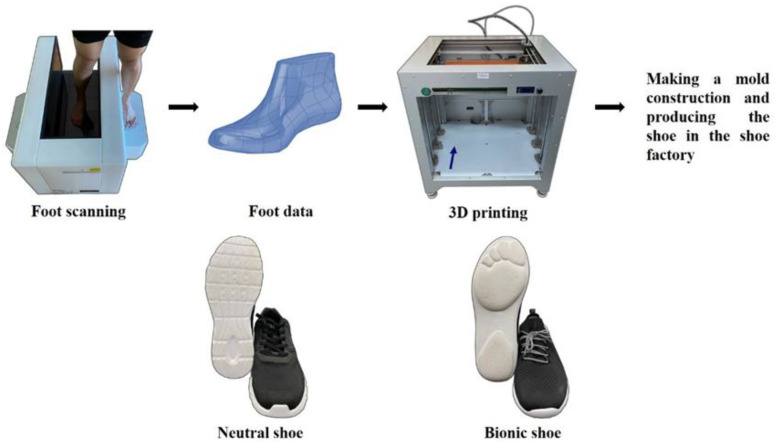
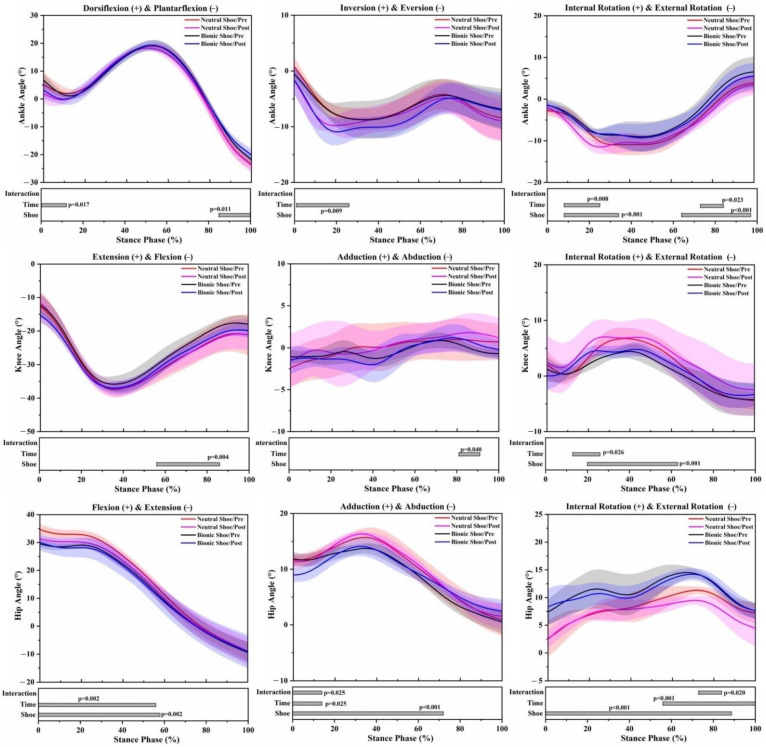
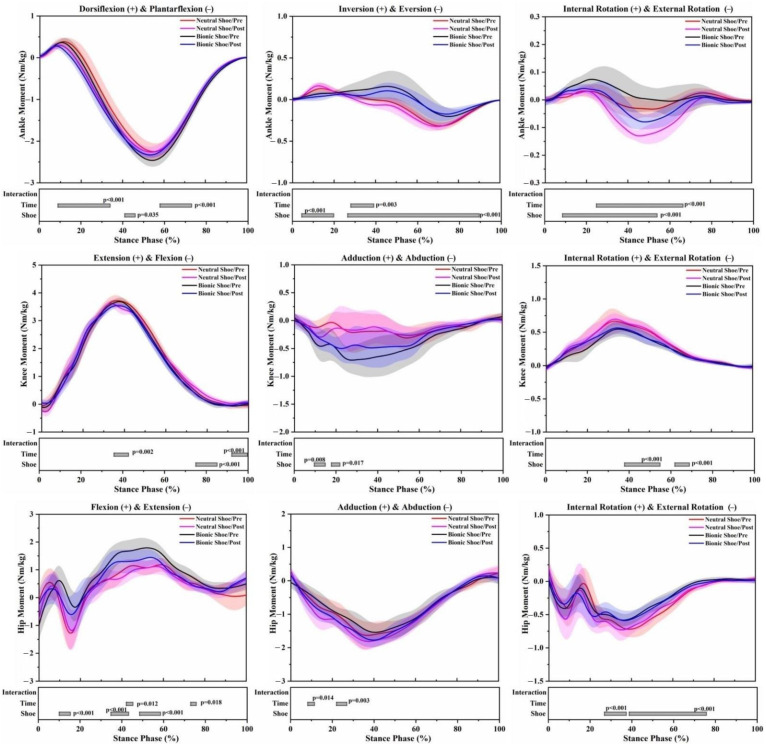
The running biomechanics of unstable shoes have been well investigated, however, little is known about how traditional neutral shoes in combination with unstable design elements and scientifically (bionic) designed shoes influence prolonged running biomechanics. The purpose of this study was to investigate biomechanical changes for a typical 5 km run and how footwear technology may affect outcomes. Sixteen healthy male recreational heel strike runners participated in this study, and completed two prolonged running sessions (neutral shoe session and bionic shoe session), with 7 to 10 days interval between sessions. A two-way repeated-measures analysis of variance (ANOVA, shoe × time) was conducted to determine any differences in joint biomechanics. Main effects for shoe type were observed at the ankle, knee and hip joints during the stance phase. In particular, decreased range of motion (ROM) was observed using the bionic shoes for all three joints, and the joint moments also had significant changes except for the frontal plane of the hip. Main effects for time were also observed at the ankle, knee and hip joints. The ROM of the sagittal plane in the knee and hip decreased post-5 km running. The reduction of ankle dorsiflexion, hip flexion, hip adduction and hip internal rotation angles were observed post-5 km running, as well as the increase of ankle eversion and external rotation, knee adduction and internal rotation angles. The kinetics also exhibited significant differences between pre-5 km running and post-5 km running. The interaction effects only existed in the ROM of the hip sagittal plane, hip adduction angle and hip internal rotation angle. The results suggested that bionic shoes could be beneficial for strengthening muscle control, enhancing postural stability and proprioceptive ability. Footwear personalization could be a solution that benefits runners, reduces injury risk and improves running performance.
Keywords: bionic science; footwear; prolonged running; running biomechanics.
Conflict of interest statement
The authors declare no conflict of interest.
Figures
References
-
- Messier S.P., Martin D.F., Mihalko S.L., Ip E., DeVita P., Cannon D.W., Love M., Beringer D., Saldana S., Fellin R.E. A 2-year prospective cohort study of overuse running injuries: The runners and injury longitudinal study (TRAILS) Am. J. Sports Med. 2018;46:2211–2221. doi: 10.1177/0363546518773755. - DOI - PubMed
LinkOut - more resources
Full Text Sources
Other Literature Sources
