. 2021 Feb 23;13(2):349.
doi: 10.3390/v13020349.

Dengue Virus Serotype 2 Intrahost Diversity in Patients with Different Clinical Outcomes

Affiliations

Dengue Virus Serotype 2 Intrahost Diversity in Patients with Different Clinical Outcomes

Maria Celeste Torres et al. Viruses. .

Abstract

Intrahost genetic diversity is thought to facilitate arbovirus adaptation to changing environments and hosts, and it might also be linked to viral pathogenesis. Dengue virus serotype 2 (DENV-2) has circulated in Brazil since 1990 and is associated with severe disease and explosive outbreaks. Intending to shed light on the viral determinants for severe dengue pathogenesis, we sought to analyze the DENV-2 intrahost genetic diversity in 68 patient cases clinically classified as dengue fever (n = 31), dengue with warning signs (n = 19), and severe dengue (n = 18). Unlike previous DENV intrahost diversity studies whose approaches employed PCR, here we performed viral whole-genome deep sequencing from clinical samples with an amplicon-free approach, representing the real intrahost diversity scenario. Striking differences were detected in the viral population structure between the three clinical categories, which appear to be driven mainly by different infection times and selection pressures, rather than being linked with the clinical outcome itself. Diversity in the NS2B gene, however, showed to be constrained, irrespective of clinical outcome and infection time. Finally, 385 non-synonymous intrahost single-nucleotide variants located along the viral polyprotein, plus variants located in the untranslated regions, were consistently identified among the samples. Of them, 124 were exclusively or highly detected among cases with warning signs and among severe cases. However, there was no variant that by itself appeared to characterize the cases of greater severity, either due to its low intrahost frequency or the conservative effect on amino acid substitution. Although further studies are necessary to determine their real effect on viral proteins, this heightens the possibility of epistatic interactions. The present analysis represents an initial effort to correlate DENV-2 genetic diversity to its pathogenic potential and thus contribute to understanding the virus's dynamics within its human host.

Keywords: dengue virus; intrahost diversity; serotype 2; severe disease.


Conflict of interest statement

The authors declare no competing financial interests.

Figures
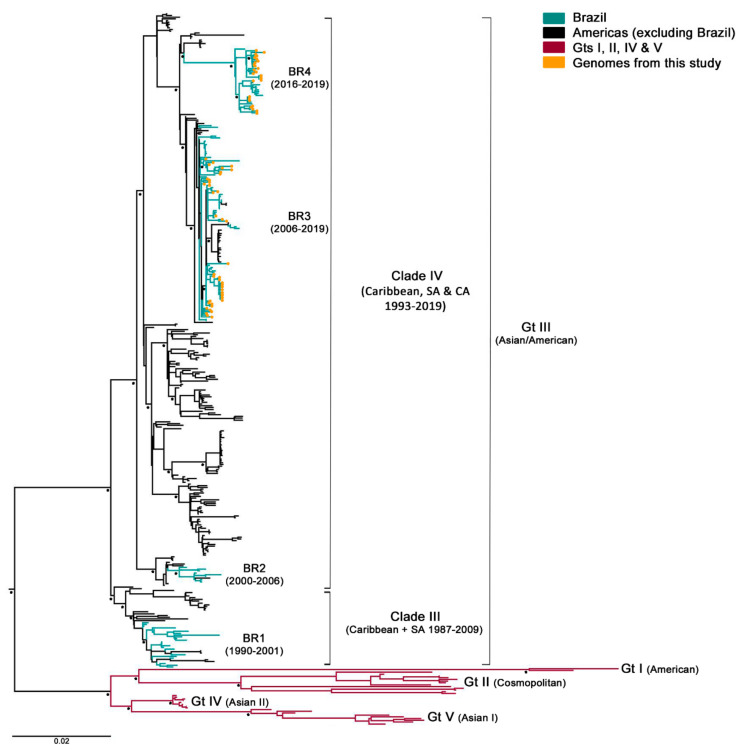
Figure 1
Figure 1
Maximum likelihood phylogenetic tree of DENV-2 polyprotein. It was constructed in RaxML v8.2.8 under GTR + I+G substitution model (General Time Reversible with gamma distribution and invariant sites), and 1000 bootstrap replicates. Main nodes with more than 70% of replicate trees of the bootstrap test for which the taxa clustered together are denoted with a black star. Brazilian sequences obtained in this study are represented in the tree with an orange circle. Gt: genotype; SA: South America; CA: Central America; and BR1-4: Brazilian lineages 1 to 4.
Figure 2
Figure 2
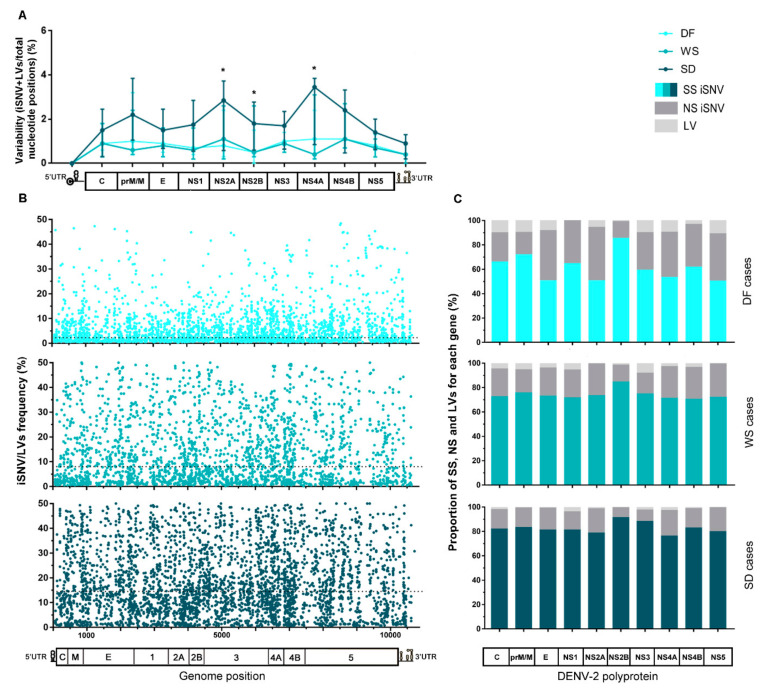
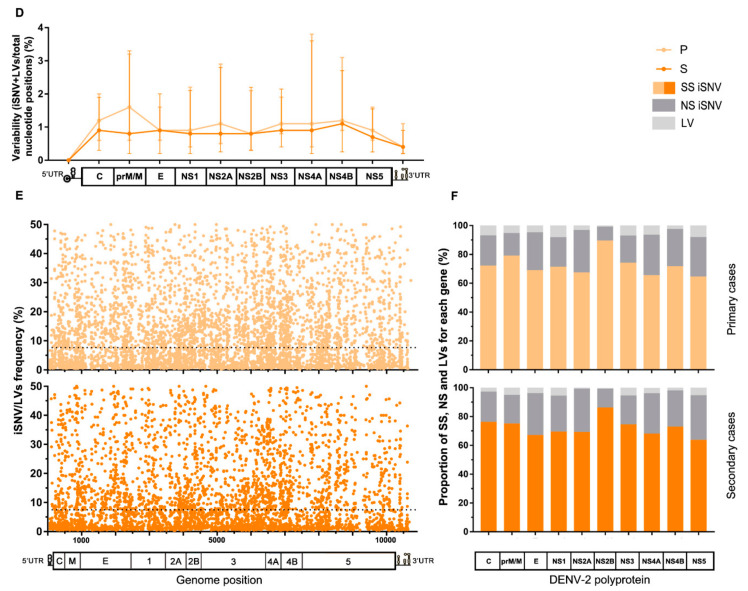
Characteristics of the intrahost viral population of cases grouped by clinical category or immune response. (A) Variability along the viral genome according to the patients’ clinical outcome. The total number of iSNVs located in each gene along the viral genome was normalized by each gene’s length (total nucleotide positions) and the median value for each group plotted in the graph, with error bars representing the interquartile ranges. (*) Statistically-supported differences among clinical groups. (B) iSNV/LVs frequency distribution along the viral genome according to the clinical category. The dotted line represents the median frequency among all iSNV/LVs found within each group. (C) Percentage of synonymous, non-synonymous iSNVs, and LVs for each gene. Clinical categories are represented separately. The total amount of each variant class per gene was summed and then normalized by group size. (DF) The same analysis was performed for cases grouped by patients’ immune response. Genome/polyprotein schemes in graphs A, C, D, and F are not scaled to genes real size, as are the schemes in graphs B and E. DF: dengue fever cases, WS: dengue with warning signs, SD: severe dengue cases, P: primary cases, S: secondary cases, SS: synonymous variants, NS: Non-synonymous variants, and LV: insertion/deletion variants.
Figure 2
Figure 2
Characteristics of the intrahost viral population of cases grouped by clinical category or immune response. (A) Variability along the viral genome according to the patients’ clinical outcome. The total number of iSNVs located in each gene along the viral genome was normalized by each gene’s length (total nucleotide positions) and the median value for each group plotted in the graph, with error bars representing the interquartile ranges. (*) Statistically-supported differences among clinical groups. (B) iSNV/LVs frequency distribution along the viral genome according to the clinical category. The dotted line represents the median frequency among all iSNV/LVs found within each group. (C) Percentage of synonymous, non-synonymous iSNVs, and LVs for each gene. Clinical categories are represented separately. The total amount of each variant class per gene was summed and then normalized by group size. (DF) The same analysis was performed for cases grouped by patients’ immune response. Genome/polyprotein schemes in graphs A, C, D, and F are not scaled to genes real size, as are the schemes in graphs B and E. DF: dengue fever cases, WS: dengue with warning signs, SD: severe dengue cases, P: primary cases, S: secondary cases, SS: synonymous variants, NS: Non-synonymous variants, and LV: insertion/deletion variants.
Figure 3
Figure 3
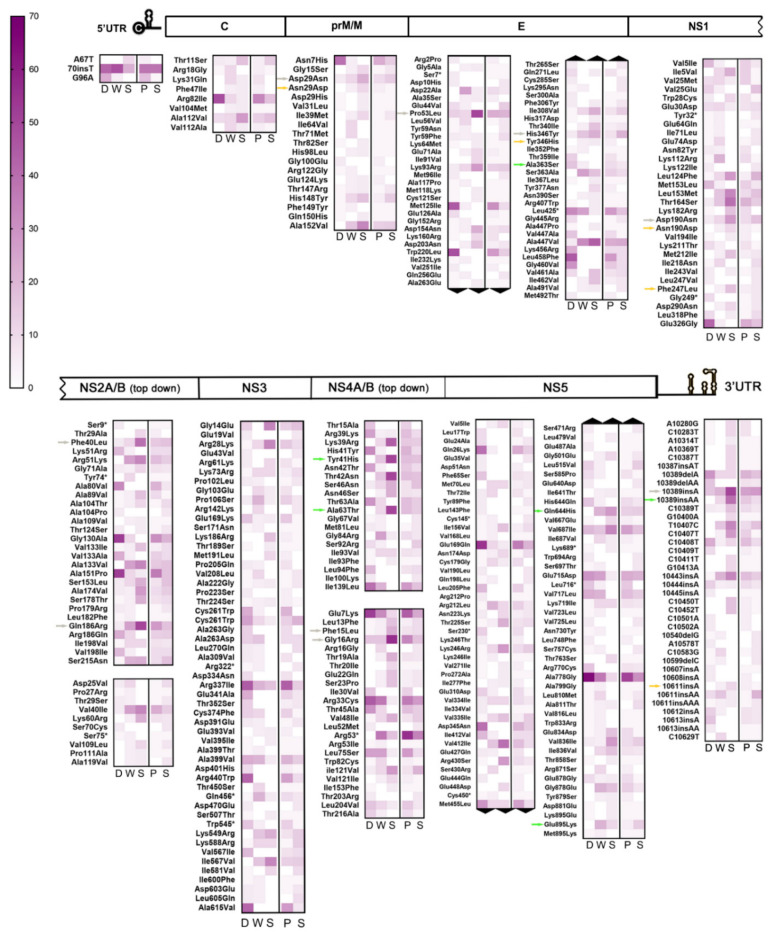
Interhost frequency of iSNV/LVs consistently detected among samples. On this graph, only those repNS-iSNV + UTR-iSNVs found in at least two different samples were considered for analysis. From left to right, F: DF cases, W: WS cases, S: SD cases; p: primary infection, and S: secondary infection. Colored-scale indicates the percentage of positive samples, with color intensity and numeric scale increasing with interhost frequency. Colored arrows indicate the most relevant variants within subgroups 2 (green), 3 (orange), and 4 (grey).
Figure 4
Figure 4
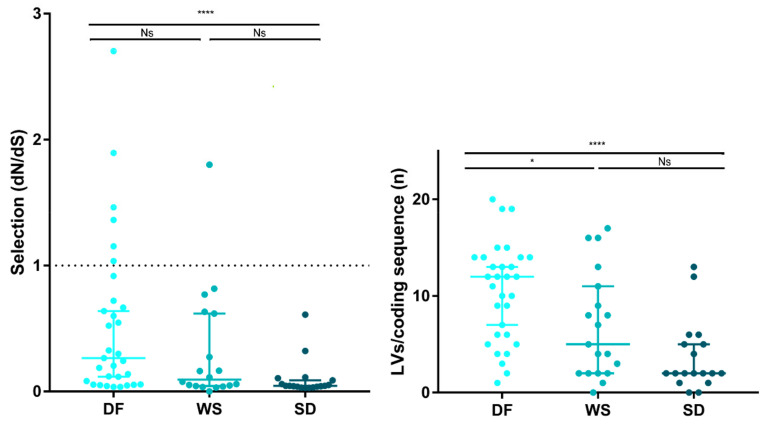
Natural selection strength assessment. The strength of host selection on virus populations was compared between clinical categories. Left: dN/dS ratio over all coding positions. dN/dS ratio of 1, is interpreted as evidence for neutral evolution (dotted line). dN/dS > 1 represents positive selection, while dN/dS < 1 represents a negative (purifying) selection. Right: Number of accumulated iLVs. In all cases, each dot represents a sample and the lines are the median with the IQR. (*) p < 0.01; (****) p < 0.0001; Ns: not significant.

References

    1. Bhatt S., Gething P.W., Brady O.J., Messina J.P., Farlow A.W., Moyes C.L., Drake J.M., Brownstein J.S., Hoen A.G., Sankoh O., et al. The global distribution and burden of dengue. Nature. 2013;496:504–507. doi: 10.1038/nature12060. - DOI - PMC - PubMed
    1. World Health Organization Dengue Guidelines for Diagnosis, Treatment, Prevention and Control. [(accessed on 17 June 2019)];2019 Available online: https://apps.who.int/iris/handle/10665/44188. - PubMed
    1. Katzelnick L.C., Gresh L., Halloran M.E., Mercado J.C., Kuan G., Gordon A., Balmaseda A., Harris E. Antibody-dependent enhancement of severe dengue disease in humans. Science. 2017;358:929–932. doi: 10.1126/science.aan6836. - DOI - PMC - PubMed
    1. Rothman A.L. Immunity to dengue virus: A tale of original antigenic sin and tropical cytokine storms. Nat. Rev. Immunol. 2011;11:532–543. doi: 10.1038/nri3014. - DOI - PubMed
    1. Lindenbarch B.D., Thiel H.J., Rice C.M. Flaviviridae: Their Viruses and Their Replication. In: Knipe D.M., Howley P.M., editors. Fields Virology. 5th ed. Lippincott-Raven Publishers; Philadelphia, PA, USA: 2007. pp. 1101–1152.

Publication types

MeSH terms

Substances

LinkOut - more resources